Zadar Riva
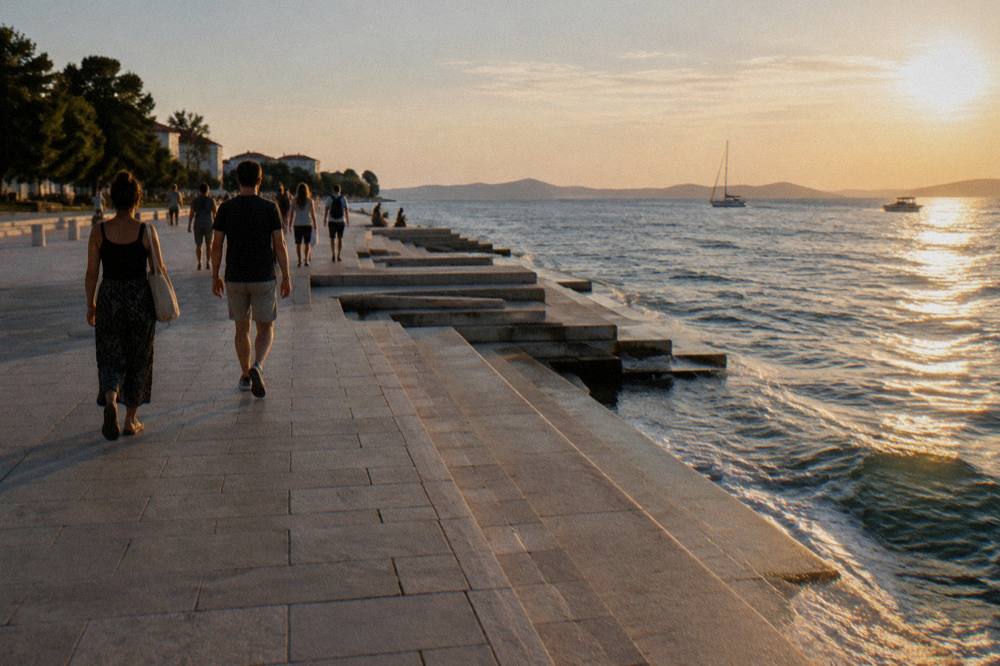
The Riva is the seafront promenade that runs the length of Zadar's Old Town peninsula in Dalmatia, Croatia, joining the ferry harbour to the Sea Organ and the Greeting to the Sun installation. This guide covers what it is, what sits along it, when to walk it, and how tours and day trips connect to it.
Short answer
The Zadar Riva is a free, open-at-all-hours waterfront promenade on the west side of Zadar's Old Town peninsula in Dalmatia, Croatia. It runs past palm trees, cafes and the ferry harbour and ends at the Sea Organ (2005) and the Greeting to the Sun (2008), both free installations by Nikola Bašić.
The Riva is the seafront promenade that runs along the western edge of Zadar's Old Town peninsula in Dalmatia, Croatia, facing the Adriatic Sea and the islands of Ugljan and Dugi Otok beyond. It is a free public space, open at all hours, and it is the single stretch of pavement where the city, the harbour and the open sea sit side by side. On one side rise the Venetian-era land and sea defences, inscribed in 2017 as one of six components of the UNESCO property of Venetian Works of Defence. On the other, white boats, blue water and the long, low line of the islands. Nothing on this page requires a ticket, and the Zadar Croatia Travel Guide desk reports it the same way as everything else here: from what the official sources actually say.
What Is The Zadar Riva And Where Does It Run?
The Zadar Riva is the stone, palm-lined waterfront promenade on the western shore of Zadar's Old Town peninsula (Poluotok), running roughly between the ferry harbour and the north-western tip where the Sea Organ and the Greeting to the Sun sit. It is a public walkway with no entry fee and no opening hours, and it doubles as the arrival face of the city for anyone coming in by boat. The name "riva" simply means waterfront in Croatian.
Zadar is a coastal city in Dalmatia, on the Adriatic, and its Old Town occupies a narrow peninsula joined to the mainland by a short neck of land. The Riva faces west across the channel towards the island of Ugljan, which sits offshore, with Dugi Otok beyond it. Because the peninsula is small and flat, the Riva is never more than a few minutes' walk from anything in the Old Town: the Roman Forum, Kalelarga, Five Wells Square and the Land Gate all sit within easy walking distance inland.
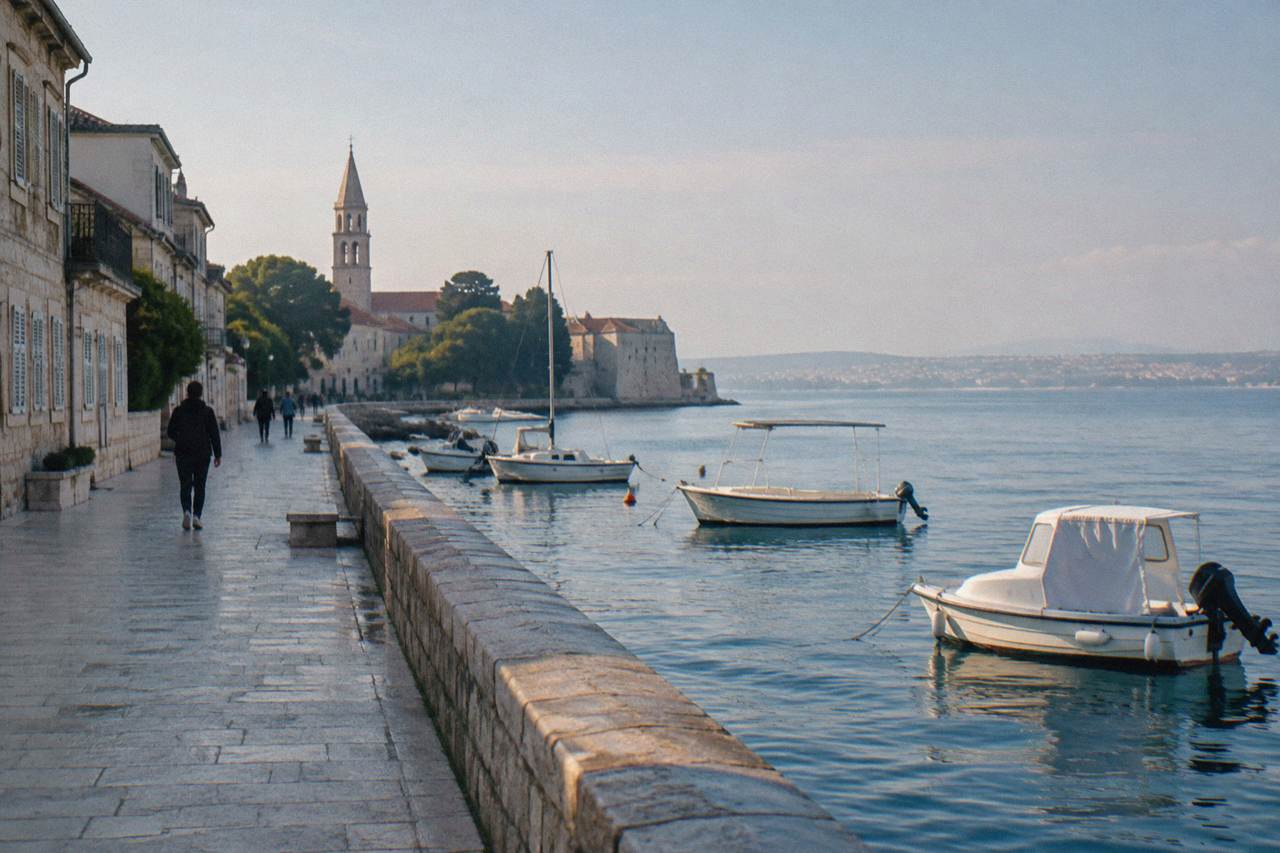
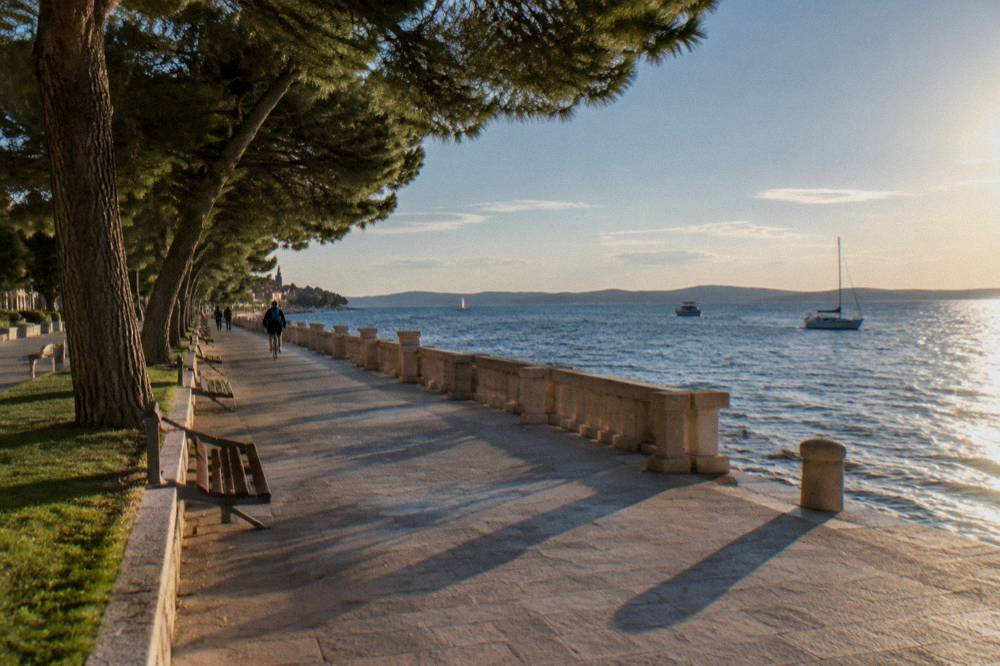
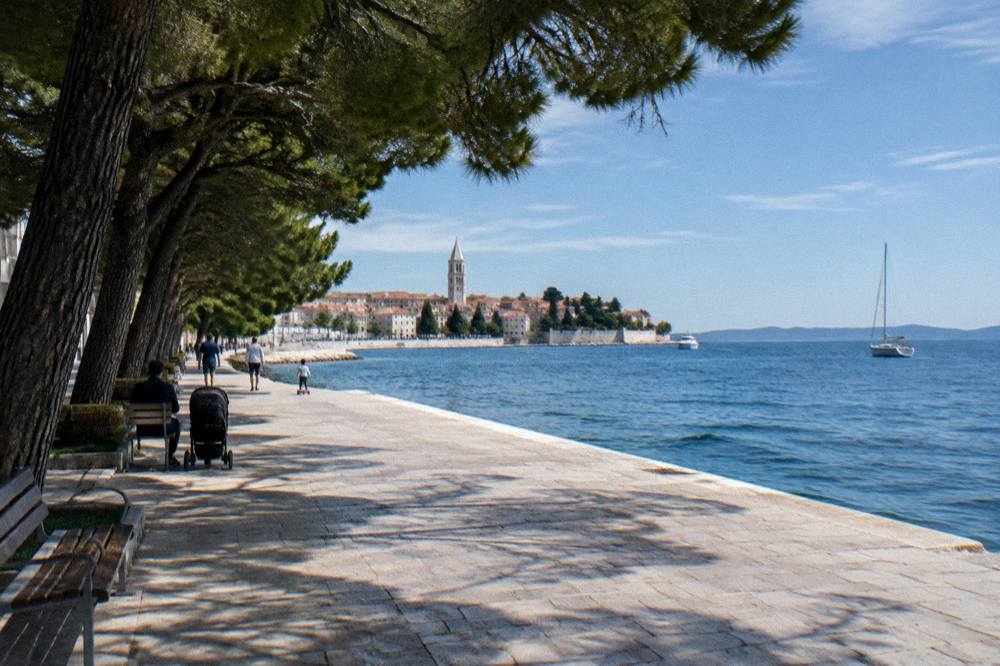
The promenade is paved in pale stone, shaded by a row of palms, and furnished with benches and cafe terraces along its length. It has the shape of a long shallow crescent, following the curve of the peninsula's west shore. At its southern end it meets the working harbour: the cruise-berth and excursion-boat quays where island trips tie up. At its northern end it reaches the modern installations that have made the seafront famous, described in their own section below.
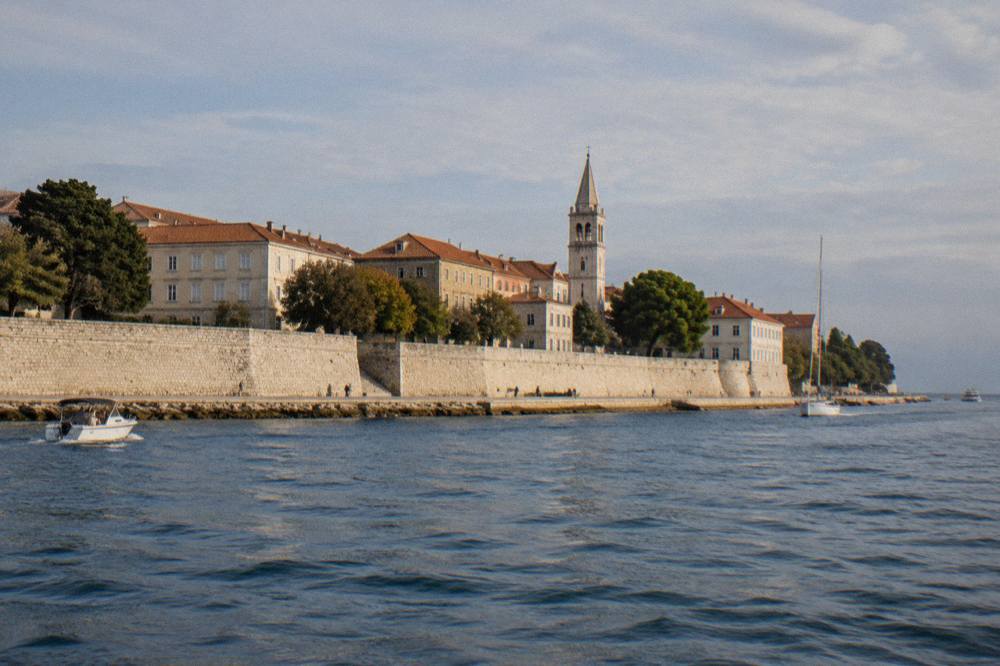
The walls behind the promenade are part of the reason UNESCO lists Zadar at all. The city is one of six components of the transnational property of Venetian Works of Defence, inscribed in 2017. The Land Gate, built in 1543 to a design by Michele Sanmicheli, belongs to that defensive system. So the walk along the Riva is a walk along the seaward face of a listed fortification, even though the promenade itself is a modern, everyday public space.
What Can You See And Do Along The Zadar Riva?
Along the Zadar Riva you can walk the full length of the Old Town's seafront, sit at waterfront cafes, watch the excursion boats and island ferries come and go, view the 1543 Land Gate and the UNESCO-listed defensive walls from outside, and reach the free Sea Organ and Greeting to the Sun installations at the northern end. Everything on the promenade itself is free and open at all hours.
The promenade is first a walk. It takes in the whole western profile of the peninsula, with the sea on one side and the wall, with its gates and towers, on the other. Cafes and ice cream stands line the stone; benches sit under the palms. Inland, a short climb through the streets delivers you to the Roman Forum, the Church of St Donatus and the Cathedral of St Anastasia, all within the peninsula.
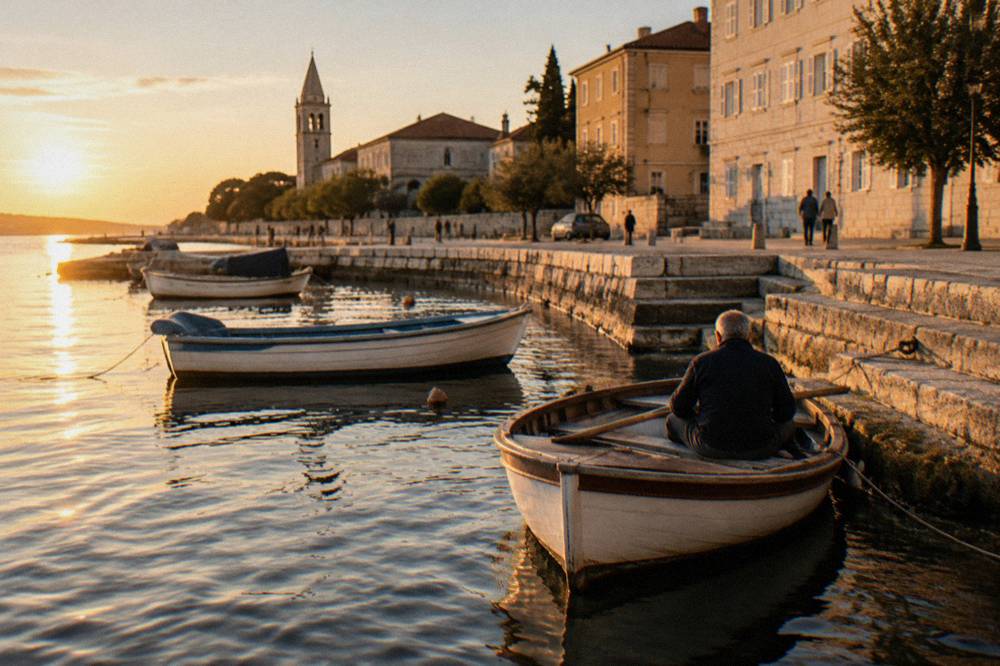
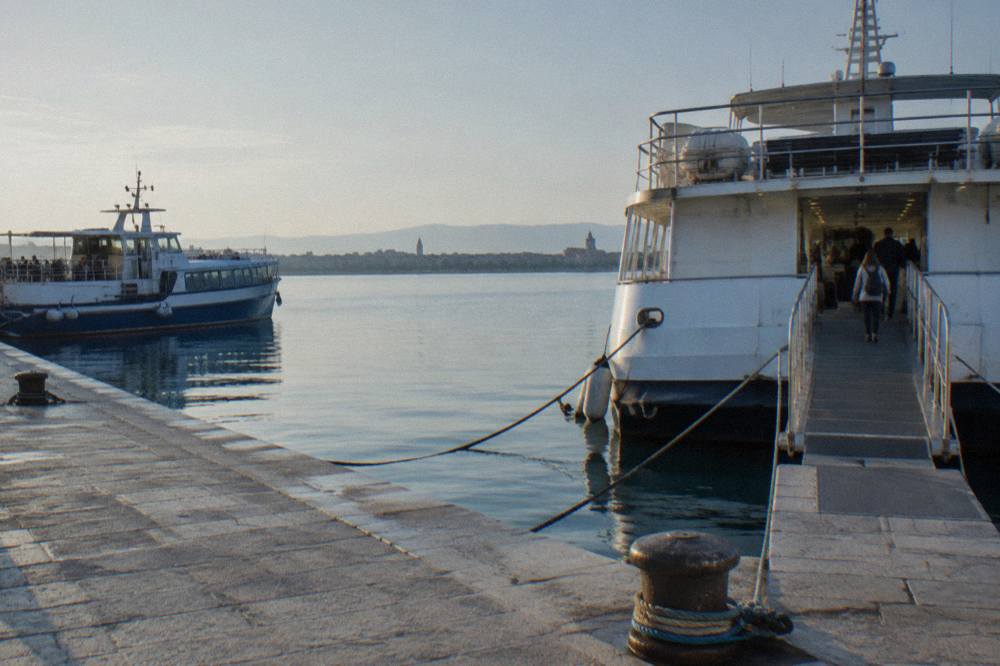
The southern part of the Riva faces the working quays. Excursion boats bound for the islands and the Kornati archipelago tie up here, and the departure points for boat trips and day tours cluster around the harbour end of the promenade. That makes the Riva the practical meeting face of the city for anyone booked on a trip: you arrive on the waterfront, board at the quay, and come back to the same stretch of stone at the end of the day.
Two smaller sights sit at or near the waterfront without needing a ticket. The Five Wells Square and the People's Square lie just inland, and the ferry port at Gaženica, from which the car ferries for Dugi Otok and the seasonal international lines sail, lies about 5.2 km south-east of the Old Town, roughly a 10 minute drive. The Riva itself is where the passenger excursion traffic lives; the big vehicle ferries use Gaženica.
The Check availability link goes to the tuk tuk tour listed on this site, which covers the waterfront and the peninsula's less obvious corners, and the classic walking options are compared on the Zadar walking tour round-up page.
How Do The Sea Organ And Greeting To The Sun Work From The Riva?
At the northern end of the Zadar Riva stand two free public installations by the architect Nikola Bašić: the Sea Organ, opened in 2005, which turns wave movement into sound through pipes set in the sea steps, and the Greeting to the Sun, opened in 2008, a circular solar-powered light installation beside it. Both are open at all hours, neither is ticketed, and the light display follows the sun rather than a fixed published start time.
The Sea Organ is built into the stone steps that run down to the water at the tip of the peninsula. Wave movement pushes air through a system of pipes under the steps, and the result is a low, changing tone that rises and falls with the sea. Reported dimensions are about 70 m of steps with 35 pipes; the site desk attributes those figures as reported rather than official. The city's own page confirms the year, 2005, and the architect. On a calm day the sound is faint; with a swell it carries clearly along the waterfront.
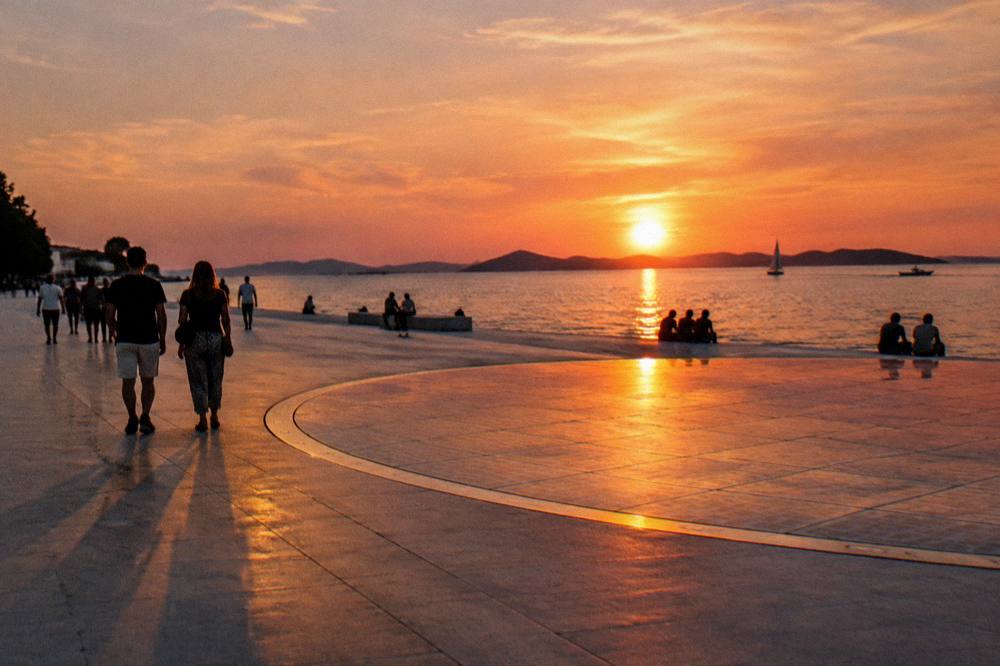
The Greeting to the Sun sits a few steps away on the paving. It is a large circle of solar cells and glass, reported at about 22 m across, that stores energy by day and produces a light display after dark. The installation underwent an electronics reconstruction in April 2026, according to local reporting, and no further closures have been reported since.
Both installations turned a formerly unremarkable stretch of concrete seafront into the reason many travellers come to this end of the promenade at dusk. There is no fence, no ticket booth and no queueing system. The full details, including how the organ physically works, are on the dedicated pages for the Sea Organ and the Greeting to the Sun.
Because the tip of the peninsula faces due west over open water, the sunset itself is the free headline event. Local promotion has long claimed Zadar's sunset as something special. What is verifiable is the geography: an unbroken western horizon over the Adriatic, watched from a stone seafront that sounds like an organ when the waves move.
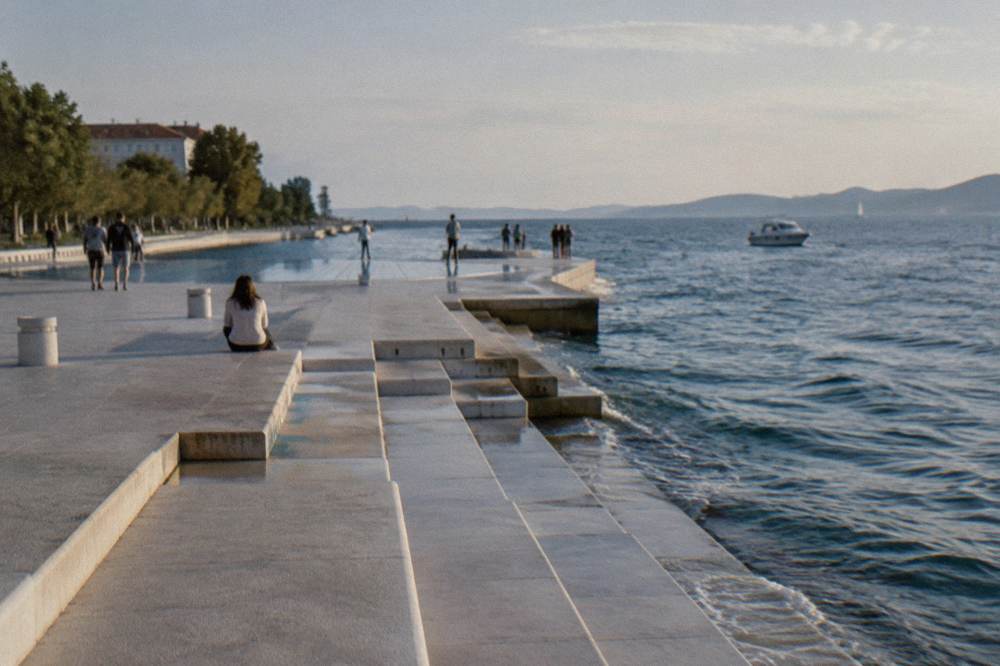
A practical note for the walk out to the tip: this is a public seafront, and the steps to the water can be wet and slick. The harbour end can be busy when excursion boats are boarding. The Old Town dress-code signs posted in summer 2026, which ask for appropriate clothing and carry reported fines up to 130 EUR for swimwear in the historic core, apply to the peninsula as a whole; a cover-up over beachwear is the simple answer.
How Long Is The Riva Walk, And What Routes Join It?
The Riva walk covers the western shore of a small, flat peninsula, so it is short and easy: the promenade itself is a single crescent that links the ferry and excursion harbour at the south to the Sea Organ and Greeting to the Sun at the north-west tip. No part involves a climb, and the walk connects directly to every major Old Town sight through the streets just inland.
Distances on the peninsula are small. Within the Old Town itself, everything on this page is a few minutes on foot. The larger distances matter mainly for day trips out: Nin is 19.8 km by road, Paklenica 46.8 km, Skradin 76 km, the Skradinski Buk end of Krka National Park 91 km, and Plitvice Lakes 145 km, all measured by the routing data this site holds. Those figures explain why the promenade is the boarding point rather than the destination: the boats and coaches leave from here.
| Route from the Old Town | Road distance | Typical drive time |
|---|---|---|
| Zadar bus station | 2.6 km | 6 min |
| Gaženica ferry port | 5.2 km | 10 min |
| Zadar Airport (Zemunik) | 13.3 km | 22 min |
| Nin | 19.8 km | 28 min |
| Biograd na Moru | 29.5 km | 39 min |
| Paklenica National Park | 46.8 km | 57 min |
| Skradin (Krka gateway) | 76 km | 62 min |
| Plitvice Lakes National Park | 145 km | 153 min |
For walks within and around the promenade itself, the useful additions are the itineraries the site has already built. The one day in Zadar plan places the Riva and the sunset installations at the end of the day, which matches how the light works. The two days in Zadar and three days in Zadar versions add the islands and a national park day, again departing from the waterfront.
Crossing the water needs no itinerary at all. The Barkajoli, the small traditional rowing boats that shuttle across the channel, make the roughly 75 m crossing in about a minute and a half to two minutes, year-round when weather permits. The fare is not officially published; reports put it at a euro or two, and this site prints no fixed figure. For scheduled ferries, the Ugljan island and island guides carry the detail.
When Is The Best Time Of Day To Walk The Zadar Riva?
The best time of day on the Zadar Riva is late afternoon into sunset: the sun drops into the open western horizon, the Sea Organ sounds with the evening breeze, and the Greeting to the Sun begins its display after dark. Early morning is the quiet alternative, with empty paving and working harbour traffic. Midday in summer is hot and exposed, since the promenade offers sea but little shade beyond the palms.
The climate record backs the timing. Zadar station, 1961-2024 (DHMZ), gives a July mean of 24.5 C and an August mean of 24.1 C, with 10 days at or above 30 C in each of those months, so a midday summer walk on pale stone is a hot one. June averages 21.9 C and September 20.2 C, both more forgiving. The station record also shows about 2,600 hours of sunshine a year, and July alone averages 358.6 hours of it, which is why the shaded benches and evening hours matter in high summer.
| Month | Mean temperature (C) | Rainfall (mm) | Sunshine (hours) |
|---|---|---|---|
| January | 7.3 | 76.4 | 115.6 |
| March | 10.0 | 66.3 | 188.5 |
| May | 17.9 | 64.4 | 279.1 |
| July | 24.5 | 35.4 | 358.6 |
| September | 20.2 | 110.9 | 243.1 |
| November | 12.1 | 123.0 | 119.2 |
All climate figures in the table are Zadar station, 1961-2024 (DHMZ). July is the driest month at 35.4 mm and November the wettest at 123.0 mm, so an autumn visit trades some rain for empty paving. The evening itself has a structure: sunset first, then the Sea Organ in whatever the sea is doing, then the Greeting to the Sun once it is properly dark. Anyone wanting a quiet version should aim for the hour before the crowds build in summer.
Winter evenings still work, at 7.3 C mean in January, and the Advent season puts the peninsula in festive use. Zadar Advent runs from 24 November 2026 to 2 January 2027 across three locations, with a new ice rink on the Forum, and the Zadar Christmas Run is scheduled for 27 December 2026, per the city's events pages. The promenade is the natural walk between the programme's venues.
Which Tours And Day Trips Start From The Zadar Waterfront?
The Zadar waterfront is the departure and meeting face for the city's boat trips and guided tours: island and snorkelling excursions board at the quays beside the Riva, walking and tuk tuk tours use the promenade as a landmark meeting point, and the big national park day trips to Krka and Plitvice collect from central Zadar before heading out by road or coach. Kornati and Telašćica trips run from the harbour side.
Boat trips are the natural fit for a seafront city with islands offshore. The roster on this site covers snorkelling and island-hopping runs of a few hours, sunset cruises, and full-day Kornati and Telašćica trips, most departing from the quays at the harbour end of the promenade. A note that catches out planners: entry to Kornati National Park is charged per vessel by length and season, not per person, and the ticket is bought outside the park, so what a boat tour's price covers varies between operators. Confirm at booking what is included.
Road day trips run the other way. Krka National Park lies 91 km from the Old Town by road and Plitvice 145 km, and both parks price seasonally: Krka charges 7 EUR per adult in the winter months, 20 EUR in April, May and October, and 40 EUR from June to September, while Plitvice charges 10, 23 and 40 EUR on the same seasonal pattern, per the parks' own 2026 price lists. Swimming at Krka's Skradinski Buk has been banned since 2021; designated swimming spots elsewhere in the park operate from 1 June to 30 September. The dedicated Krka and Plitvice pages carry the full detail.
| Day trip from Zadar | Type | Park entry (adult, seasonal) |
|---|---|---|
| Krka National Park | Road, 91 km | 7 / 20 / 40 EUR by season |
| Plitvice Lakes | Road, 145 km | 10 / 23 / 40 EUR by season |
| Kornati National Park | Boat | Charged per vessel, by length and season |
| Telašćica Nature Park | Boat | 6 EUR off season, 8 EUR Jun-Sep at land entrance |
| Paklenica National Park | Road, 46.8 km | 5 / 8 / 10 EUR by season |
| Nin | Road, 19.8 km | No park entry |
For a first-day orientation, a guided loop of the peninsula is the efficient choice, and the tuk tuk option covers ground a walking tour cannot. The Check availability link beside this paragraph is the same product this site features across its attractions pages; free cancellation terms are on the booking page.
Is The Zadar Riva Free, Accessible And Suitable For Families?
Yes: the Zadar Riva is a free public promenade with no entry charge, no ticket and no closing time, and its flat stone surface makes it one of the most accessible walks in the city, usable with strollers and wheelchairs along its main length. The adjoining sights split into free public spaces (Forum, Five Wells Square, Kalelarga) and ticketed museums and churches, whose prices are listed separately below.
The promenade itself has no gate, booth or schedule. The steps down to the water at the Sea Organ are the one place where wheels meet a barrier, but the main paved crescent stays level from the harbour end to the installations. The whole Old Town is compact and mostly pedestrian, which is why Zadar works as a walkable short-break city; the site's walkability answer covers the detail.
| Sight near the Riva | Entry |
|---|---|
| The Riva promenade itself | Free, open at all hours |
| Sea Organ | Free, open at all hours |
| Greeting to the Sun | Free, display follows the sun |
| Roman Forum, Five Wells Square, Kalelarga | Free public spaces |
| Museum of Ancient Glass | 7.00 EUR adult, per its ticket page |
| Archaeological Museum and St Donatus | Around 7 EUR at full price |
| Cathedral of St Anastasia bell tower | Price not published officially; confirm on site |
Families manage this stretch easily. The flat paving, the ice cream stands, the boats to watch and the water sounds give children plenty without a single queue. The one caution is the water itself: the steps are a sea edge, not a beach, and swimmers should use the real beaches such as Kolovare a short way south, or the beach areas in Borik. Beach rules in Zadar County for the 2026 season keep access free and public, with commercial zones limited to part of each beach's area.
Two museums give the promenade a rainy-day counterpart. The Museum of Ancient Glass charges 7.00 EUR for an adult ticket on its published price list, with reduced group and school rates, and the Archaeological Museum, which administers St Donatus, shows rows of 7.00 and 5.00 EUR on its tariff page. Opening hours for the glass museum conflict between sources, so this site links rather than states them.
What Should You Know Before You Go To The Zadar Riva?
Before walking the Zadar Riva, know that it is free and always open, that Croatia uses the euro and is in the Schengen area, that the emergency number is 112, and that a tourist tax exists but its local rate is confirmed at booking rather than published here. The airport is about 8 km from the city with a 5.00 EUR shuttle, and the promenade sits at the centre of a compact, walkable peninsula.
Money and formalities are simple: Croatia has used the euro since 1 January 2023 and is a Schengen member, so no border formalities apply within the zone. Getting in from the airport, the shuttle run by Liburnija costs 5.00 EUR one way including luggage, takes about 20 minutes, and the ticket is valid 90 minutes on city buses, per the airport's own page. The airport's how-to-get-here page gives the distance as 8 km from the city.
Getting out again is equally concrete. The bus station on Ante Starčevića 1 is 2.6 km from the Old Town, the Gaženica ferry port 5.2 km, and the car ferry to Brbinj on Dugi Otok takes 1 h 40 min on Jadrolinija's line 434. The seasonal fast catamaran to Ancona ran to 6 September 2026 and no 2027 season has been announced, so Italy-bound travellers should check the operator's page before planning.
The last practical habits are small ones. Confirm museum hours on the day, since the sources for the glass museum conflict. Do not plan the Greeting to the Sun around a printed start time; it follows the sun. Bring a layer for the evening, when the bora, a north-easterly wind, can cut across the water in the cooler months. And if a boat trip from the quays is on the list, check what the price covers before booking, because park entries, particularly Kornati's per-vessel charge, are handled differently between operators. The promenade itself will still be there afterwards, free, sounding quietly, at the edge of the Adriatic.
Common Questions About The Zadar Riva
Is the Zadar Riva free to visit?
Yes. The promenade is a free public space open at all hours, and the Sea Organ and Greeting to the Sun at its northern end are also free, open public installations. Only the adjoining museums and churches charge entry.
How long does it take to walk the Zadar Riva?
The promenade is a single flat crescent along a small peninsula, so the walk itself is short. Visitors tend to spend longer than the walking time suggests, because the cafes, the harbour traffic and the sunset installations at the tip invite stopping.
Can you see the sunset from the Zadar Riva?
Yes, the promenade faces due west over open Adriatic water, so the sunset horizon is unbroken. The Greeting to the Sun light display follows the sun after dark; this site prints no start time because none has been officially verified.
Where does the Zadar Riva start and end?
It runs along the western shore of the Old Town peninsula, from the ferry and excursion harbour at the southern end to the Sea Organ and Greeting to the Sun at the north-western tip.
Is the Zadar Riva accessible for wheelchairs and strollers?
The main paved length is flat stone and usable with wheels. The steps down to the water at the Sea Organ are the exception, and the surrounding Old Town streets are mostly pedestrian and compact.
Do tours leave from the Zadar Riva?
Boat trips, island excursions and Kornati and Telašćica day trips board at the quays beside the promenade, and guided walks and tuk tuk tours use the waterfront as a meeting landmark. Confirm the exact meeting point on the booking page at booking.