Narodni Trg Zadar
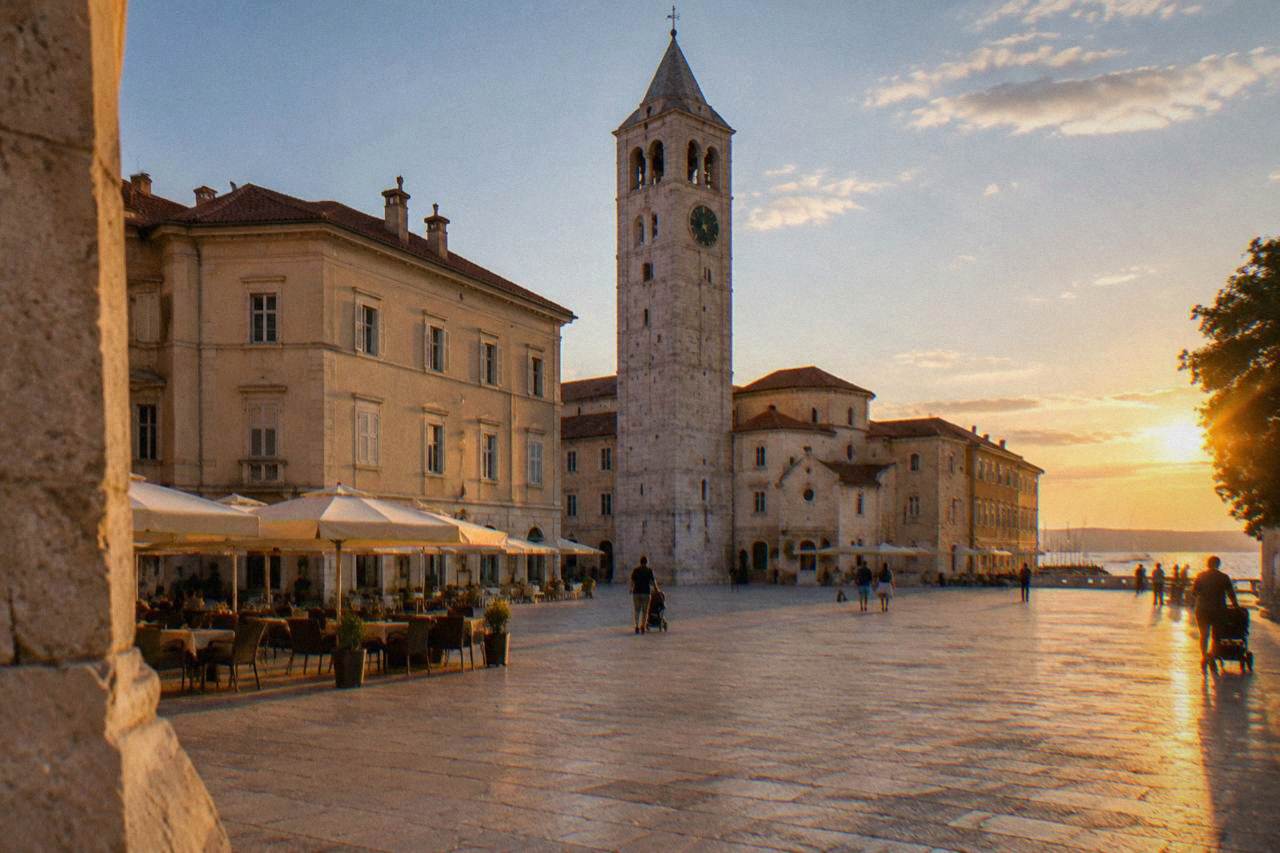
Narodni Trg, the People's Square, is the civic heart of Zadar's Old Town peninsula in Dalmatia, Croatia, a free, open-at-all-hours square ringed by historic buildings, cafes and the City Loggia, a short walk from the Kalelarga, the Roman Forum and the Riva.
Short answer
Narodni Trg in Zadar is a free public square in the Old Town on the Poluotok peninsula, open at all hours, with no ticket and no set visiting time, surrounded by historic civic buildings and cafes and within a short walk of the Kalelarga, the Forum and the Land Gate.
Narodni Trg, the People's Square, sits at the centre of Zadar's Old Town on the Poluotok peninsula, a coastal city in Dalmatia, Croatia, facing the Adriatic Sea. The square is free public space with no ticket, no gate and no opening hours, and the tourist board lists it among the city's public sights alongside the Kalelarga and the Roman Forum. Around it stand the civic buildings that ran the city for centuries, and today it works as the Old Town's living room: cafe tables under stone facades, a clock tower, and the City Loggia, now used as an exhibition space. Zadar charges a tourist tax collected by the accommodation, and its amount is confirmed at booking; everything on the square itself costs nothing to walk through.
Croatia uses the euro since 1 January 2023 and is a Schengen member, so a visit to the square involves no currency arithmetic beyond euros. The emergency number, if ever needed, is 112. This guide from the Zadar Croatia Travel Guide editorial desk covers what the square is, what sits on and around it, what nearby sights cost in 2026, the local rules in force in the Old Town, and how the square fits a first day in the city.
What Is Narodni Trg In Zadar?
Narodni Trg, or the People's Square, is the main civic square of Zadar's Old Town on the narrow Poluotok peninsula in Dalmatia, Croatia. It is free public space, open at all hours, with no ticket office and no closing time, and no official price page exists for it because none is needed. The square is the administrative and social centre the city has grown around, a few minutes' level walk from the Kalelarga, the Roman Forum and the Riva seafront.
The square's Croatian name simply means People's Square, and locals use it the way a city uses its front room: a place to meet, drink coffee and pass through between the peninsula's other landmarks. The tourist board groups it with Zadar's freely accessible public spaces, in contrast with the museums and churches that run on published tariffs. Nothing about the square requires planning in the museum sense; it requires only that you arrive, on any day, at any hour, and that you respect the Old Town rules on clothing and behaviour that the city has begun enforcing with visible signage.
What gives the square its weight is accumulation rather than any single monument. The peninsula as a whole carries Zadar's layered past, from the Roman Forum through the Land Gate of 1543, built to the design of Michele Sanmicheli, to the two modern installations on the western tip, the Sea Organ of 2005 and the Greeting to the Sun of 2008, both by Nikola Bašić. Zadar is also one of six components of the UNESCO property "Venetian Works of Defence between the 1500s and 1600s: Stato da Terra, western Stato da Mar", inscribed in 2017, though the inscription covers the defensive system, not the Old Town as a whole.
What Can You See On And Around Narodni Trg?
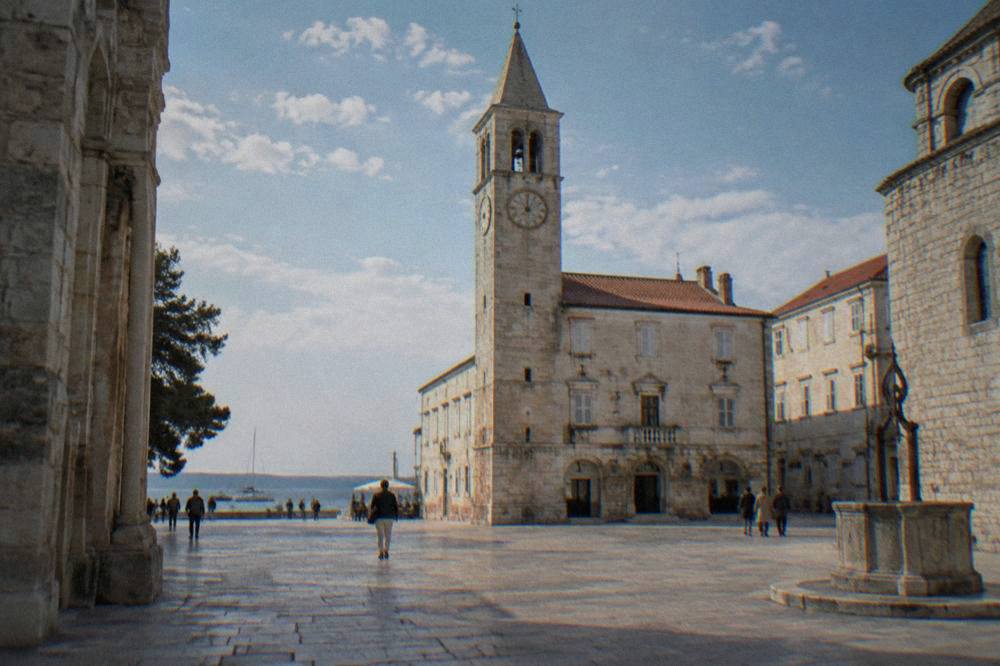
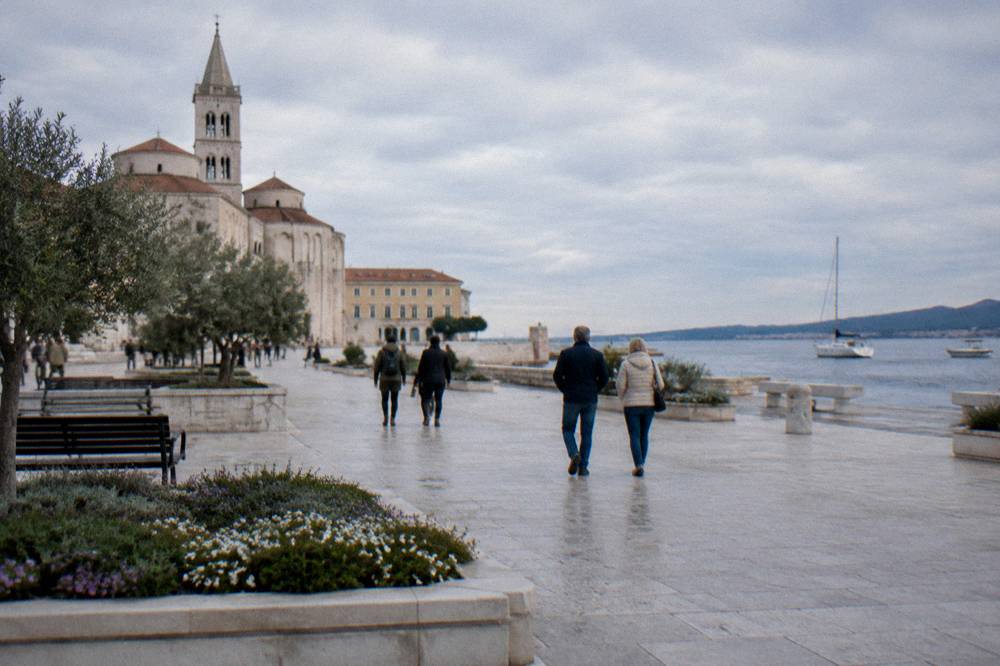
The square is ringed by historic civic buildings, including the City Loggia, the former council and court building that now serves as an exhibition venue, and the City Guard house with its clock tower, plus continuous cafe terraces under restored stone facades. All of it is visible from free public space, and the city is funding facade and courtyard renovation across the peninsula, with 156,916 euros approved for the first seven buildings, reported on 2 October 2026.
The City Loggia is the square's architectural anchor. Historic loggias of this type served as the public business end of a Dalmatian town, where councils met and judgments were read out, and Zadar's version now hosts exhibitions rather than verdicts. Check locally for what is showing, because the programme changes and no permanent ticket applies to the building as such. The clock tower, keeping time above the square, marks the spot where the Old Town's commercial life has always concentrated.
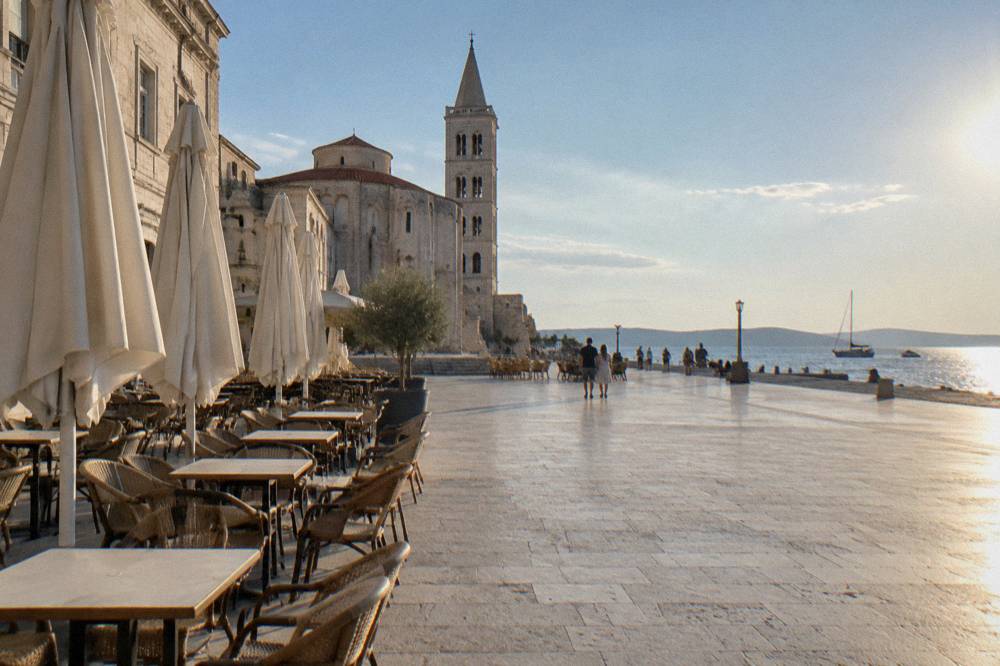
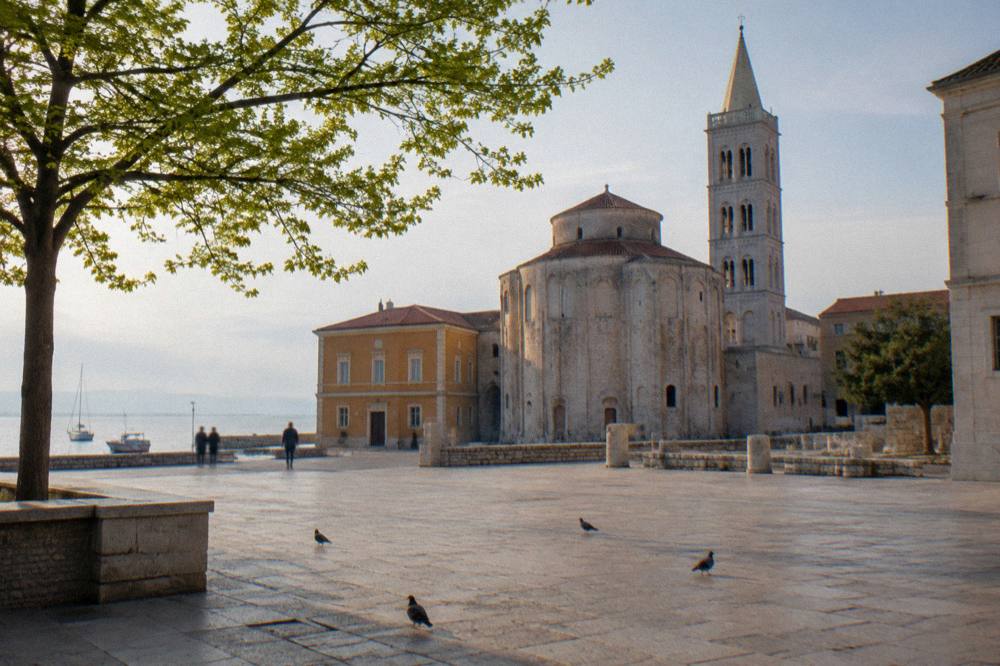
The renovation programme is worth knowing about because it shapes what the square looks like right now. The city approved the first tranche of funding in October 2026 for cleaning, repair and repainting of facades and courtyards on the peninsula, part of an annual programme with 300,000 euros allocated overall. Scaffolding on one building should not be read as decline; it is the visible edge of active investment. The same applies at the Church of St Donatus, where a roof restoration tender of about 1.3 million euros was launched in August 2026 and works are planned from autumn 2026 for about six months, so access may be limited and should be checked before a visit.
Around the square, the rest of the peninsula unfolds in a compact loop. The Five Wells Square, the Land Gate and the Cathedral of St Anastasia all sit within the same walkable core, and the Old Town area guide covers the peninsula street by street.
A guided tuk tuk ride is one way to see the square and its surroundings with a driver who narrates, and the options above cover the city loops that run locally. The rest of this guide stays on foot, because the peninsula rewards walking above every other mode.
Which Zadar Sights Are Close To Narodni Trg, And What Do They Cost?
The sights around the square divide cleanly into free public space and ticketed museums: the Roman Forum, Five Wells Square, the Land Gate, the Sea Organ and the Greeting to the Sun are free and open at all hours, while the Archaeological Museum and St Donatus run around 7 EUR at full price on the published tariff rows.
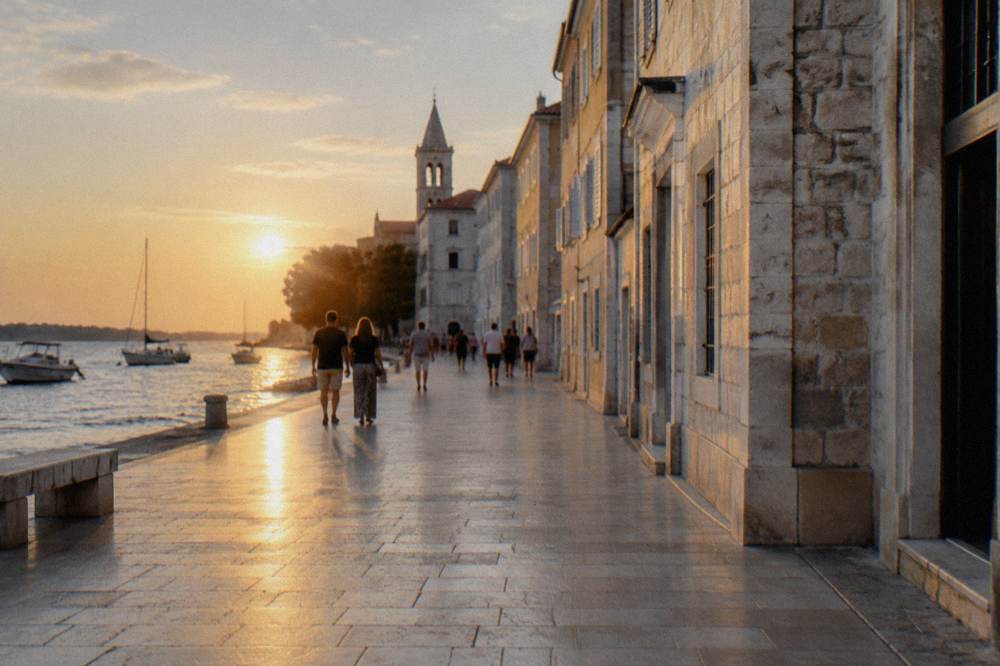
The free installations need no planning at all. The Sea Organ and the Greeting to the Sun, both by Nikola Bašić, are open public installations on the western waterfront, free at all hours, and no light-show start time is published, so plan around sunset itself rather than a schedule. The Roman Forum and the Land Gate of 1543 are equally free and always accessible.
| Sight | Relation to the square | Access | Ticket |
|---|---|---|---|
| Roman Forum | Short level walk on the peninsula | Free, open public space | None |
| Sea Organ (2005) | Western tip of the peninsula | Free, open at all hours | None |
| Greeting to the Sun (2008) | Beside the Sea Organ | Free, open at all hours | None |
| Land Gate (1543) | Edge of the Old Town green belt | Free public access | None |
| Five Wells Square | Near the Land Gate | Free public access | None |
| Museum of Ancient Glass | On the peninsula | Ticketed | 7.00 EUR adult |
| Archaeological Museum / St Donatus | Peninsula core | Ticketed | Around 7 EUR full price |
The Museum of Ancient Glass publishes its full tariff: 7.00 EUR adult, 5.00 EUR for groups of five or more, 4.00 EUR for schoolchildren, free for preschoolers and listed groups, with guided tours at 20 EUR in Croatian or 30 EUR in other languages for a group of about 30. Its opening hours conflict between sources, so the museum's own hours page is the reference to check before going. The Archaeological Museum and St Donatus share the AMZD tariff, whose page shows 7.00 and 5.00 EUR rows, which this site reports as around 7 EUR at full price; note again the St Donatus roof works that may limit access from autumn 2026.
For the cathedral's bell tower, no price or hours could be found on an official page, so confirm locally before planning a climb. The same applies to the Gold and Silver of Zadar exhibition, whose ticket appears only in secondary sources.
A tuk tuk loop is the motorised alternative for anyone who wants the peninsula's story without pacing it out, and the listing above shows the current terms. For everyone else, the square is the natural midpoint of a walking day, and the one day in Zadar itinerary strings these sights into a route that starts and ends near the water.
What Rules Apply Around Narodni Trg In Zadar's Old Town?
The Old Town has a dress code backed by signage: swimwear and nudity are not permitted in the historic core, with a verbal warning first and fines up to 130 euros reported from July 2026, and the municipality has also moved to restrict night-time retail alcohol sales on the peninsula for the 2026 season, a measure reported in local coverage and aimed at noise and overtourism.
The dress-code signs went up at key access points to the peninsula in summer 2026, based on the city's existing communal order decision. The rule is simple to follow: cover up between the beach and the square. The alcohol restriction applies to shops, kiosks and delivery in the Old Town, not to bars and restaurants, and it exists alongside a broader national law change allowing municipalities to set such limits.
Zadar County also reworked its beach concession rules for the 2026 season: no fencing, ramps, barriers or entry fees are allowed on concession beaches, access stays fully public and free, and commercial use such as sunbeds is capped at 40 to 60 percent of a beach's area depending on the site. That matters for a square-centred visit, because the beaches of Kolovare, Borik, Puntamika and Diklo are a bus or short drive away and none of them now charges for entry.
When Is The Best Time Of Year To Visit The Square And Zadar?
Zadar's climate, measured at the city's station for 1961-2024, runs from a July mean of 24.5 C, the warmest month, to a January mean of 7.3 C, the coldest, with July also the driest month at 35.4 mm and November the wettest at 123 mm, so late spring and early autumn combine warm air with fewer rain days, while winter visits trade warmth for the Advent programme that runs 24 November 2026 to 2 January 2027.
The station record is the honest basis for planning. The table below gives the monthly means from the DHMZ, the Croatian national meteorological service, for the Zadar station over 1961-2024, and it rewards a close read: September is still a 20.2 C month but carries 110.9 mm of rain, while June is nearly as warm as August with far less rain.
| Month | Mean temperature (C) | Precipitation (mm) |
|---|---|---|
| Jan | 7.3 | 76.4 |
| Feb | 7.8 | 67.0 |
| Mar | 10.0 | 66.3 |
| Apr | 13.4 | 61.4 |
| May | 17.9 | 64.4 |
| Jun | 21.9 | 48.5 |
| Jul | 24.5 | 35.4 |
| Aug | 24.1 | 52.8 |
| Sep | 20.2 | 110.9 |
| Oct | 16.3 | 106.8 |
| Nov | 12.1 | 123.0 |
| Dec | 8.6 | 99.6 |
Sunshine totals about 2,600 hours a year at the station. Summer days at or above 30 C number about ten each in July and August, with a record high of 39.0 C recorded on 6 August 2022 and a record low of minus 9.1 C in January 1963, all from the same station series.
Winter has its own case. The Advent programme across the peninsula brings concerts and a rink, and the square sits inside that footprint. Rain is at its annual peak in November, so a winter visit should keep an indoor list ready, covered in the museum section above.
Which Day Trips Start Near Narodni Trg?
The park day trips that define a longer Zadar stay, Krka, Plitvice, Kornati, Paklenica and Telašćica, all start from the city, and their 2026 adult entry fees are seasonal: Krka runs 7, 20 or 40 EUR by month, Plitvice 10, 23 or 40 EUR, Paklenica 5, 8 or 10 EUR, and Telašćica 6 or 8 EUR at its land entrance, while Kornati is charged per vessel by length and season, bought outside the park.
Both Krka and Plitvice dropped to their winter-shoulder rates on 1 October 2026, so an autumn visit costs materially less than a summer one. At Krka, swimming is banned at Skradinski Buk, in force since 2021 to protect the travertine, and is allowed only in designated areas at Roški slap, Stinice and Pisak from 1 June to 30 September, weather permitting. Any tour promising a swim at the main waterfall is out of step with park rules; the swim stops that Zadar tours use sit at Skradin.
| Park | 2026 adult entry (EUR) | Seasons | Basis |
|---|---|---|---|
| Krka NP | 7 / 20 / 40 | Jan-Mar and Nov-Dec / Apr, May, Oct / Jun-Sep | Per person, all accessible land sites |
| Plitvice Lakes NP | 10 / 23 / 40 | Jan-Mar, Nov-Dec / Apr-May, Oct / Jun-Sep | Per person, 1-day |
| Paklenica NP | 5 / 8 / 10 | Jan, Feb, Nov, Dec / Mar, Apr, Oct / May-Sep | Per person, 1-day |
| Telašćica | 6 / 8 | Jan-May, Oct-Dec / Jun-Sep | Per person, Dolac land entrance |
| Kornati NP | 25-45 for the smallest vessels | Varies by length and month | Per vessel, 1 day, bought outside the park |
| Vransko jezero | 6 | Single rate, child 3, family 15 | Per person |
The Krka National Park guide and the Plitvice guide carry the full detail, including how the Kornati vessel-based fee differs from every per-person park around it. For the square-bound visitor, the point is simpler: the city is the launch pad, and the peninsula's sights, the square included, fill the hours before and after a park day.
The Krka tour with a Skradin swim stop, linked below, is this site's featured pairing for a waterfall day out of Zadar.
For anyone weighing the drive, the OSRM-computed distances from the Old Town are: Krka's Skradinski Buk 91 km, Plitvice 145 km, Paklenica 46.8 km, and Nin 19.8 km, all by road. The day trips overview puts them in itinerary order.
How Does Narodni Trg Fit Into A Zadar Itinerary?
The square works as the midpoint of any peninsula itinerary, sitting between the Kalelarga and the Forum on the walk from the Land Gate to the Sea Organ, and every itinerary this site publishes, from one day to four, routes through it naturally because it is the level, shaded, cafe-lined hinge of the Old Town rather than a detour.
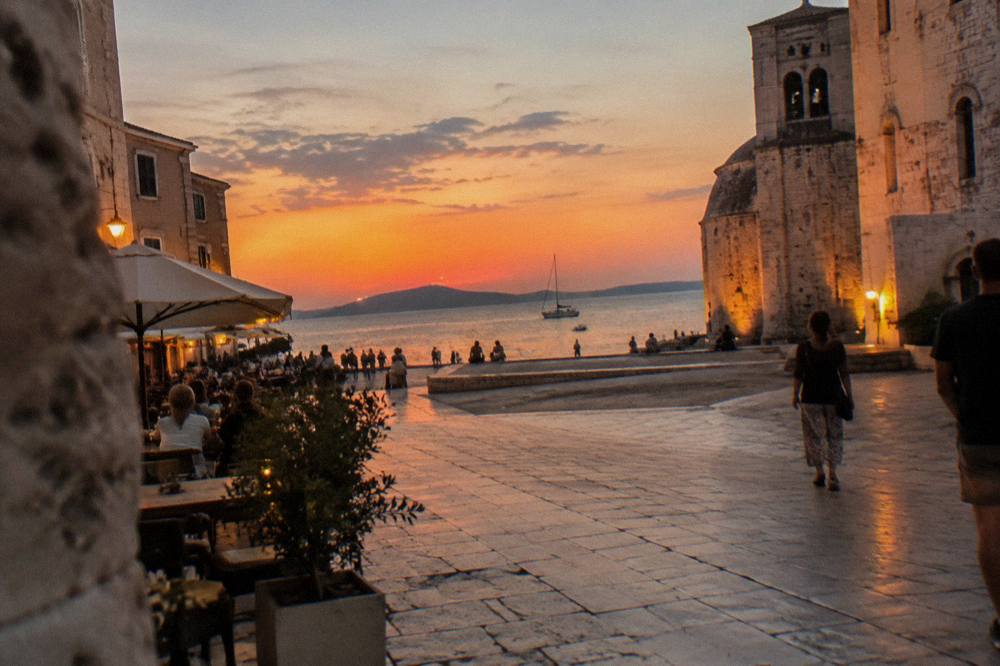
A first day typically runs: enter the peninsula at the Land Gate, cross Five Wells Square, walk the Kalelarga to Narodni Trg for a coffee, continue to the Forum and St Donatus, and finish on the Riva for the sunset installations. The two days in Zadar and three days in Zadar versions add the museums and the islands, and Ugljan and Dugi Otok lie offshore for a boat day, with the Jadrolinija crossing to Brbinj on Dugi Otok taking 1 h 40 min on line 434.
The square is also the sensible fallback in bad weather, though Zadar's indoor list is short: the Museum of Ancient Glass and the Archaeological Museum are the reliable ticketed options, and their tariffs are tabled above. The peninsula is pedestrian core, and the bus station at Ante Starčevića 1 sits 2.6 km from the Old Town by road.
Common Questions About Narodni Trg Zadar
Is Narodni Trg in Zadar free to visit?
Yes. The square is free public space, open at all hours, with no ticket office. The tourist board lists it among Zadar's freely accessible public areas, unlike the museums around it which run on published tariffs.
What does Narodni Trg mean?
It means People's Square in Croatian. It is the main civic square of Zadar's Old Town on the Poluotok peninsula, ringed by historic buildings including the City Loggia and the clock tower of the City Guard house.
How far is Narodni Trg from the Sea Organ?
Both sit on the same small peninsula. No official walking time is published, but the Sea Organ and Greeting to the Sun occupy the western tip and every standard walking route joins them to the square in one continuous level stroll.
Is there a dress code at Narodni Trg?
Yes, for the whole Old Town. Signs installed in July 2026 require appropriate clothing, with no swimwear or nudity in the historic core, backed by a verbal warning first and fines up to 130 euros as reported in local coverage.
The square asks nothing of a visitor except presence: arrive dressed for a city core, keep the evening open for the waterfront installations a short stroll west, and check the St Donatus access situation before counting on that stop on the same walk.
