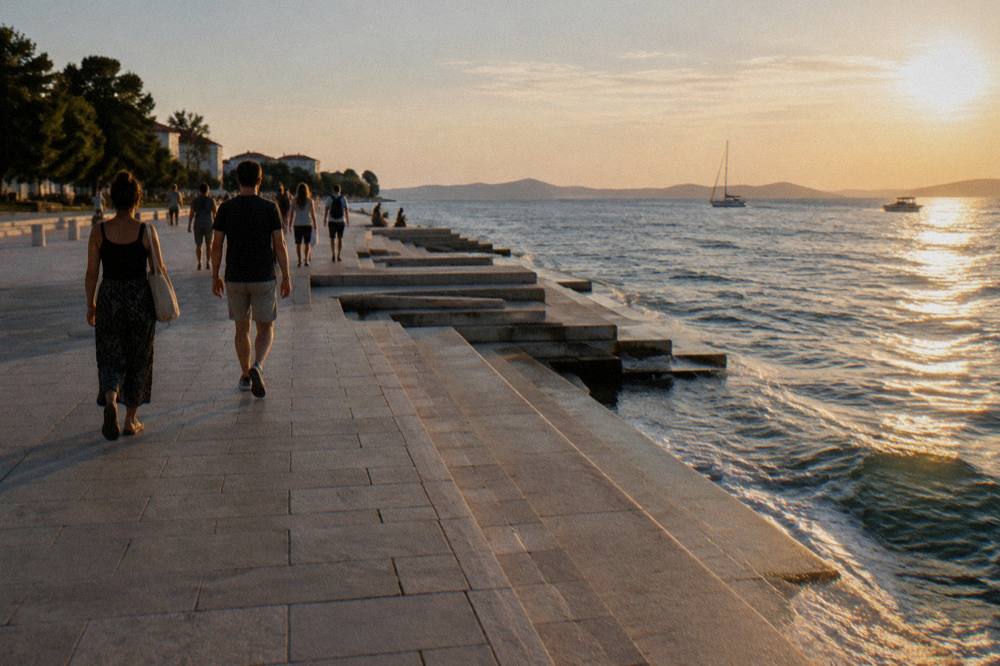
Sea Organ Zadar
The Sea Organ in Zadar is a free, wave-driven sound installation set into the stone steps of the Riva, playing continuously as the sea moves through hidden pipes. This guide covers how it works, when to listen, and what to see around it.
Short answer
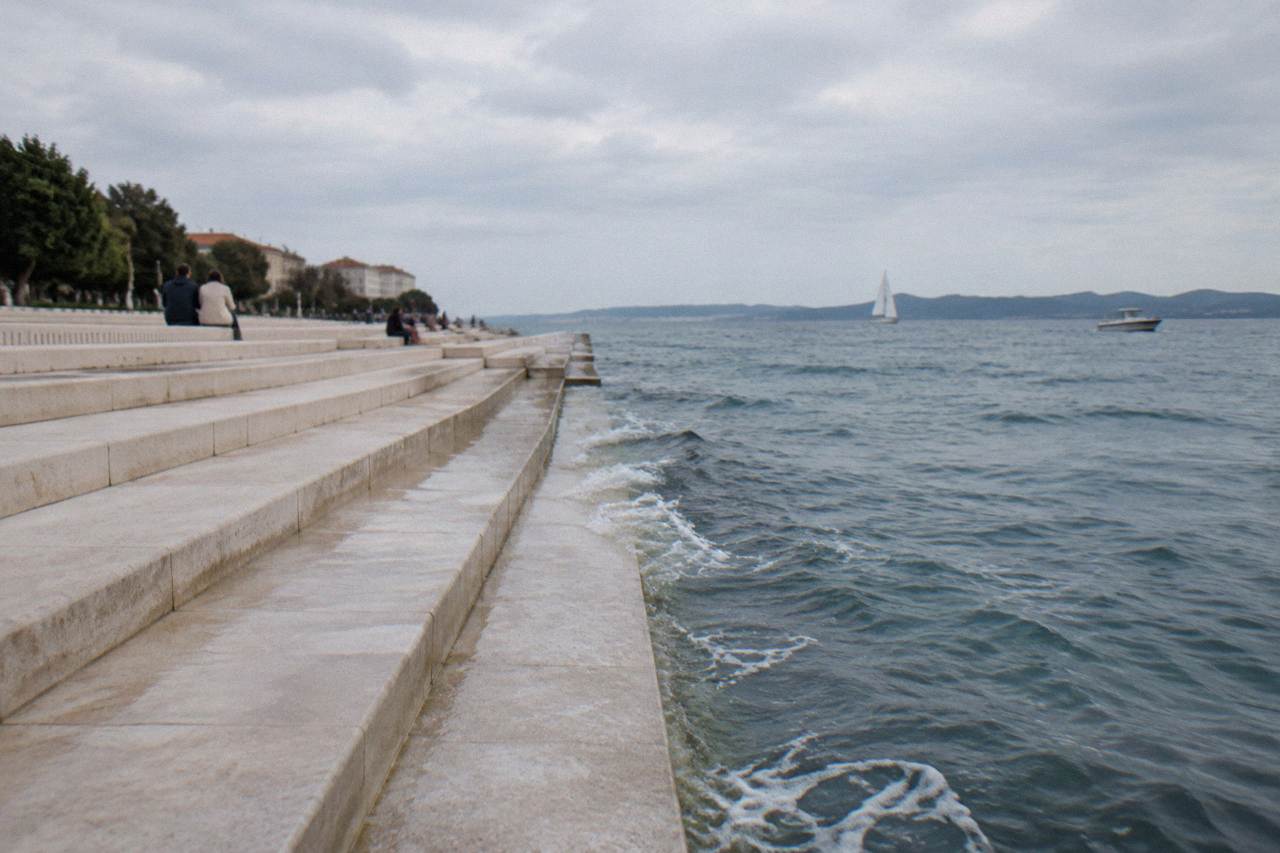
The Sea Organ in Zadar is a free public installation by architect Nikola Bašić, opened in 2005, built into the stone steps of the western Riva. Waves push air through pipes under the steps to produce low harmonic tones. It is open at all hours, costs nothing, and sits beside the Greeting to the Sun light installation.
The Sea Organ in Zadar, a coastal city in Dalmatia on the Adriatic, is a musical instrument played by the sea itself. Built into the stone steps on the western end of the Riva, it turns wave motion into sound through a system of pipes hidden beneath the promenade. The city's official page for the installation credits architect Nikola Bašić and gives 2005 as the year it opened. It is free, it is open at all hours, and it has become the single spot the city is now known for worldwide, sitting a few minutes' walk from the Roman Forum and the Church of St Donatus.
This page from the Zadar Croatia Travel Guide covers everything a visitor needs: how the organ produces its tones, when the sea and the weather give the best listening, exactly where the steps are, what the neighbouring Greeting to the Sun installation does after dark, and how the Sea Organ fits into a day spent in the Old Town. The Zadar station, 1961-2024 climate record from the Croatian meteorological service (DHMZ) is used for every weather figure below, and each price that appears comes from an official source stated alongside it.
What Is The Sea Organ In Zadar?
The Sea Organ is a free, open-air sound installation set into the stone steps of Zadar's western Riva, designed by architect Nikola Bašić and opened in 2005, in which waves push air through submerged pipes to produce low, harmonic tones through openings in the steps. It is a public work, open at all hours, with no ticket, no gate and no schedule, and the city's own page for it names Bašić and the year 2005.
The installation replaced an anonymous concrete seawall from the city's postwar reconstruction with stepped white stone, and the sound was the point from the start: Bašić's concept was to let the sea finish the composition, since no two wave patterns ever repeat. Reports describing the build give the organ a length of roughly 70 metres with about 35 pipes of varying lengths tuned to a harmonic scale; those dimensions come from secondary reporting rather than an official technical sheet, so they are best treated as approximate. The tones are low and resonant, closer to a ship's hull humming than to a church organ, and they change with every swell.
There is nothing to queue for and nothing to photograph on a ticket. The steps themselves are the instrument, and sitting on them is the standard way to listen. The site's companion page, how the wave-powered organ actually works, goes deeper into the physics for anyone curious.
How Does The Sea Organ In Zadar Work?
Waves entering inclined channels under the steps push columns of air ahead of them, and that air escapes upward through organ pipes built into the stone, each tuned to a different note; the size and rhythm of the swell decide which pipes sound, how loudly and in what sequence, so the music is produced entirely by the sea and the wind, with no electricity, no pump and no performer.
The mechanism is a clever inversion of a pipe organ. In a church organ, air is pushed through pipes by a blower. Here, the sea is the blower. Underwater channels open toward the incoming waves, and a wave arriving in a channel compresses the air column in the connected pipe, forcing it out through a sounding hole in the step above. As the wave recedes, the air column settles. A long, slow swell produces long, slow chords; short choppy water produces quicker, more fragmented notes.
That dependence on conditions is the practical takeaway for a visitor. On a flat, windless morning the organ may be nearly silent, with only the faintest breath under the steps. With a bora wind blowing from the northeast in winter, or a jugo from the south pushing water up the channel, the steps can sound almost continuous. The DHMZ station record for Zadar shows July as the month with the fewest rain days (five) and November as the wettest month (123 mm of rain across the month, Zadar station, 1961-2024), which hints at the pattern: calmer seas in high summer, more energetic water in the cooler months.
| Month | Mean temperature (C) | Precipitation (mm) | Rain days |
|---|---|---|---|
| January | 7.3 | 76.4 | 10 |
| April | 13.4 | 61.4 | 10 |
| July | 24.5 | 35.4 | 5 |
| October | 16.3 | 106.8 | 9 |
| November | 12.1 | 123.0 | 12 |
The figures above are Zadar station, 1961-2024 means from the DHMZ, the Croatian national meteorological service.
For visitors who want the organ explained while standing on it, a guided walk is the natural fit. The listing for the related Old Town and Sea Organ highlights walk covers the peninsula's main sights with local tastings included, and the operator's live listing carries the current price and availability.
When Is The Best Time To Hear The Sea Organ In Zadar?
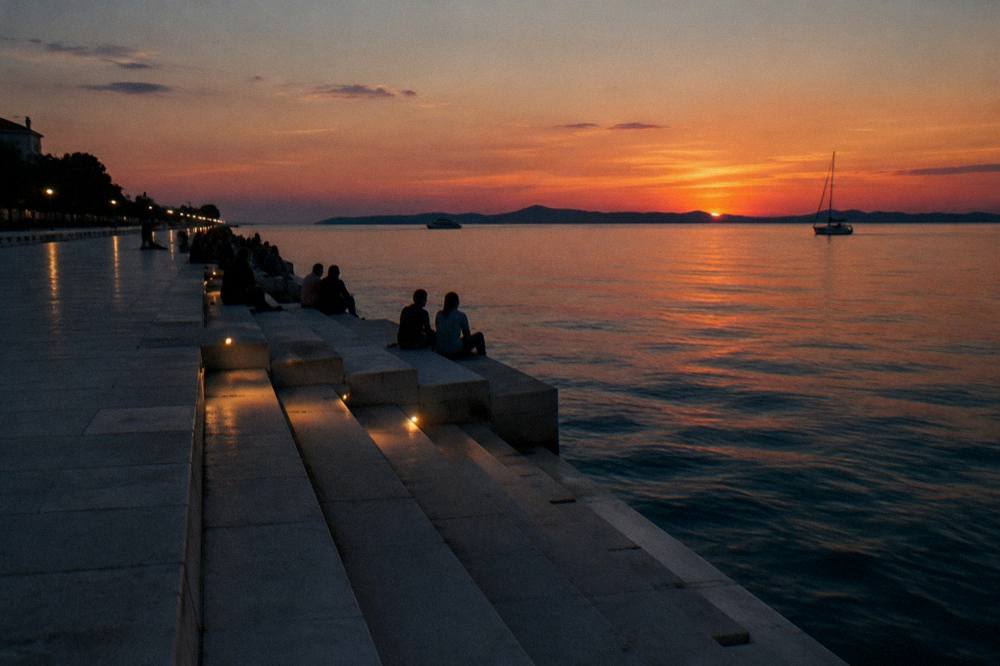
Any time of day works because the organ plays whenever there is a swell, but the two most reliable windows are late afternoon into sunset, when the steps fill and the light drops over the islands of Ugljan and Pašman, and the stormier months from October through March, when stronger winds and bigger waves drive louder, more continuous tones; in flat-calm midsummer the instrument can fall almost silent.
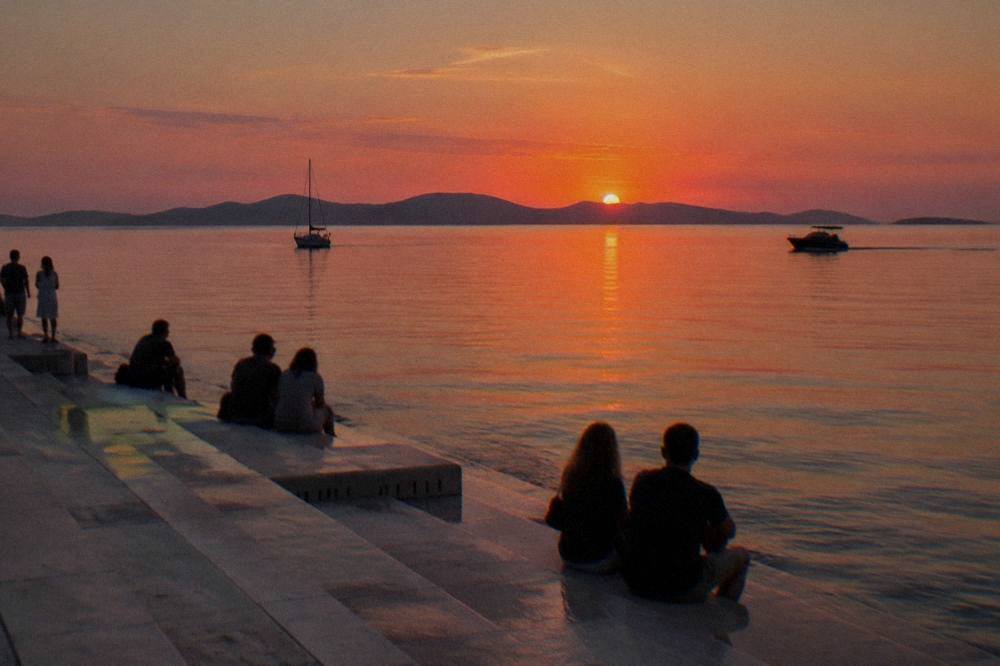
Sunset is the classic slot, and Zadar's own tourist board has long marketed the city's sunsets, a claim endorsed by the film director Alfred Hitchcock, who visited in May 1964 and called Zadar's the most beautiful sunset in the world. The practical point stands: the sun sets over the channel in front of the steps, and the hour before dusk is when the Riva is at its liveliest.
The seasons matter more than the clock. The DHMZ record shows July and August as the warmest months (24.5 C and 24.1 C means) but also among the calmest for swell-producing wind. Autumn and winter bring the bora, the cold, gusty northeast wind the Dalmatian coast is known for, and the jugo from the south; both pile water into the channels and give the organ its fullest voice. A winter listener in a coat will often hear more organ than a July listener in swimwear.
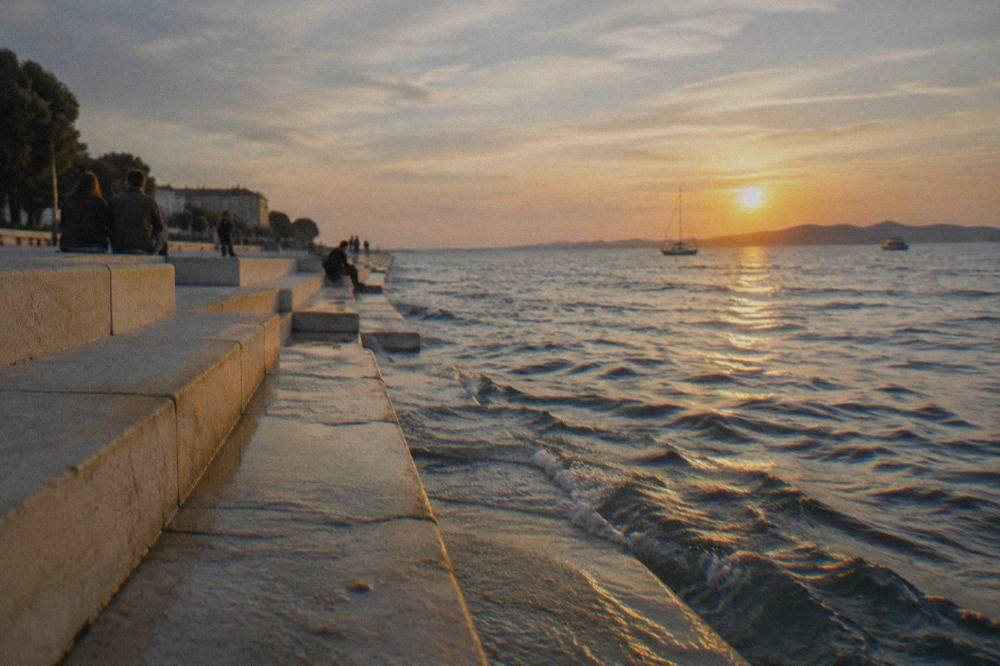
There is one timing myth to correct: the neighbouring Greeting to the Sun installation is sometimes described as having a fixed evening start time. The display follows the sun; it charges by day and glows after dark, so the honest advice is simply to stay past sunset and watch the lights come up.
Where Exactly Is The Sea Organ And How Do You Get There?
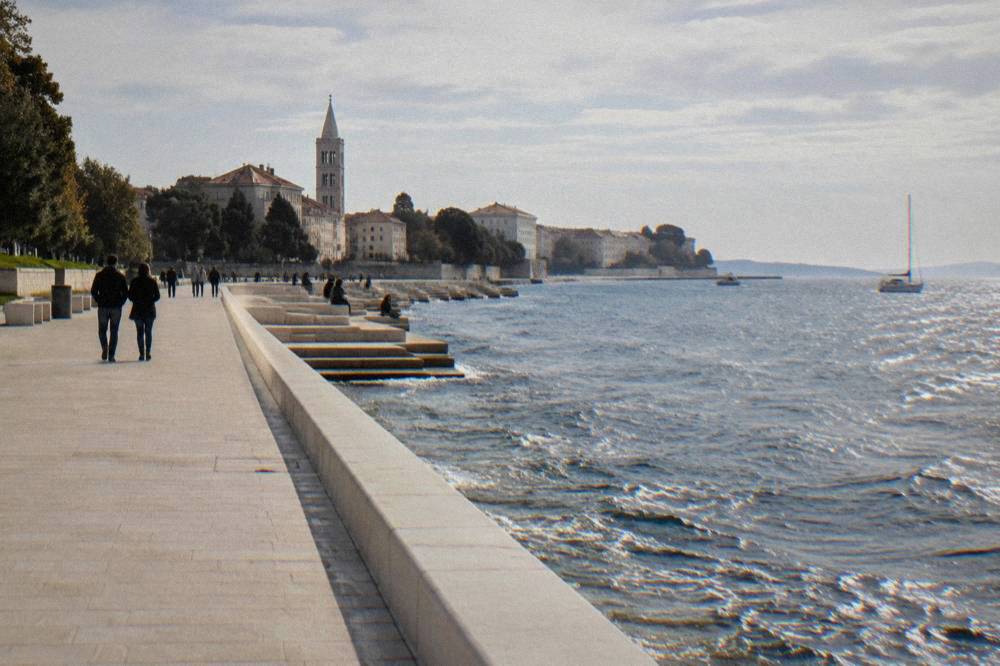
The Sea Organ sits at the northwestern tip of Zadar's Old Town peninsula (Poluotok), built into the stone steps of the Riva between the harbour point and the Greeting to the Sun circle, about a five-minute walk west of the People's Square and the Roman Forum; everything in the Old Town is on foot, and no vehicle is needed to reach it.
The Old Town occupies a narrow peninsula, and the organ is at the point where the Riva meets the open channel facing the islands of Ugljan and Pašman. From the Roman Forum, the walk west along the waterfront passes the Cathedral of St Anastasia and reaches the steps within minutes; the site's Roman Forum guide and Riva guide map the surrounding streets in detail. Cruise passengers arriving for a day can follow the cruise port day plan with the organ as its final stop.
Two practical notes for arrival. First, the city's bus station sits at Ante Starčevića 1, roughly 2.6 km by road from the Old Town per driving-distance data this site holds, and the airport shuttle from Zadar Airport terminates at the bus station before continuing toward the Old Town; the airport's own page gives the shuttle at 5.00 EUR one way including luggage, about 20 minutes, with the ticket valid 90 minutes on city buses. Second, drivers should not aim for the peninsula itself: the Old Town core is a pedestrian zone, and parking sits outside it, with the site's parking guide covering the zones.
| Nearby sight | Direction from the Sea Organ | Cost |
|---|---|---|
| Greeting to the Sun | Immediately beside the steps | Free |
| Roman Forum | East, short walk | Free public site |
| Cathedral of St Anastasia | East, short walk | Check locally for tower access |
| Church of St Donatus | East, beside the Forum | Around 7 EUR full price |
| Land Gate (Kopnena vrata) | Southeast, across the Old Town | Free public site |
One fresh caveat: the city has launched a public procurement for a full roof replacement at St Donatus, with works reported to be planned from autumn 2026 over about six months, so access may be limited and should be checked before a visit.
Is The Sea Organ In Zadar Free To Visit?
Yes, completely: the Sea Organ is a free public installation with no ticket, no opening hours and no closing time, and the same applies to the Greeting to the Sun beside it; both are open around the clock, and no official source attaches any fee, guided-audio charge or timed entry to either one, which makes them the most accessible sights in a city where several museums charge admission.
For contrast, the paid sights nearby run on published tariffs. The Museum of Ancient Glass lists 7.00 EUR for an adult ticket on its own price page, with 5.00 EUR for groups of five or more and 4.00 EUR for schoolchildren. The Archaeological Museum and St Donatus share the tariff noted above. The organ asks for nothing but a seat on the steps.
| Old Town sight | Admission | Source basis |
|---|---|---|
| Sea Organ | Free, open at all hours | City page, 2005, Nikola Bašić |
| Greeting to the Sun | Free, open at all hours | City page, 2008, Nikola Bašić |
| Roman Forum | Free public site | No official price page exists |
| Museum of Ancient Glass | 7.00 EUR adult | Museum ticket page |
| Archaeological Museum | Around 7 EUR full price | Museum tariff page |
The pattern is worth knowing when budgeting a day. The free layer of Zadar, the Forum, the Kalelarga, the Five Wells Square, the Land Gate of 1543, the Sea Organ and the Greeting to the Sun, is generous, and the one day in Zadar itinerary is built around it. The paid layer is the museums, and their prices are modest and published. The site's cost guide compares the two layers in detail.
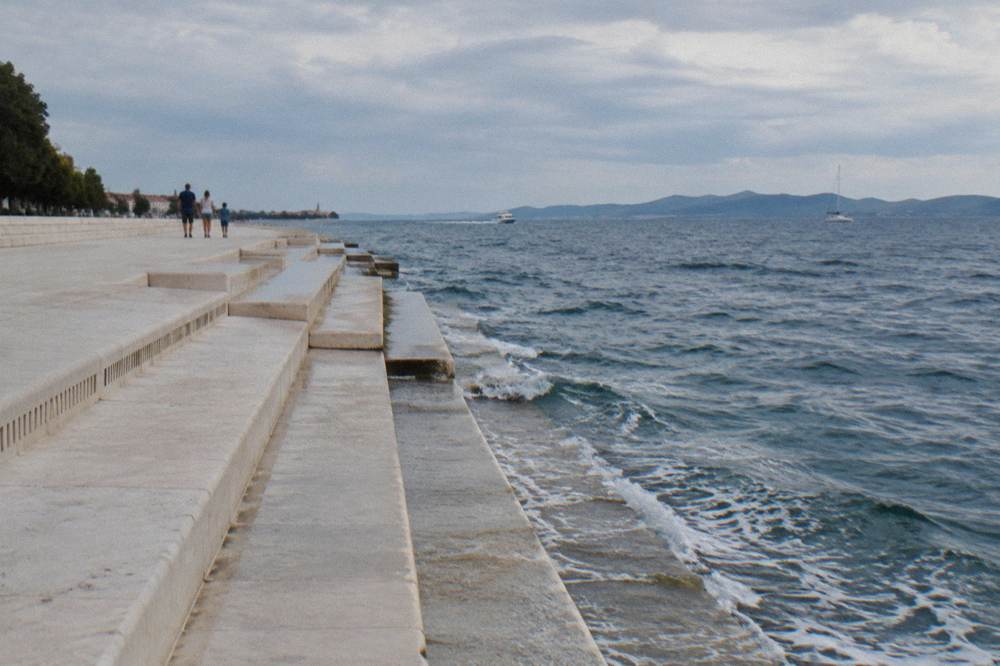
What Is Next To The Sea Organ: Greeting To The Sun And The Riva
Immediately beside the organ's steps lies the Greeting to the Sun, a circular solar-powered light installation by the same architect, Nikola Bašić, opened in 2008, which stores energy by day and glows in shifting patterns after dark; together the two works form a designed pair at the tip of the peninsula, the organ for the ears and the circle for the eyes, and both are free.
The Greeting to the Sun is a glass-and-solar disc set flush with the pavement, reported at about 22 metres across, a dimension that comes from secondary reporting rather than an official technical sheet. Its electronics were rebuilt in a reconstruction reported in April 2026, which suggests the display is maintained and current. The two installations bookend the sunset: the organ sounds as the light drops, and the circle begins to glow as the sky goes dark. Waiting for both is the single best free hour Zadar offers.
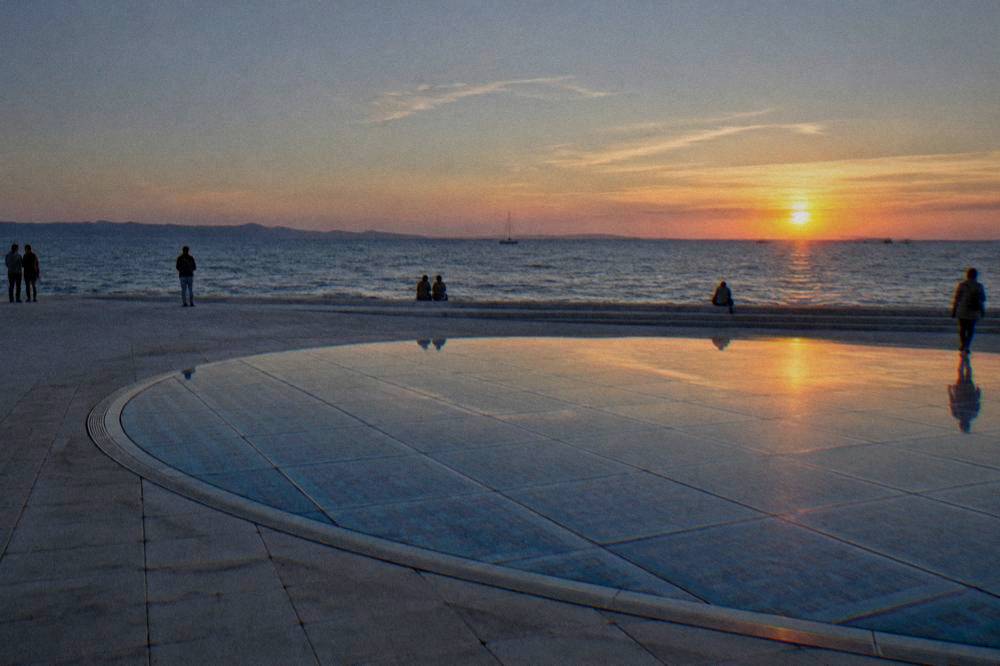
Behind the pair stretches the Riva itself, the waterfront promenade lined with palms and benches, which the Riva guide covers walk by walk. South and east of it, the Old Town opens up: the Greeting to the Sun page details the light installation, the Kalelarga page covers the main street, and the Five Wells Square and Land Gate pages complete the circuit. None of it needs a ticket.
A short detour north along the coast reaches Kolovare, the city's main beach, described in the Kolovare beach guide. Concession rules reported for 2026 say beaches in Zadar County cannot fence off access or charge entry, with commercial sunbed areas limited to a share of each beach; those rules are reported rather than independently verified by this site, so treat them as the current direction of policy rather than a guarantee.
Sea Organ Zadar: Tips For Listening And Photographing
Pick a day with wind or swell rather than a flat-calm one, sit low on the steps close to the water where the sounding holes are, and stay at least 30 minutes because the tones come in patterns; for photography, the hour around sunset gives the strongest composition with the islands on the horizon, and after dark the Greeting to the Sun provides a second, blue-glowing subject metres away.
The listening advice follows directly from the mechanism. The pipes respond to water entering the channels, so a listener standing at the top of the steps hears less than one sitting near the waterline, where the sound holes are. Wind direction matters: the bora from the northeast and the jugo from the south both drive water into the western Riva, while a flat anticyclonic morning can leave the organ almost mute. Checking the marine forecast before going is the practical move.
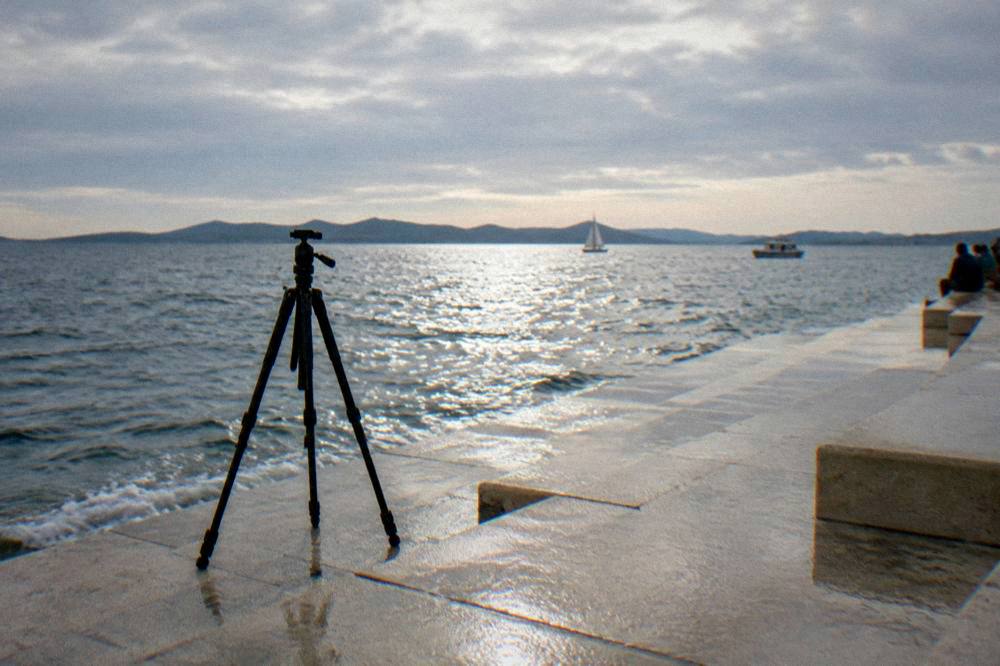
For photographers, the steps face west over the channel toward Ugljan and Pašman, which makes the spot a sunset lens by geography. The sun drops into the open water in front of the steps, silhouetting the islands, and the white stone reflects warm light late. After dark, the Greeting to the Sun circle shifts through coloured patterns, and long exposures from the steps capture both the glow and the harbour lights. No permit is needed; both installations are public space.
Two local rules reported for 2026 are worth knowing. Dress-code signs were installed at key access points to the historic core in summer 2026, asking for appropriate clothing with no swimwear or nudity, backed by fines reported up to 130 EUR; the seafront steps are not a beach, and the city has asked visitors to treat them that way. Separately, the municipality has signalled intent to restrict night-time retail alcohol sales in the Old Town, a national-law change reported in 2026; bars and restaurants are unaffected, and the rule's enforcement should be confirmed locally.
| Reported 2026 rule | What it means on the Riva |
|---|---|
| Dress-code signs in the historic core | No swimwear on the steps; fines reported up to 130 EUR |
| Night retail alcohol restriction (intent) | Shops in the Old Town affected; bars and restaurants not |
| Beach concession rules | No entry fees or fencing at public beaches; sunbeds limited to a share |
All three items are reported measures rather than texts this site has read, so they are stated softly and flagged for local confirmation.
How Does The Sea Organ Fit Into A Longer Zadar Stay?
The organ needs no more than an evening on its own, so the standard plan is to fold it into a first day: Old Town sights through the afternoon, the steps and the Greeting to the Sun at sunset, then dinner in the peninsula, and from day two onward use Zadar as the base for the island and park day trips that start here, including Ugljan and Dugi Otok offshore and Krka and Plitvice inland.
The two days in Zadar and three days in Zadar plans do exactly this, keeping the sunset hour free both days because no two evenings on the steps sound alike. Beyond the peninsula, the day-trip layer is where Zadar earns its base-city status.
| Day trip from Zadar | Driving distance from the Old Town | Park entry (adult, 2026) |
|---|---|---|
| Nin | 19.8 km | Historic town, no park fee quoted here |
| Paklenica National Park | 46.8 km | 5 EUR winter, 8 EUR shoulder, 10 EUR summer |
| Krka National Park | 91 km to Skradinski Buk | 7 / 20 / 40 EUR by season |
| Plitvice Lakes | 145 km | 10 / 23 / 40 EUR by season |
The park figures come from each park's own 2026 price list: Paklenica's official PDF gives 5 EUR in January, February, November and December, 8 EUR in March, April and October, and 10 EUR from May to September; Krka's 2026 tariff gives 7 EUR in the winter months, 20 EUR in April, May and October, and 40 EUR from June to September; Plitvice's list gives 10 EUR in January to March and November to December, 23 EUR in April, May and October, and 40 EUR in the June-to-September peak. Press reporting confirms both big parks dropped to their lower winter-shoulder rates from 1 October 2026.
For the water itself, the site's Krka guide and Plitvice guide compare the two parks, including the rule that swimming at Krka's Skradinski Buk has been banned since 2021, with swimming permitted only at designated spots such as Roški slap, Stinice and Pisak from 1 June to 30 September. Closer to home, the questions of whether you can swim in the sea in Zadar and how warm the sea is are answered on their own pages, with the caveat that only an official live reading exists for sea temperature.
Guided options cover both layers. For the sea, the listing for the luxury island boat tour with snorkeling and wine is the site's featured boat pick, and the operator's live listing carries current prices and times.
For the inland parks, the listing for the Plitvice guided day tour with tickets bundles transport with entry, and the operator's live listing shows what the current price covers.
What Events Happen Near The Sea Organ In Zadar?
The steps and the surrounding peninsula host the city's public events through the year, and the biggest is Zadar Advent, announced to run from 24 November 2026 to 2 January 2027 with an ice rink on the Forum and concerts across three locations, followed by the Zadar Christmas Run on 27 December 2026; in summer the Riva itself is the stage for open-air programmes, all within a short walk of the organ.
The 2026/27 Advent programme is the fresh item here. Local reporting and the city's events page give the run from 24 November 2026 to 2 January 2027, with the programme expanded to three locations including a new ice rink on the Forum, plus an opening concert at Trg Petra Zoranića on 24 November and further named concerts through early January. The Zadar Christmas Run on 27 December 2026 is listed on the city's events calendar. The 20th Festival tolerancije, a free-entry film and exhibition festival, ran at Kneževa palača and Providurova palača from 8 to 10 October 2026 and has now passed.
An off-season visit is quietly the better one for the organ specifically. The winter months bring the winds that drive the pipes hardest, the Advent programme lights the peninsula, and the parks are at their cheapest entry tiers. The trade is the weather: the DHMZ record shows November as the wettest month (123 mm) and January as the coldest (7.3 C mean), against July's 24.5 C. The site's best time to visit Zadar page weighs the whole year.
For anyone building a full plan, the things to do in Zadar page collects the whole roster, and the guided walk below remains the simplest way to hear the organ with context, local tastings included.
Common Questions About The Sea Organ In Zadar
Is the Sea Organ in Zadar free?
Yes. It is a free public installation with no ticket, no gate and no opening hours, and the Greeting to the Sun beside it is the same. Both are open at all hours.
When was the Sea Organ built?
The city's official page gives 2005 as the year the Sea Organ opened, designed by architect Nikola Bašić. The Greeting to the Sun beside it followed in 2008.
How does the Sea Organ work?
Waves push air through pipes built under the stone steps, and the escaping air produces low harmonic tones through sounding holes in the steps. The sea and the wind are the only power source; there is no electricity and no performer.
When can you hear the Sea Organ?
Whenever there is a swell. Calm summer mornings can leave it nearly silent, while windier weather from autumn through spring drives louder, more continuous tones. Sunset is the classic time to sit and listen.
Where is the Sea Organ located?
At the northwestern tip of Zadar's Old Town peninsula, built into the stone steps of the Riva, a few minutes' walk west of the Roman Forum and beside the Greeting to the Sun.
Can you swim at the Sea Organ steps?
The steps are a listening spot on the working waterfront, not a beach, and dress-code signage installed in 2026 asks for appropriate clothing in the historic core. City beaches such as Kolovare sit a short walk north along the coast.
The Sea Organ costs nothing, closes for nothing and plays for no one in particular, which is precisely why it works: the sea decides the programme, and every evening on the steps is a different piece.