How Does The Zadar Sea Organ Work?
The Zadar Sea Organ turns Adriatic waves into sound through pipes built into the Riva steps. How it works, when to hear it best, and what it costs to visit.
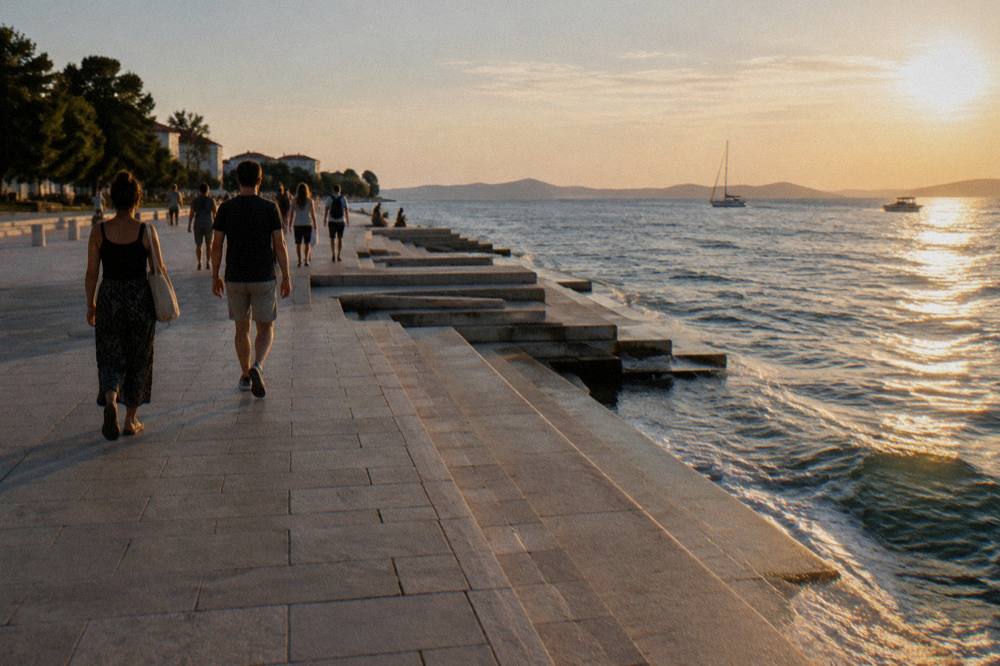
Zadar, a coastal city in Dalmatia on Croatia's Adriatic shore, is home to one of the strangest musical instruments anywhere in Europe. Set into the marble steps of the Riva, the city's seafront promenade, the Sea Organ (Morske orgulje) plays notes that nobody performs. The waves of the Adriatic push air through a hidden system of polyethylene pipes and laboratory resonators, and the result is a low, shifting chord that rises and falls with the swell. The city's own pages confirm the essentials: the installation is the work of architect Nikola Bašić, it opened in 2005, and it sits beside a second Bašić work, the Greeting to the Sun, a solar-powered light circle from 2008.
This page explains what the Sea Organ actually is, how the wave-and-pipe mechanism produces its sound, where the idea came from, and how to plan a visit: when the organ is at its clearest, what it costs, and how it fits into an evening on the peninsula. The full attraction profile, including the surrounding Riva stretch, sits on the Sea Organ attraction page.
How Does The Zadar Sea Organ Work?
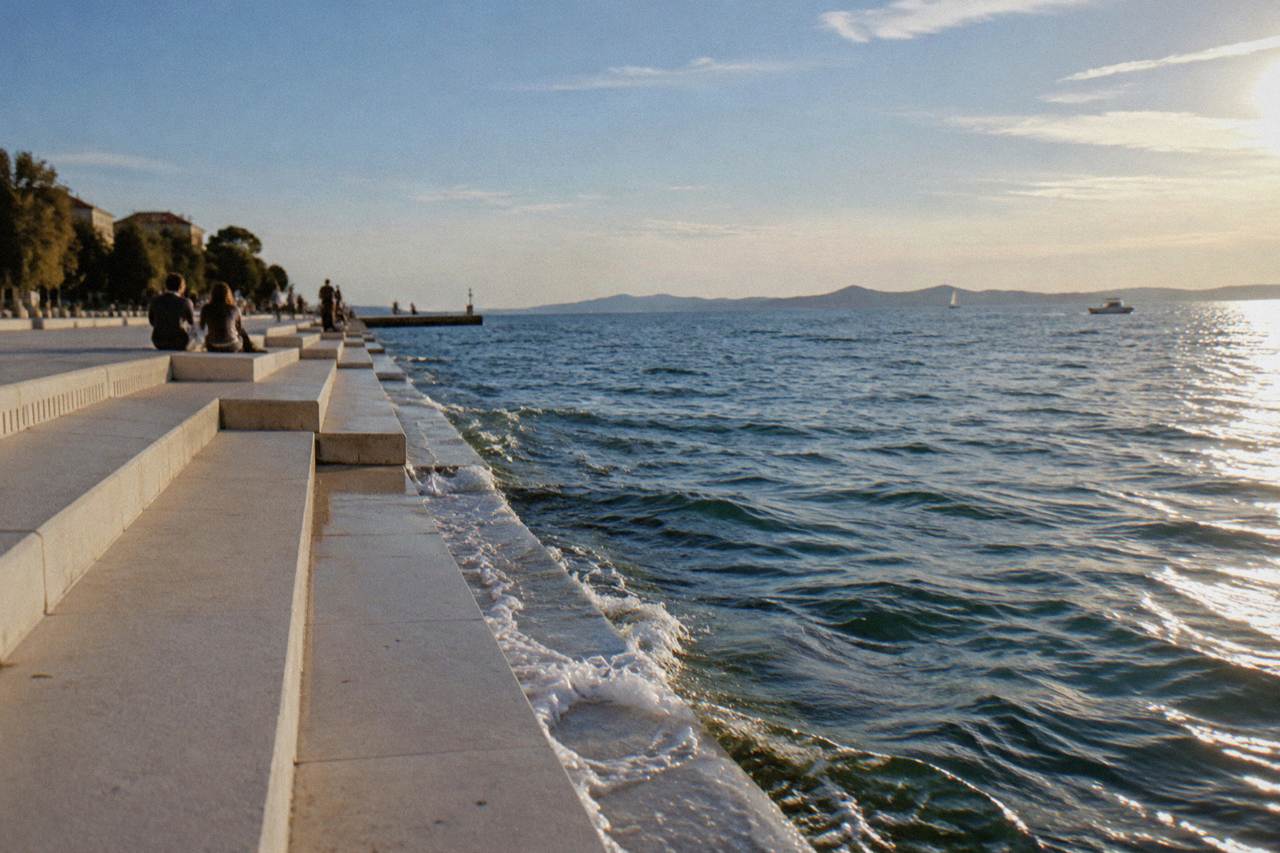
The Zadar Sea Organ works by channeling wave motion into compressed air: as seawater enters chambers under the white marble steps of the Riva, it pushes air ahead of it up through a series of tuned pipes, each fitted with a resonator, and the escaping air sounds a note, so that the constant motion of the Adriatic plays a slow, irregular chord through openings in the steps. No performer, no power supply and no speaker are involved. The instrument is played entirely by the sea.
The mechanism sits inside the stepped sea wall that runs along the northwest edge of the peninsula, roughly parallel to the cruise-berth side of the Old Town. Each sounding channel follows the same principle as a bottle blown across the mouth, or the labial pipes of a church organ: air is forced across a sharp lip, and the column of air inside a tube of a given length vibrates at a frequency fixed by that length. Longer, wider tubes sound deeper notes; shorter, narrower tubes sound higher ones. The pipework is distributed so that as different sections of step are flooded and drained at different moments, different notes enter and leave the texture.
The tuning is deliberately loose rather than melodic. The pipes are organized so that simultaneous notes sit in consonant relationships, close to a chord rather than to a scale, which means the organ never produces a tune that could be hummed afterwards. What a listener hears is closer to a drone: a cluster of low tones whose volume follows the energy of the water, thinned to almost nothing on a flat sea and swelling after wind or passing boat wakes. Boat traffic matters more than visitors expect, since the wake of a ferry leaving the nearby port can run the whole sequence from silence to full chord and back within a minute or two.
The scale of the installation is usually reported at about 70 metres of steps carrying 35 sounding pipes, with the pipes angled at varying degrees so that each responds to a slightly different water level. Those two figures come from secondary reporting rather than from the city's own pages, so treat them as approximate; the city confirms the architect, the year and the location, and the engineering detail comes from coverage of the project. The material face of the instrument is the stone itself: white marble steps that double as a public sitting place, which is why the organ is audible and inhabited at every hour of the day.
Who Built The Zadar Sea Organ And Why?
The Sea Organ was designed by Croatian architect Nikola Bašić and opened on Zadar's Riva in 2005, as part of a redesign of the seafront promenade that replaced an older concrete embankment with white stone steps, and Bašić's idea was to let the sea itself complete the reconstruction with sound.
The context matters. The reconstruction of the waterfront produced a long, hard concrete embankment that turned its back on the water. When the Riva was eventually rebuilt as a promenade, Bašić's office proposed treating the new sea defence not as a wall but as an instrument, embedding the pipe system into the steps so the boundary between city and sea would make the sea audible. The neighbouring Greeting to the Sun, a 22-metre circle of solar-charged glass plates set into the pavement and completed in 2008, extends the same idea into light: it stores energy from the day and returns it after dark as a shifting pattern of LEDs. The diameter figure and the solar mechanism are reported details rather than city-page facts, and no start time for the evening display is published; the display simply follows the sun.
Bašić is a Zadar-based architect, and the two works are treated locally as a pair, a sound organ and a light organ facing the same stretch of water. Together they anchor the northwest tip of the peninsula, a few minutes' walk from the Roman Forum and the Church of St Donatus. The sequence of Old Town sights leading to them is covered in the guide to what Zadar is famous for.
A guided walk is the natural way to hear the instrument with context attached, because the guides who work the peninsula explain the pipe system while standing on top of it. The related tour on this site, a highlights walk with local tastings, routes through the Old Town and finishes along the Riva; the listing shows the current price, meeting point and availability, and Check availability covers it directly.
When Can You Hear The Sea Organ Best?
The Sea Organ plays at all hours, every day, because it is a permanent public structure with no ticket, no gate and no schedule: it sounds whenever there is wave energy against the steps, so the best listening conditions are simply any period of stronger swell, typically after bora or jugo winds, after ferry movements, or on breezy afternoons, and never on a mirror-flat sea. Sunset is the popular hour for reasons of light rather than sound, since the sun sets directly across the channel in front of the steps.
Winds shape the experience more than the calendar. The bora, a cold, gusty northeast wind, and the jugo, a warm, humid southerly, both agitate the water in front of the Riva and drive more air through the pipes; a flat, still morning in high summer can leave the organ almost silent. Boat wakes are the reliable backup: the port lies within earshot, and scheduled departures send a low surge across the steps at intervals through the day. Listeners who want the loudest, clearest demonstration should pick a day with visible chop and sit low on the steps, close to a sounding channel.
Weather-wise, the city's station record, Zadar station, 1961-2024 (DHMZ), shows July as the driest month at 35.4 mm of rain and November as the wettest at 123 mm, with July also the warmest at a mean of 24.5 C. Summer evenings therefore offer the most dependable dry listening weather, while autumn and winter storms offer the more dramatic performances. The surrounding sea temperature is published only as an official live reading, so swimmers should check the current value rather than assume; the question of whether the sea is warm in Zadar is answered separately with that reading in mind.
| Listening condition | Effect on the Sea Organ |
|---|---|
| Flat, windless sea | Near silence, occasional faint tones from boat wakes |
| Light afternoon breeze | Soft, intermittent notes, most common summer state |
| After a bora or jugo wind | Full chord, rising and falling with the swell |
| Ferry or boat wake | Short, clearly audible surge through the pipes |
| Storm swell | Loudest sustained sound, unsafe to sit on the lowest steps |
What Does It Cost To Visit The Sea Organ?
The Sea Organ costs nothing to visit: it is a free, open public installation embedded in the Riva steps, accessible at all hours with no ticket, no queue and no booking, and the neighbouring Greeting to the Sun light circle is equally free, so an evening spent between the two is one of the least expensive experiences on the entire Dalmatian coast. The city's pages list neither an entrance nor an opening time because neither exists.
The only costs that attach to a visit are the optional ones around it: a drink on the Riva, a guided walk, or a boat trip that shows the organ's stretch of coast from the water. Zadar does levy a tourist tax collected through accommodation, and its amount is confirmed at booking rather than published on this site. Everything else on the peninsula within a few minutes' walk, the Roman Forum, Five Wells Square, Kalelarga and the Land Gate of 1543, is likewise free public space. Visitors weighing the city against its larger neighbour can start from the comparison in is Zadar nicer than Split, while those budgeting a whole stay will find the timing question covered under how many days in Zadar is enough.
Is The Sea Organ The Same As The Greeting To The Sun?
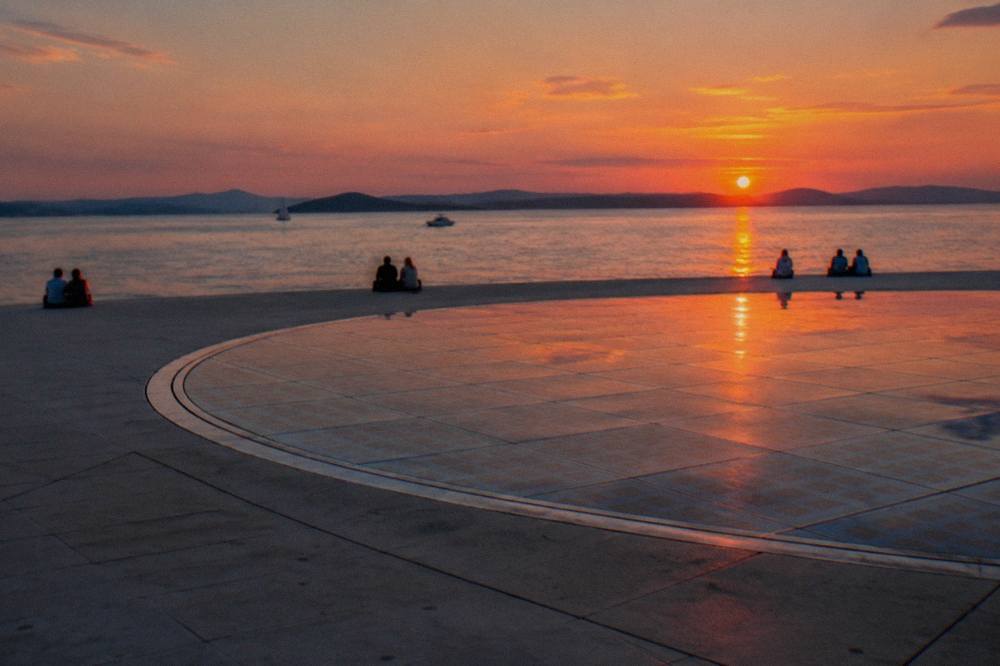
No: the Sea Organ and the Greeting to the Sun are two separate installations by the same architect, Nikola Bašić, standing a short distance apart on the same stretch of Zadar waterfront, with the Sea Organ producing sound through wave-driven pipes from 2005 and the Greeting to the Sun producing light through a solar-charged glass circle from 2008, and although they are usually visited together they work on entirely different principles. One converts water motion into air pressure; the other converts daylight into an evening light display.
The Greeting to the Sun is a circular plate of multi-layer glass set flush into the promenade pavement, above photovoltaic cells that charge through the day. After dark the circle plays a programmed sequence of coloured light. No start time is published, because the trigger is the falling light itself rather than a clock; on bright days the display runs longer on a fuller charge. The installation underwent an electronics reconstruction in April 2026, reported in local coverage, and no closure or restriction followed it.
The pairing is deliberate. Where the organ answers the sea with sound, the circle answers the sun with light, and the two frame the northwest corner of the peninsula that faces the open channel, the direction Zadar's sunsets come from. The claim that the city has a famously beautiful sunset belongs to that geography rather than to any instrument, and the full profile of the second installation is covered in the site's attraction pages. Readers planning to swim before sunset should note that the nearest beaches sit off the peninsula, and the practicalities are handled under can you swim in the sea in Zadar.
Where Exactly Is The Sea Organ And How Do You Reach It?
The Sea Organ lies on the northwest edge of Zadar's Old Town peninsula, set into the stone steps of the Riva between the cruise-berth end of the promenade and the point where the waterfront turns toward the Forum, roughly a five-minute walk from the People's Square and the centre of the peninsula, on ground that is entirely pedestrian. There is no address to aim for because the instrument is the sea wall itself.
Arriving from outside the Old Town, the peninsula is car-free at its core, so the walk in from the bus station area or from parking on the edge of the centre is part of the visit. From the airport, the airport's own pages put the airport about 8 km from the city, and the Liburnija shuttle runs to the bus station with a ticket that stays valid on city buses for 90 minutes; the transfer details are set out in the guide on getting from Zadar airport to the city centre. Cruise passengers have the shortest walk of all, since the berth sits a few hundred metres along the same waterfront.
The organ is also a common turnaround point for evening walks, and it sits directly on the route the sunset crowds take. On the lowest steps, spray can reach listeners when the sea is rough, so the driest seats are one or two rows up. The steps are wide, stone and unsheltered, which makes them hot at midday in summer and exposed in the bora season; the dress-code signs posted at the peninsula's access points since summer 2026, requiring clothing rather than swimwear and carrying fines of up to 130 EUR, apply to the Old Town streets behind, and coverage attributes the figures to the city's announcements.
| Fact about the installation | Detail |
|---|---|
| Architect | Nikola Bašić |
| Year opened | 2005 |
| Reported length | About 70 m of steps (reported figure) |
| Reported pipes | 35 tuned pipes (reported figure) |
| Admission | Free, open at all hours |
| Neighbouring work | Greeting to the Sun, 2008, solar-powered |
Common Questions About The Zadar Sea Organ
How does the Zadar Sea Organ work?
Waves entering chambers under the marble steps of the Riva push air through a system of tuned pipes and resonators, and the escaping air sounds low notes whose pitch depends on the length of each pipe. The sea itself is the only performer, and no power supply or mechanism drives the sound.
Does the Zadar Sea Organ play all the time?
The organ is physically capable of sounding at every hour because it is a permanent structure in the sea wall, but its volume depends entirely on wave energy. On a flat, still day it can fall almost silent, while wind, swell and boat wakes bring out the full chord.
How much does it cost to visit the Sea Organ?
Nothing. It is a free, open public installation with no ticket, no gate and no opening hours, and the neighbouring Greeting to the Sun is equally free.
Who designed the Zadar Sea Organ?
Croatian architect Nikola Bašić, whose design was part of the reconstruction of the Riva promenade. Bašić also designed the adjacent Greeting to the Sun, opened in 2008.
When is the best time to hear the Sea Organ?
Any period of stronger swell: after bora or jugo winds, on breezy afternoons, or just after ferry movements send wakes across the steps. Sunset is the popular hour for the view rather than the volume.
Is the Sea Organ the same as the Greeting to the Sun?
No. The Sea Organ produces sound through wave-driven pipes and opened in 2005; the Greeting to the Sun is a solar-powered circle of glass plates that produces light after dark and opened in 2008. Both are by Nikola Bašić and stand a short distance apart on the same waterfront.
The instrument asks nothing of its audience: no ticket to buy, no schedule to keep, no platform to book through. It asks only for waves, and the Adriatic supplies those on its own. For everything else on the peninsula, from the Roman Forum to the restaurants a street behind the steps, the site's coverage continues across its attraction and answer pages, and a planning pass through the Zadar Croatia Travel Guide homepage will point the way.