What Is Zadar, Croatia Famous For?
Zadar, on Croatia's Dalmatian coast, is famous for the Sea Organ, the Greeting to the Sun, its Roman and Venetian Old Town, the Riva sunset and its island and national park day trips.
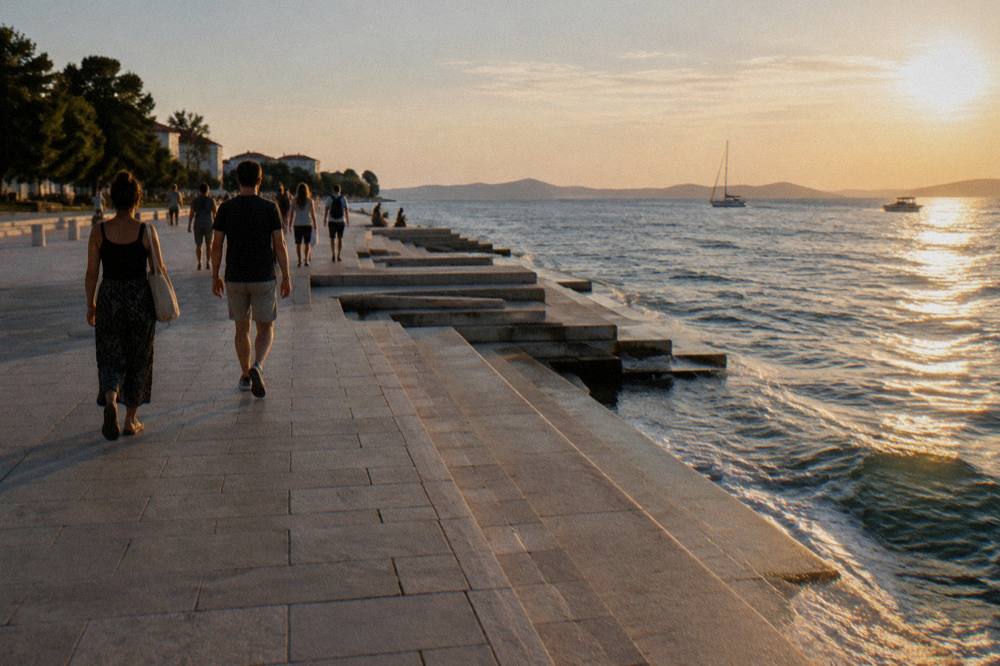
Zadar is a coastal city in Dalmatia, Croatia, on the Adriatic Sea, and it is famous for a waterfront that plays music: the Sea Organ, an installation by the architect Nikola Bašić completed in 2005, turns the movement of the waves into sound through pipes set into the quay. Beside it sits the Greeting to the Sun, Bašić's solar-powered light installation from 2008. The city's Old Town occupies a narrow peninsula, and offshore lie the islands of Ugljan and Dugi Otok, with the national parks of Krka, Plitvice, Kornati and Paklenica all reachable on a day trip. That combination, a compact historic core, a famous sunset and a launch pad for islands and parks, is what the city is known for.
The city's own tourist board pages describe the Sea Organ and the Greeting to the Sun together as the signature waterfront experience, and they are the two things the name Zadar most often calls to mind. The Old Town around them layers a Roman Forum, a pre-Romanesque church and Venetian fortifications into a space you can walk end to end in under an hour. This page sets out each of the things the city is famous for, with verified dates, prices where they are published, and links into the site's deeper guides.
What Is Zadar, Croatia Famous For?
Zadar is famous for five things above all: the Sea Organ and the Greeting to the Sun on its quay, the Roman Forum and the church of St Donatus in its Old Town, the sunsets over the Adriatic from the Riva promenade, maraschino cherry liqueur, and its position as the departure point for the islands of Ugljan and Dugi Otok and the national parks of Krka, Plitvice, Kornati and Paklenica. The city's defensive walls are also part of a UNESCO World Heritage listing, inscribed in 2017 as one component of a serial property of Venetian fortifications shared between Croatia, Italy and Montenegro.
That last point is often misread. Zadar's walls are one of six components of the UNESCO property of Venetian defensive works, inscribed in 2017. The Old Town as a whole is not a World Heritage Site, and the city does not market itself that way. The Land Gate, built in 1543 to a design attributed to Michele Sanmicheli, is the most visible piece of that fortification legacy and stands at the neck of the peninsula.
The table below gives the quick reference, with the verified date or figure attached to each item.
| What Zadar Is Famous For | The Detail | Verified Figure Or Date |
|---|---|---|
| Sea Organ | Wave-driven sound installation by Nikola Bašić | 2005 |
| Greeting to the Sun | Solar-powered light installation beside the Sea Organ | 2008 |
| Land Gate | Venetian gate by Michele Sanmicheli | 1543 |
| UNESCO listing | Zadar's walls, one of six components | 2017 |
| Old Town setting | Historic core on the Poluotok peninsula | Free public space |
| Day-trip platform | Islands and four national parks in reach | Distances below |
The Sea Organ And The Greeting To The Sun
The Sea Organ is a set of pipes built into Zadar's waterfront steps in 2005 that the waves themselves push air through, producing low tones that change with the sea state, and the Greeting to the Sun is a 22-metre circle of solar panels and glass laid into the pavement beside it in 2008 that stores energy by day and plays a light pattern after dark. Both were designed by the architect Nikola Bašić, both are free, and both are open at all hours as public installations on the quay.
The Sea Organ runs for roughly 70 metres along the steps, with 35 pipes tuned to a musical scale, and it is silent only when the sea is completely flat. The city's tourist board credits the installation with transforming a stretch of concrete waterfront rebuilt after the Second World War into the city's signature attraction. The Greeting to the Sun sits a short walk away; its electronic system underwent a reconstruction in April 2026, after which no further works have been reported. No start time for the light pattern is published on an official page, so plan to be on the quay around sunset and let the light arrive on its own schedule.
The site has a full guide to how the Sea Organ works and a deeper page on the Sea Organ itself, alongside the Greeting to the Sun guide. A guided walk is the efficient way to take both in with their context: the Old Town, Sea Organ and tastings walk covers the installations and the historic core with local tastings included, and Check availability shows the operator's live listing.
The Old Town Peninsula: Roman Forum, St Donatus And The Walls
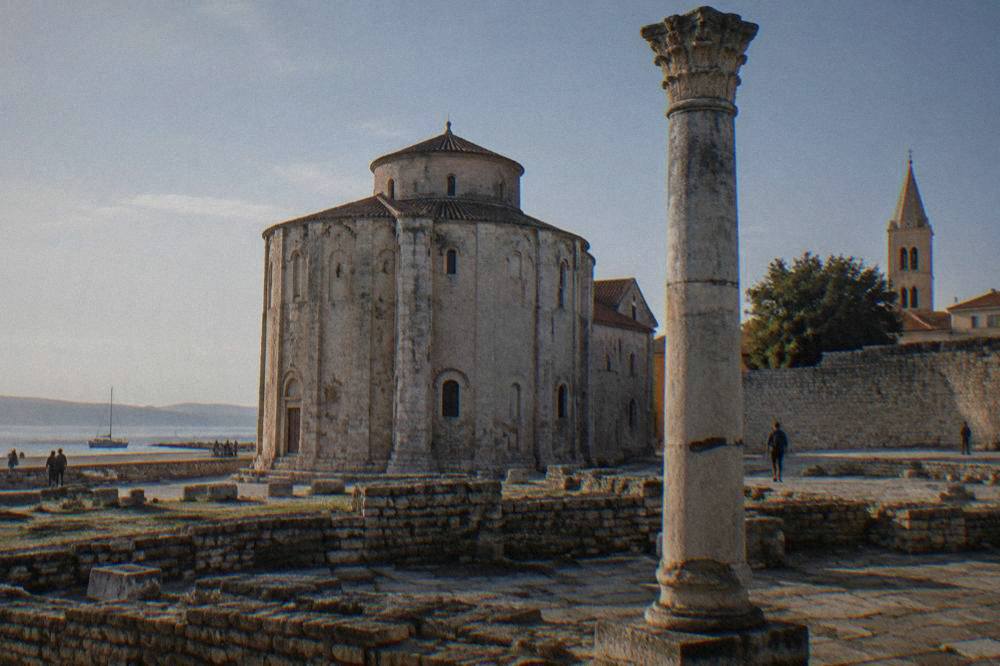
Zadar's Old Town sits on the Poluotok peninsula and is famous for the Roman Forum laid out beside the sea, the pre-Romanesque church of St Donatus from the early medieval period, the cathedral of St Anastasia, the Land Gate of 1543, and the street of Kalelarga, all within a space of a few hundred metres that is closed to through traffic and free to wander. The Archaeological Museum and St Donatus run on a shared tariff of around 7 EUR at full price, with reduced rows at 5 EUR.
The Forum is the open ruin at the heart of it, a public space with no ticket and no fence. St Donatus stands beside it as the city's most recognisable building, and it faces a restoration: a public tender for a full roof replacement, estimated at about 1.3 million euros, was launched at the end of August 2026, with works planned from autumn 2026 over roughly six months as the first phase of a wider two-year restoration. During the works, group visits are suspended and individual access depends on the phase, so check locally before counting on going inside. The Land Gate and the walls carry the UNESCO connection described above, and the Five Wells Square and People's Square complete the circuit.
The Old Town also has rules of its own that arrived in 2026. Signs posted at the entrance points in July 2026 ask for appropriate clothing, with no swimwear or nudity, on the basis of the existing communal order decision, and reports say fines can run up to 130 EUR after a warning. A restriction on night-time retail alcohol sales in the Old Town was discussed for the 2026 season under a national law change; the bars and restaurants are not affected, and the rule's current status is worth confirming locally. The site's Old Town guide and the answer to whether the Old Town is worth visiting go deeper.
The Sunset On The Riva
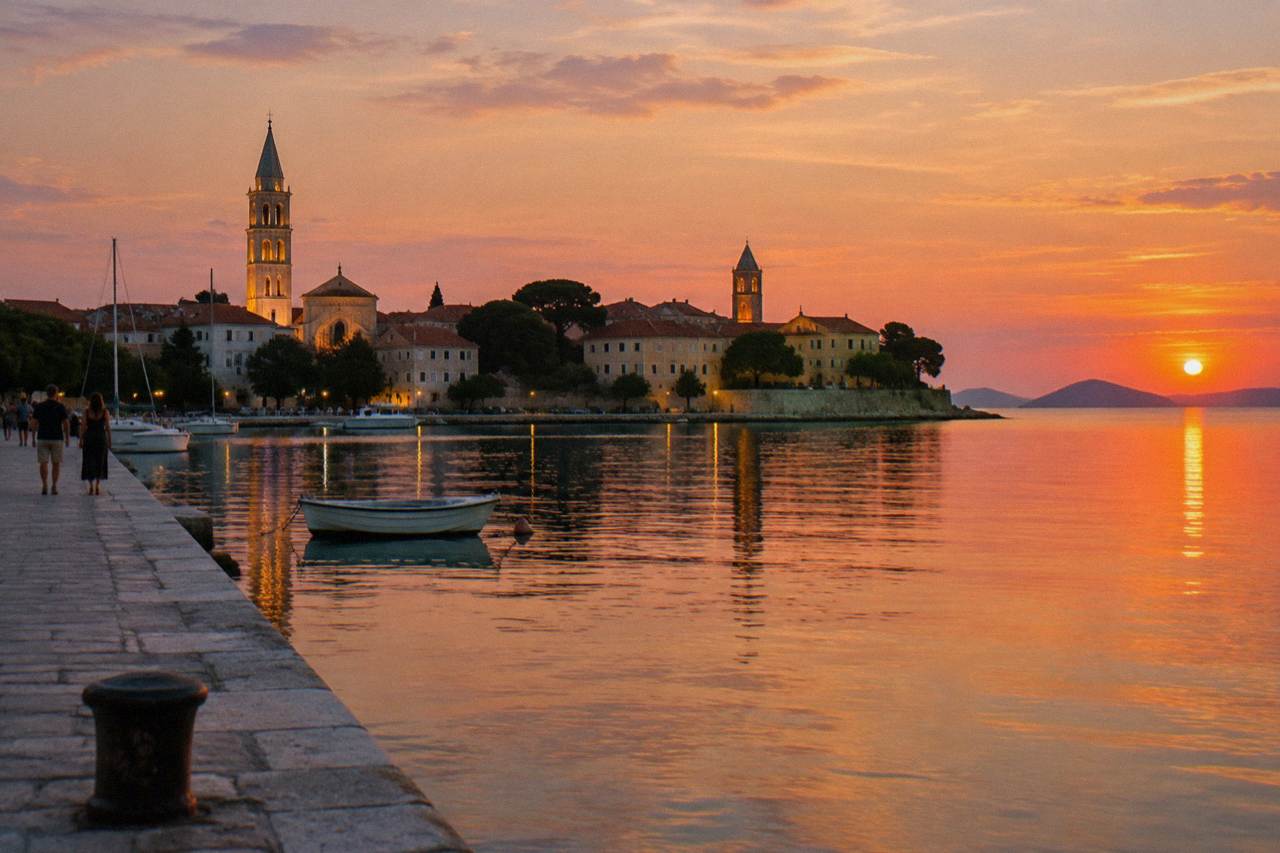
The Riva is the tree-lined seaside promenade on the western edge of the peninsula, and Zadar's sunset over the Adriatic is famous enough that the city puts it at the centre of its own marketing, with the Sea Organ providing the soundtrack and the Greeting to the Sun providing the light show, all free and all a few steps from the Old Town's cafés. No ticket, no timetable: the show runs every evening the sky is clear.
What is documented is the climate behind the evenings. The DHMZ station table for Zadar, covering the period 1961-2024, records 358.6 hours of sunshine in July and 324.7 in August, part of an annual total of about 2,600 hours, and July's mean temperature of 24.5 C with just 5 rain days makes it the settled heart of the season. The site's sunset and evening route plots the walk.
Islands And National Parks Within A Day Trip
Zadar is famous as a base because four national parks and a string of islands sit within day-trip range of its ferry port at Gaženica: Krka's waterfalls 91 km away by road, Plitvice Lakes 145 km, Paklenica's gorges 46.8 km, the Kornati archipelago by boat, and the islands of Ugljan and Dugi Otok directly across the water, with Ugljan's Preko reached by a crossing of roughly 25 to 30 minutes. Jadrolinija's route page shows the Dugi Otok ferry, line 434 to Brbinj, running one hour and forty minutes.
The park entry fees are published and seasonal. Krka charges 7 EUR in the winter months, 20 EUR in the shoulder season and 40 EUR from June to September for an adult at all accessible land sites; Plitvice charges 10, 23 and 40 EUR on the same pattern, with a reduced late-afternoon price of 25 EUR in summer. Both parks dropped to their winter-shoulder rates on 1 October 2026. Paklenica runs 5, 8 and 10 EUR by season, and Kornati is different again: it is charged per vessel by length and season, and the ticket is bought outside the park. One rule matters at Krka: swimming at Skradinski Buk has been banned since 2021, and swimming is allowed only at the designated spots of Roški slap, Stinice and Pisak between 1 June and 30 September.
| Day Trip From Zadar | Distance By Road | Adult Entry, In Season |
|---|---|---|
| Nin | 19.8 km | Free historic town |
| Paklenica National Park | 46.8 km | 10 EUR (May-Sep) |
| Pag Town | 54 km | Free island town |
| Krka (Skradinski Buk) | 91 km | 40 EUR (Jun-Sep) |
| Plitvice Lakes | 145 km | 40 EUR (Jun-Sep) |
| Ugljan (Preko, by ferry) | By sea, about 25-30 min | No park fee |
Distances come from route calculations for driving from the Old Town. Boat tours to the Kornati islands and Telašćica run from the city harbour through the season, and the site's day trips guide and the comparison of Plitvice versus Krka help with choosing between them. Tip-based free walks also run locally; confirm arrangements directly with the guide.
Maraschino, Museums And The Rest Of The Reputation
Zadar is also famous for maraschino, the cherry liqueur distilled in the city from local marasca cherries and historically exported across Europe's royal courts, for the Museum of Ancient Glass with its live glassblowing demonstrations, and for the archaeological collection around the Forum, with the museum's ticket page listing 7.00 EUR for an adult, 5.00 EUR for groups of five or more and 4.00 EUR for schoolchildren. Guided tours of the glass museum run at 20 EUR in Croatian or 30 EUR in other languages for a group of about thirty.
Maraschino is the city's oldest export claim, though this site prints no founding century and no superlative about the city's age; the answer page on whether Zadar is Croatia's oldest city handles that question carefully. Beyond the museums, the city's calendar is increasingly part of its pull: Zadar Advent runs from 24 November 2026 to 2 January 2027, expanding to three locations including a new ice rink on the Forum, and the Zadar Christmas Run is scheduled for 27 December 2026.
For planning around all of this, the site's pages on how many days in Zadar is enough and the best time to visit cover the trade-offs. More of the site's coverage sits at Zadar Croatia Travel Guide.
Common Questions About What Zadar Is Famous For
What is Zadar, Croatia famous for?
Zadar is famous for the Sea Organ and the Greeting to the Sun on its waterfront, the Roman Forum and St Donatus in its Old Town, the Adriatic sunset from the Riva, maraschino liqueur, and its ferry and road links to islands such as Ugljan and Dugi Otok and national parks including Krka, Plitvice, Kornati and Paklenica.
Are the Sea Organ and the Greeting to the Sun free?
Yes. Both are free, open public installations by Nikola Bašić, open at all hours. The Sea Organ dates from 2005 and the Greeting to the Sun from 2008, and no official page publishes a start time for the light pattern.
Is Zadar Old Town a UNESCO World Heritage Site?
No. Zadar's defensive works are one of six components of the UNESCO property of Venetian defensive works, inscribed in 2017. The Old Town as a whole is not inscribed.
Can you swim at the Krka waterfalls on a Zadar day trip?
Not at Skradinski Buk. Swimming there has been banned since 2021 to protect the travertine formations, and it is allowed only at designated spots, Roški slap, Stinice and Pisak, between 1 June and 30 September, weather and water conditions permitting.
What food and drink is Zadar known for?
Maraschino, the cherry liqueur made from marasca cherries, is the signature local product. The city's food scene centres on Dalmatian seafood, ham, cheese and olive oil; the site's food guides cover restaurants and where to taste maraschino.
Do you need a car in Zadar?
Not for the city itself: the Old Town is a compact pedestrian peninsula. A car or an organised tour helps for the park day trips, though boat tours to Kornati and the islands depart from the city harbour and the ferry port at Gaženica handles the island routes.
That is the full picture of the city's reputation: a waterfront that sounds and lights itself, a peninsula of Roman and Venetian stone, a sunset the city has built its identity around, and a hinterland of islands and parks that keeps visitors here longer than they planned.