Zadar Sunset
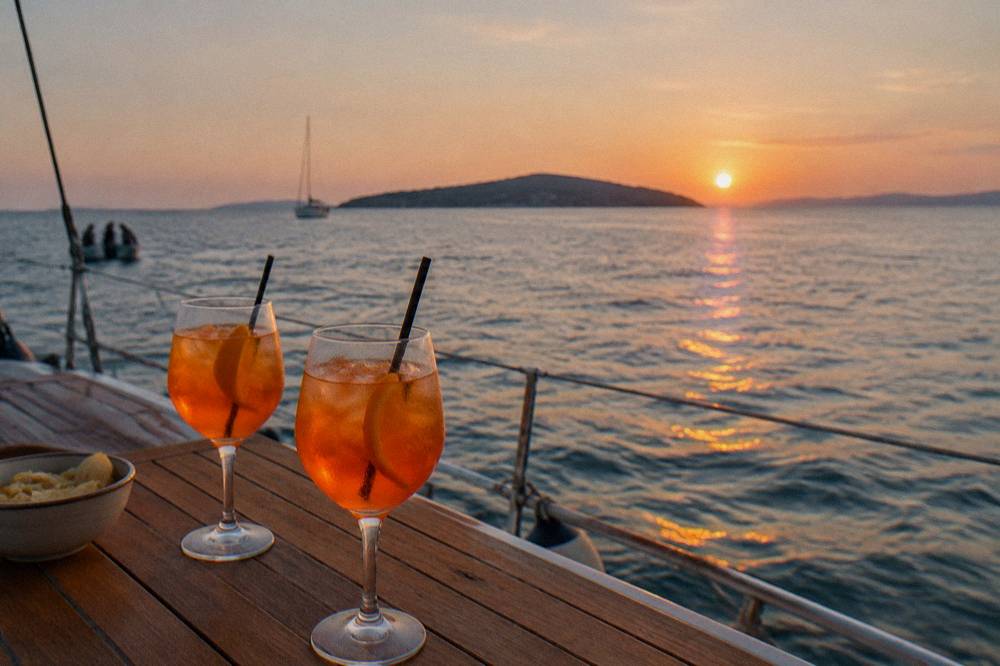
Zadar, on Croatia's Dalmatian coast, is a city whose evening show is free and runs every night: the sun drops into the Adriatic west of the peninsula while the Sea Organ plays underneath it. This route walks the whole sequence, from golden hour on the Riva to the last light on the Greeting to the Sun, with food, drink and backup plans included.
Short answer
Start on the Riva about an hour before the sun reaches the horizon, sit on the Sea Organ steps while the light turns, then move to the Greeting to the Sun as darkness falls. Both installations are free and open at all hours. Confirm the exact sunset time for your date in a live sun calendar, since it shifts through the year.
The evening sequence on Zadar's western edge is the one thing every guide to this Dalmatian city agrees on, and it costs nothing. The Old Town sits on a narrow peninsula, its western shore open to the Adriatic with no land between the Riva and the horizon, so the sun goes down over open water. The installations that frame it, the Sea Organ and the Greeting to the Sun, are documented public works by the architect Nikola Bašić, both are free, and both are open at all hours.
This route is built for one evening on foot. It assumes you are starting inside or near the Old Town, and it works in every season, because the show does not close for winter. It also lists what to do when the sky is grey, since the Zadar station climate record, 1961-2024, shows November as the wettest month of the year.
What Time Is Sunset In Zadar, And When Is The Sky At Its Best?
The sun sets over open water to the west of Zadar every evening of the year, and the exact clock time shifts so much between seasons that no single printed time is reliable: check a live sun calendar for your date before you go. What the weather-station record does fix is the character of each season. Zadar station, 1961-2024, shows July as the driest month at 35.4 mm of rain and only five rain days, and November as the wettest at 123 mm across twelve rain days.
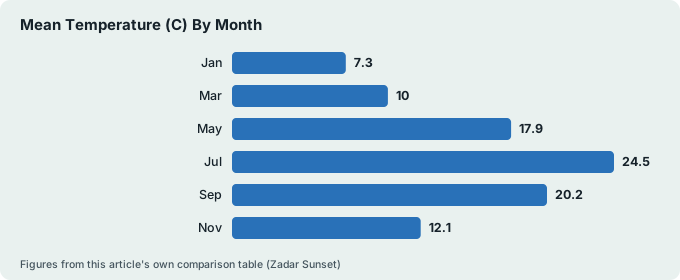
The station record, published by the Croatian Meteorological and Hydrological Service for the Zadar station over the period 1961-2024, gives the monthly averages that decide how your evening will feel. July is the warmest month at a 24.5 C mean, January the coldest at 7.3 C, and the city logs about 2,600 hours of sunshine a year. July alone averages 358.6 sunshine hours, December just 106.8, so the summer sky is far more dependable, but the winter light comes with its own advantage: crowds thin out and the Riva becomes a local promenade again.
| Month | Mean temperature (C) | Rainfall (mm) | Rain days |
|---|---|---|---|
| Jan | 7.3 | 76.4 | 10 |
| Mar | 10.0 | 66.3 | 9 |
| May | 17.9 | 64.4 | 10 |
| Jul | 24.5 | 35.4 | 5 |
| Sep | 20.2 | 110.9 | 9 |
| Nov | 12.1 | 123.0 | 12 |
Wind matters as much as rain on this coast. The bora, a cold, dry north-easterly, blows hardest in winter and can make the western Riva feel raw an hour before sunset, while the warmer southerly jugo brings humid, hazy air that softens the light. Neither is a reason to skip the evening; both are reasons to bring a layer outside of midsummer. A live weather forecast on the day beats any monthly table for the actual sky.
Where To Watch The Sunset In Zadar: The Riva And The Sea Organ Steps
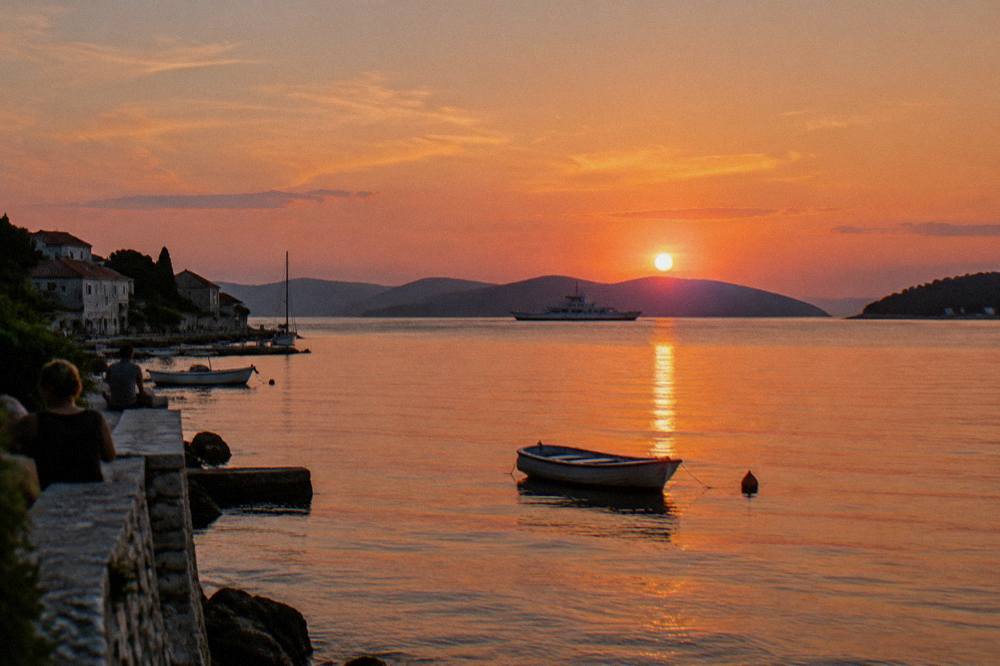
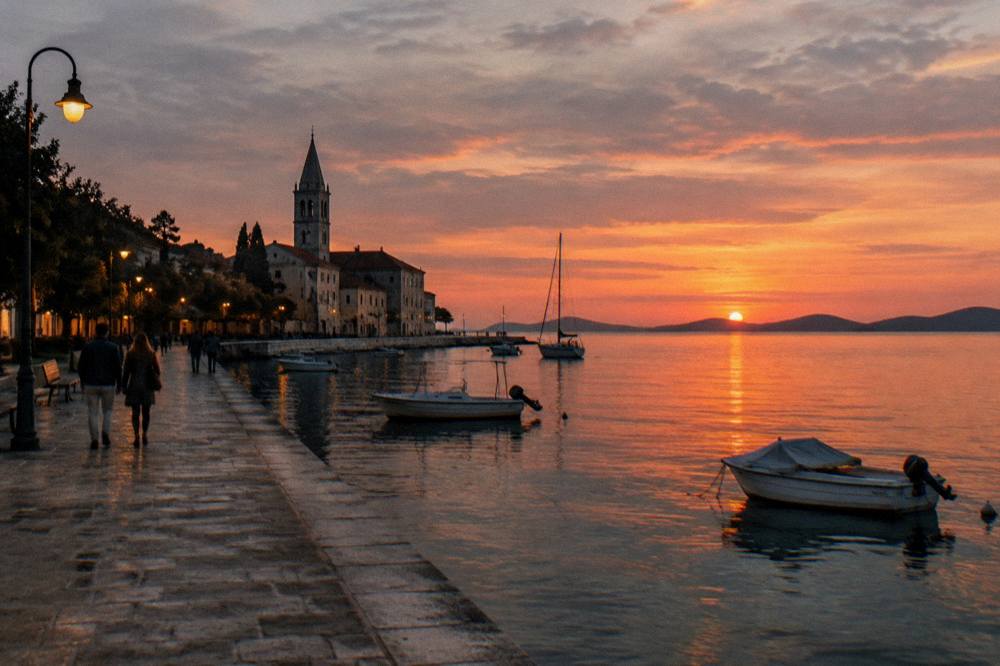
The Riva, the waterfront promenade on the Old Town's western shore, is the primary sunset viewpoint in Zadar, and the Sea Organ steps at its north-western end are the classic place to sit: a free, wave-driven sound installation by Nikola Bašić, opened in 2005, with steps that run down to the water directly facing the setting sun. The installation is open at all hours, costs nothing, and needs nothing but waves and wind to play.
The Sea Organ works on a simple physical principle. Underneath the stepped stone edge, a system of tubes and pipes, reported at about 70 metres of Organ length and 35 pipes, converts the movement of the waves into low, breathy tones that push up through openings in the steps. The sound is never the same twice, because the sea writes the score. On a calm evening it is a murmur; when the bora or jugo has been pushing water around, it grows noticeably louder. Arriving early, while the sun is still a hand's width above the horizon, lets you hear the shift as the wind typically eases toward evening.
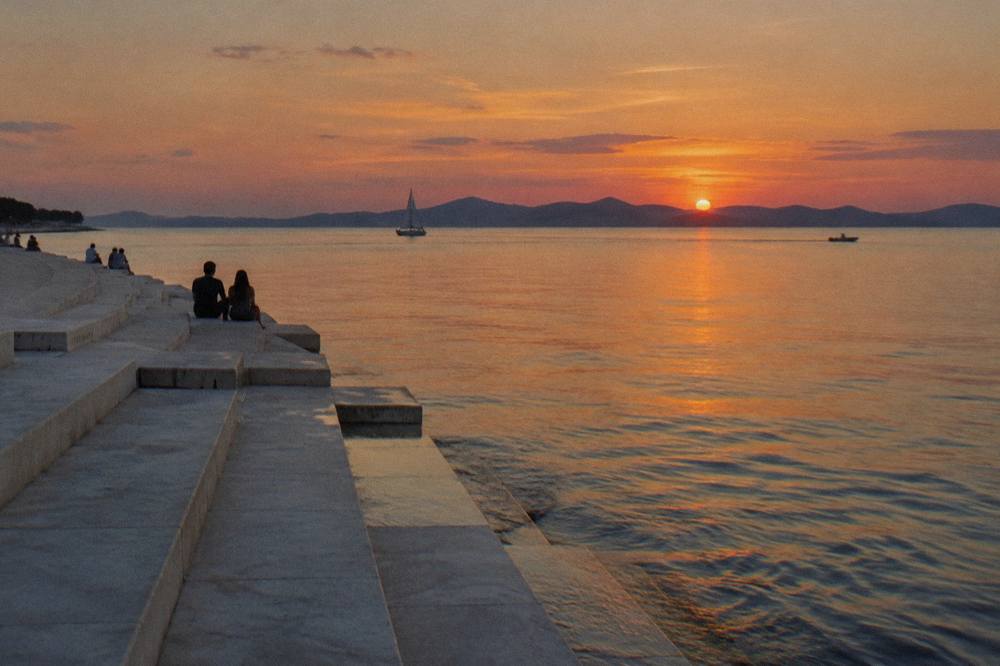
The practical geometry of the peninsula is on your side. Because the Old Town faces open water with no islands directly west, the horizon is clean from almost the whole western promenade, and you can shift a few hundred metres north or south along the Riva without losing the view. The steps nearest the Organ fill first on summer evenings; the stretch toward the ferry-side end is usually quieter and gives the same sky.
For travellers who want the sequence compressed, a tuk-tuk ride covers the city's viewpoints before the light peaks, and a 90-minute tuk-tuk ride with views and stories can be slotted in ahead of the walk down to the water.
If you would rather be out on the water for the drop itself, the operators below run evening departures from the city harbour, which put the peninsula behind the boat and the open sea in front.
What Happens At The Greeting To The Sun After Dark?
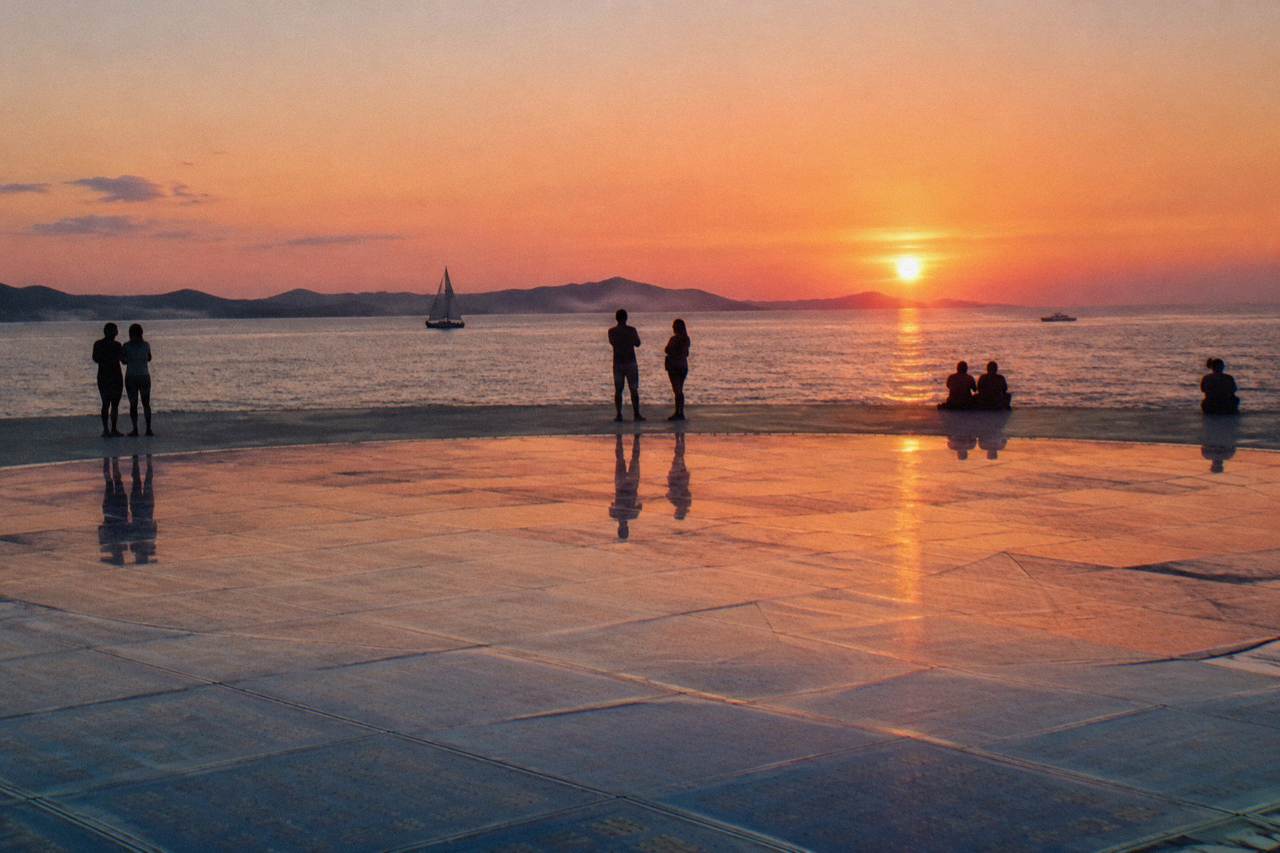
The Greeting to the Sun, a circular solar-powered light installation by Nikola Bašić opened in 2008 beside the Sea Organ, is the second half of the evening: a glass-paved disc, reported at about 22 metres across, that stores energy during the day and produces a patterned light display after dark. It is free, open at all hours, and its cycle follows the sun rather than a published schedule, so no start time is printed here.
The two works were designed as a pair. The Sea Organ translates the sea into sound; the Greeting to the Sun translates the day into light. Its photovoltaic cells charge through daylight hours, and once the sky is properly dark, the surface plays through shifting light patterns. The installation underwent a reconstruction of its electronic system in April 2026, according to local press reports, so the display is running on refreshed hardware going into this winter.
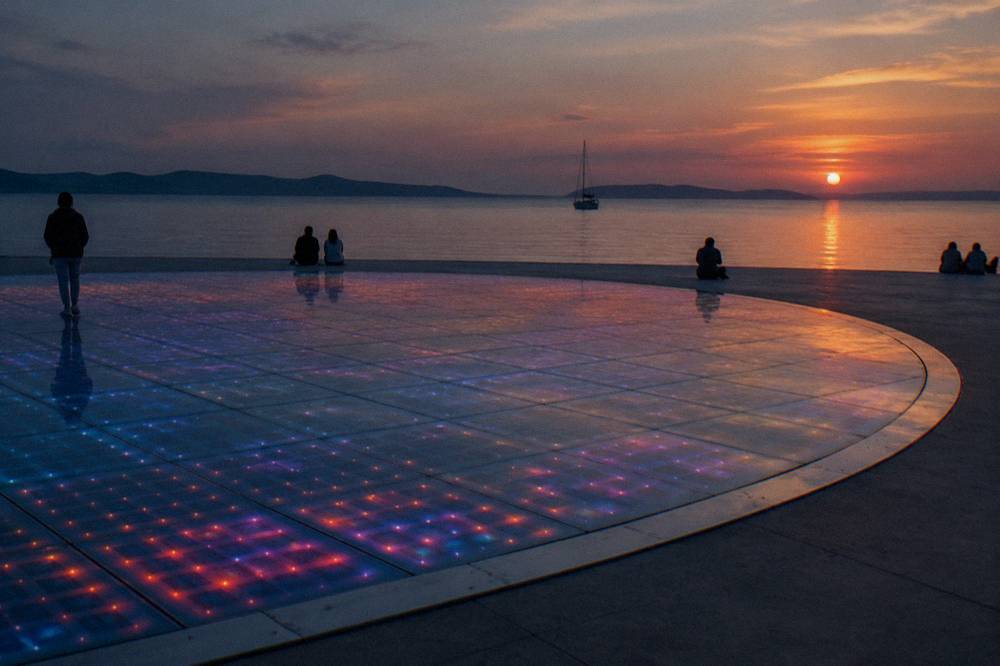
The sequencing for the evening is simple. Stay on the Sea Organ steps while the sun touches the horizon, then walk the couple of minutes south to the Greeting to the Sun as the afterglow fades, and you catch the light display as it becomes visible in the darkening sky. There is no fence, no ticket and no queue; the installation is level with the promenade and you walk straight onto it, though standing rather than sitting on the glass surface is the respectful norm. Crowds are thickest in July and August; from October through spring, the circle is often shared with only a handful of other people.
A guided walk that ends at both installations gives the sequence with commentary attached, and the Zadar sunset walking options include tastings alongside the Old Town and Sea Organ stops.
What Is The Best Evening Walking Route Through Zadar Old Town?
A two-hour evening route that works in any season runs: People's Square for an early drink, Kalelarga westward as the light softens, the Roman Forum and the Cathedral of St Anastasia as golden hour peaks, the Land Gate for a look back at the walls, then out to the Riva, the Sea Organ steps for the sunset itself, and the Greeting to the Sun for the light display after dark. Every stop except any drink you buy is free and open air.
Work backwards from the sun. If sunset is at eight, be on Kalelarga by seven and at the Forum by half past. The route below keeps the walking segments short, because the peninsula is compact, and it front-loads the stone streets while the light is still workable, saving the open water for the finale.
| Order | Stop | What You Get At This Hour |
|---|---|---|
| 1 | People's Square | Cafes and lamplit stone squares, early-evening atmosphere |
| 2 | Kalelarga | The main street in low golden light, shopfronts still open |
| 3 | Roman Forum | Open excavated ruins, free public access, warm stone colour |
| 4 | Cathedral of St Anastasia | The exterior in golden hour; climb details are not published officially, confirm locally |
| 5 | Land Gate (1543) | The Venetian gate by Michele Sanmicheli, quietest at dusk |
| 6 | Riva and Sea Organ steps | The sunset itself over open water, free |
| 7 | Greeting to the Sun | The light display as darkness settles, free |
Two notes on accuracy. The Cathedral of St Anastasia's bell tower is a known viewpoint, but its climb price and hours are not published on an official page, so confirm locally before counting on it. And the Church of St Donatus, the circular pre-Romanesque landmark beside the Forum, is entering a roof restoration: local reporting from autumn 2026 says works are planned over roughly six months as the first phase of a longer restoration, with group visits suspended and individual access dependent on the phase, so check its status rather than assuming entry.
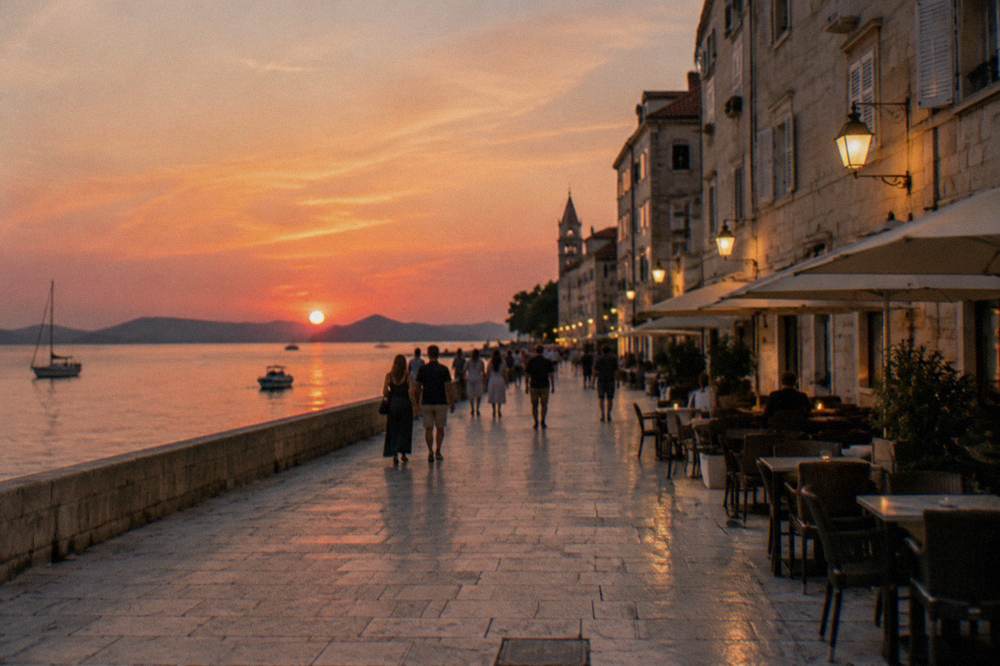
Zadar is one of six components of the UNESCO property of Venetian defensive works of the Stato da Terra and Stato da Mar, inscribed in 2017, and the Land Gate and walls you pass on this route are part of that defensive system, so the walk doubles as a tour of the listing even though the Old Town as a whole is not a World Heritage Site. If one evening is all you have, the fuller one day in Zadar itinerary covers the same ground in daylight.
Where Should You Watch The Sunset From The Water Instead Of The Riva?
Zadar's boat and kayak operators run evening departures that reframe the sunset: a kayak puts you a few metres off the Riva at water level, while a boat tour takes you out beyond the harbour so the whole peninsula silhouettes against the western sky. Prices, ratings and durations render from the listings themselves, so check the live listing for each product rather than any figure quoted secondhand.
The transparent LED kayak option is built for exactly this hour. The boats light up from below as dusk falls, which turns the trip into a floating night-light once the sun is down, and it departs from the city waterfront rather than requiring a transfer.
For a calmer, drier version of the same idea, a short sunset cruise with a glass in hand covers the harbour and the peninsula from the seaward side.
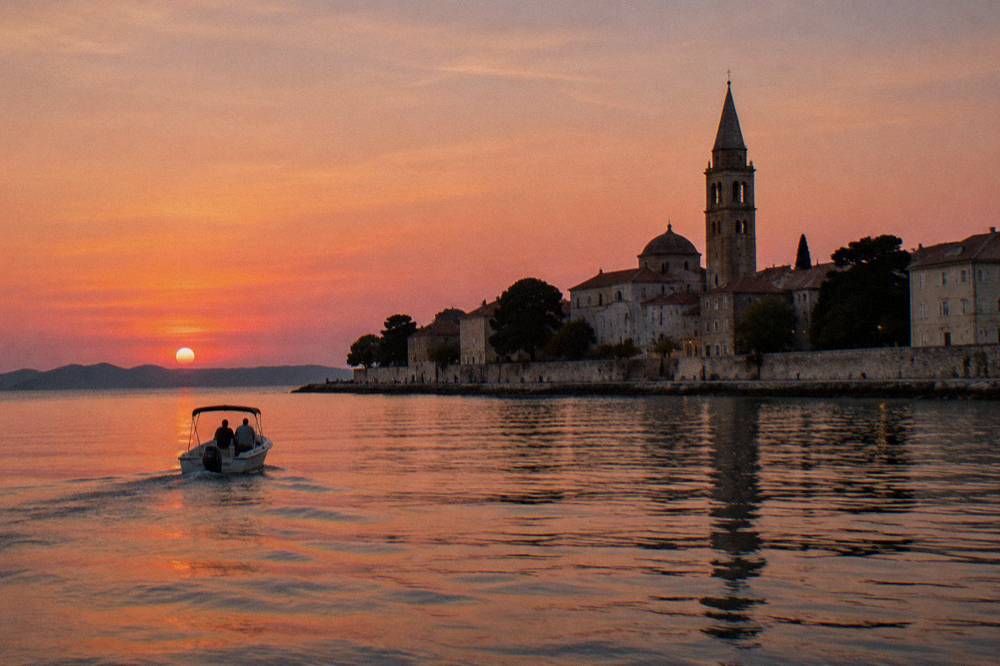
The choice between land and water comes down to wind and ambition. On a bora evening the water off the peninsula is choppy and the Riva is the better seat. On a calm July or August evening, when the station record shows the driest, most dependable skies of the year, being out on the water is the stronger version of the show. Whichever you choose, book ahead in peak season, since evening departures are the ones that sell out first, and note that operators run reduced schedules from late autumn through early spring.
Where To Eat And Drink After The Zadar Sunset?
After the light display, the evening continues inside the Old Town: the area around People's Square and Kalelarga holds the densest run of konobas, wine bars and cafes within a five-minute walk of the Greeting to the Sun, and the Peninsula's restaurant kitchens stay open into the late evening through the tourist season. Maraschino, the local cherry liqueur, is the traditional Zadar nightcap and appears on most bar lists.
Dinner timing on this route is a deliberate choice. Eating before the sunset means committing to a table by 6 pm in midsummer, which fights the whole point of the evening; eating after means kitchens near the water are winding down by the time you leave the Greeting to the Sun. The local compromise is a drink first at a square-side bar, then dinner at a konoba one or two streets inside the Peninsula, then a final walk down to the water to see whether the Sea Organ is still audible.
| Evening stop | Neighbourhood | What It Suits |
|---|---|---|
| Square-side cafe | People's Square | A drink under the lamps before dinner |
| Konoba (tavern) | Kalelarga side streets | Fish and grill, the classic Dalmatian dinner |
| Wine bar | Around the Five Wells Square end | Local Pošip and Plavac Mali by the glass |
| Riva cafe | The promenade itself | One last look at the dark water |
| Late bar | Peninsula lanes | Drinks into the night in season |
Food tours that walk the Old Town with tastings are a daytime-to-evening alternative if you want the eating curated rather than chosen; the Old Town food and wine walks pair the history with the plates. One rule to respect while planning the bar run: signage installed in summer 2026 asks for appropriate clothing in the historic core, with swimwear explicitly out and fines reported up to 130 EUR after a warning, so come back from the beach changed.
Can You Chase The Sunset Beyond The City: Islands And Day Trips?
Yes, and the strongest option is west and north: Dugi Otok and the islands beyond it put you on beaches that face the open Adriatic, with the sunset behind you only if you sit on the east coast, so choose the shore deliberately. The practical versions are a full-day boat trip out of Zadar that returns in the evening, or a ferry across to Ugljan using the regular Jadrolinija crossing of roughly 25 to 30 minutes to Preko.
The Sakarun beach route is the one to look at closely. It combines the lagoon beach on Dugi Otok with a shipwreck stop and a tunnel, and it runs from Zadar as a boat day, which means the return leg often carries the late-afternoon light across the channel.
Krka National Park is the other classic full-day trip out of Zadar, and its Skradin end in particular makes a soft evening finale: the boat ride up the Krka river to Skradinski Buk runs through gorge light that turns gold late in the day. Swimming at Skradinski Buk itself has been banned since 2021 to protect the travertine, with swimming only at designated spots such as Roški slap, Stinice and Pisak between 1 June and 30 September, so plan the water time accordingly. The full park background is in the Krka National Park guide.
What If The Evening Sky Turns Grey In Zadar?
A grey or rainy evening in Zadar is a museum and bar evening, not a lost one: the Museum of Ancient Glass charges 7.00 EUR for an adult ticket, the Archaeological Museum and St Donatus run on a shared tariff around 7 EUR at full price, and the Old Town's cafes and wine bars carry the night after that. The station record says September through November are the wettest stretch of the year, so this backup plan earns its keep.
The Museum of Ancient Glass's own ticket page lists 7.00 EUR adult entry, 5.00 EUR for groups of five or more and 4.00 for schoolchildren, with guided tours at 20 EUR in Croatian or 30 EUR in other languages; its opening hours conflict between sources, so check the museum's hours page before going. The Archaeological Museum tariff page shows 7.00 and 5.00 EUR rows, free for children up to 10. Both museums sit within a few minutes' walk of the Riva, which means a rain-safety plan can still end at the Sea Organ, since the steps are as free in drizzle as in clear skies and the organ actually plays better with more wave.
| Condition | First move | Backup |
|---|---|---|
| Clear sky, calm sea | Sea Organ steps, on time | Greeting to the Sun, then dinner |
| Clear sky, bora wind | A sheltered Riva cafe with glass front | Move between bar and water in bursts |
| Overcast, dry | Do the walking route anyway; the light is soft | Museums before dark |
| Rain | Museum of Ancient Glass | Wine bar; Sea Organ between showers |
| Storm | Stay off the water and the Riva edge | Full rainy-day itinerary |
The fuller wet-weather plan, with museum detail and indoor options, is the Zadar rainy day itinerary. Cruise passengers with only an evening ashore have a dedicated Zadar cruise port day route that compresses this same sequence to the waterfront core.
Common Questions About Zadar Sunsets
What time is sunset in Zadar?
The clock time shifts through the year, so check a live sun calendar for your exact date. The weather-station record fixes the likelihood of a clear sky instead: Zadar station, 1961-2024, shows July as the driest month with five rain days, and November as the wettest with twelve.
Do the Sea Organ and Greeting to the Sun cost anything?
No. Both are free, open public installations by Nikola Bašić, open at all hours. The Sea Organ opened in 2005 and the Greeting to the Sun in 2008.
What time does the Greeting to the Sun light show start?
No start time is published. The installation is solar powered and its display follows the sun, becoming visible as the sky darkens after sunset.
Where is the best place to watch the sunset in Zadar?
The Sea Organ steps at the north-western end of the Riva are the classic spot, facing open water with nothing between you and the horizon. The whole western promenade shares the same view if the steps are full.
Can you watch the sunset from a boat in Zadar?
Yes. Evening boat and kayak departures run from the city harbour in season, including transparent LED kayaks that stay lit after dark. Check the live listing for each departure, since winter schedules are reduced.
Is the Zadar sunset worth it in winter?
The sky is less dependable, with November the wettest month at 123 mm of rain in the station record, but the installations are free, the crowds are gone, and the Greeting to the Sun lights regardless of temperature. Bring a layer for the bora.
The whole route, from People's Square to the last light on the Greeting to the Sun, costs nothing but the dinner and works in every month of the year, which is exactly why the Zadar Croatia Travel Guide keeps it as the default first evening in the city. Check the sky, check a live sunset time for your date, and walk west.