Zadar Rainy Day
Rain in Zadar does not shut the city down. This itinerary pairs the indoor museums whose prices are on official tariff pages with the covered squares, café streets and food walks that carry a grey afternoon, and it says plainly which numbers are verified and which you must confirm on arrival.
Short answer
Spend a rainy Zadar day indoors at the Museum of Ancient Glass (7.00 EUR adult), the Archaeological Museum and St Donatus (around 7 EUR full price), then eat and drink through the Old Town on a guided food walk. The Sea Organ and Greeting to the Sun stay free and open in any weather.
Rain reaches Zadar in measurable, predictable amounts, and the city's own weather record says exactly when. The Zadar station, 1961-2024 (DHMZ), counts November as the wettest month at 123.0 mm and July as the driest at 35.4 mm, with September and October close behind November at 110.9 mm and 106.8 mm. In other words, the months when many travellers are already here are also the months when a wet day is likeliest. The good news sits in the geography: Zadar's Old Town is a compact peninsula where the museums, the Roman Forum, the arcaded squares and the café streets sit within a short walk of each other, so a downpour costs minutes, not hours. This itinerary from the Zadar Croatia Travel Guide editorial desk lays out a full day that works in rain, names the verified prices, and flags the figures no official source confirms.
What Does Rain In Zadar Actually Look Like?
Rain in Zadar is frequent but rarely extreme: the Zadar station, 1961-2024, records between 5 and 12 rain days a month, peaking in November and December at 12 each, with July lowest at 5, so a rainy day is a scheduling problem, not a washout. Total annual precipitation sums to 912.5 mm, spread across the year rather than concentrated in a single storm season.
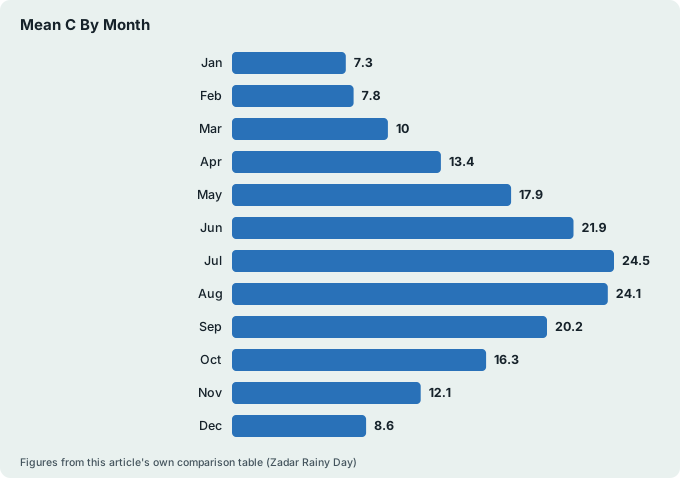
The DHMZ table for the Zadar station gives rain days per month as 10, 9, 9, 10, 10, 8, 5, 6, 9, 9, 12, 12 from January to December. That pattern matters for planning. Summer rain is rare and brief; autumn rain is more sustained. The record high of 39.0 C was set on 6 August 2022 and the record low of -9.1 C in January 1963, but those are extremes, not the norm. Mean temperatures run from 7.3 C in January to 24.5 C in July, which means a rainy day in October is a mild, walkable affair rather than an ordeal.
The winds deserve a sentence because they change how rain feels. The bora, a cold, dry, gusty north-easterly, mostly belongs to winter, while the jugo, a warm, humid south-easterly, often arrives with grey, drizzly skies. Neither needs a number attached; knowing the name simply helps when a local mentions the wind instead of the forecast.
| Month | Mean C | Rainfall mm | Rain days |
|---|---|---|---|
| Jan | 7.3 | 76.4 | 10 |
| Feb | 7.8 | 67.0 | 9 |
| Mar | 10.0 | 66.3 | 9 |
| Apr | 13.4 | 61.4 | 10 |
| May | 17.9 | 64.4 | 10 |
| Jun | 21.9 | 48.5 | 8 |
| Jul | 24.5 | 35.4 | 5 |
| Aug | 24.1 | 52.8 | 6 |
| Sep | 20.2 | 110.9 | 9 |
| Oct | 16.3 | 106.8 | 9 |
| Nov | 12.1 | 123.0 | 12 |
| Dec | 8.6 | 99.6 | 12 |
Source for every figure: Zadar station, 1961-2024, DHMZ. Sunshine across the year totals about 2,600 hours, so a rainy day here is bracketed, statistically, by bright ones. For the fuller climate picture, see the site's Zadar weather guide siblings elsewhere, or better, the practical pages already written for this: if you are deciding when to come at all, the one-day Zadar itinerary assumes sun, and this page assumes the opposite.
Which Zadar Museums Are Worth A Wet Morning?
The Museum of Ancient Glass charges 7.00 EUR for an adult ticket on its published price list, with 5.00 EUR for groups of five or more and 4.00 EUR for schoolchildren, while the Archaeological Museum and St Donatus run on a shared tariff with a 7.00 EUR full-price row and a 5.00 EUR row, free for children up to 10. Together they fill a rainy morning without leaving the peninsula.
The Museum of Ancient Glass is the anchor stop. Its ticket page lists the 7.00 EUR adult price, the group and schoolchild reductions, free entry for preschoolers, and guided tours at 20 EUR in Croatian or 30 EUR in other languages for a group of about 30. Glassblowing demonstrations and Roman glassware are the substance of the visit, and both are fully indoors.
The Archaeological Museum complex includes St Donatus Church next to the Roman Forum. The tariff page shows 7,00 and 5,00 EUR rows and free entry for children up to 10 and on Museum Night days. One caveat belongs here: St Donatus faces roof restoration from autumn 2026, planned for about six months as the first phase of a roughly two-year restoration, with group visits suspended during the works and individual access depending on the phase. Confirm access before you count on entering.
| Site | Adult price | Status |
|---|---|---|
| Museum of Ancient Glass | 7.00 EUR | Verified on the museum's price list |
| Ancient Glass, groups of 5+ | 5.00 EUR | Verified on the museum's price list |
| Ancient Glass, schoolchildren | 4.00 EUR | Verified on the museum's price list |
| Ancient Glass guided tour | 20 EUR Croatian / 30 EUR other languages | Verified, per group of about 30 |
| Archaeological Museum | around 7 EUR full price | Tariff page shows 7,00 and 5,00 rows |
| St Donatus | around 7 EUR full price | Same tariff; access may be limited by works |
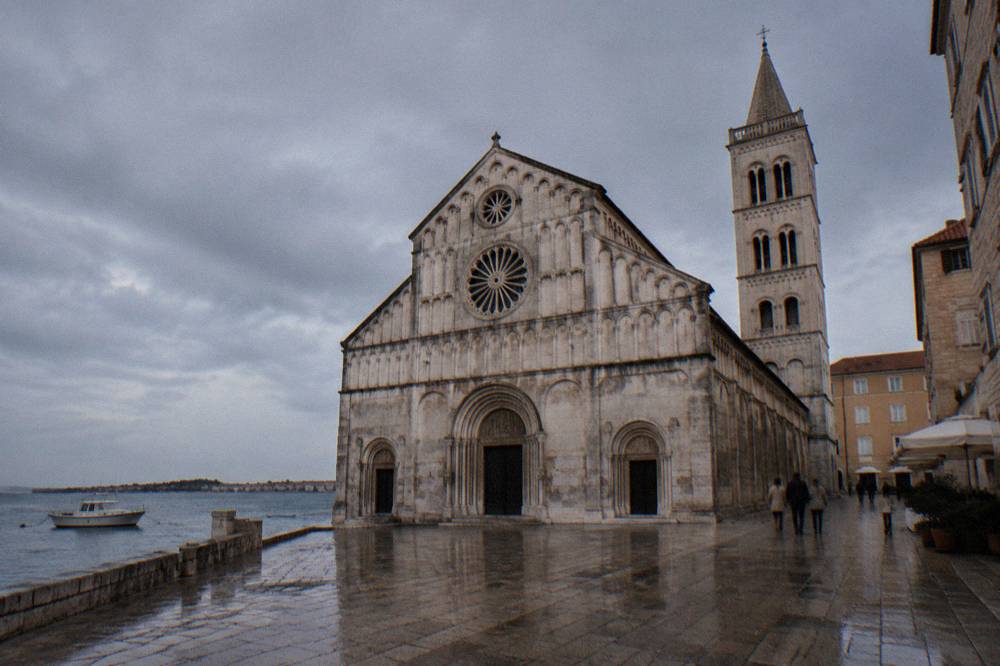
Two further collections sit inside the same walk: the Gold and Silver of Zadar in the Church of St Mary, whose ticket price appears only in secondary sources and is therefore not printed here, and the Cathedral of St Anastasia, whose bell-tower climb has no official price or hours page this site could verify. Visit both if the rain persists, and confirm entry costs at the door. For depth on the peninsula's Roman layer, the Roman Forum guide covers what the stones outside the museum windows actually are.
A wet morning is also the right moment for the covered parts of the peninsula that cost nothing. The Five Wells Square and the Land Gate, built in 1543, can be crossed between showers, and the Kalelarga's storefront awnings give intermittent cover on the way between museums.
Can You Still Enjoy The Old Town When It Rains?
Yes, because the Zadar peninsula packs its squares, arcades and covered passages into a walk of a few hundred metres, and its two signature installations, the Sea Organ (2005) and the Greeting to the Sun (2008), both by Nikola Bašić, are free, open-air and open at all hours, so rain changes what you hear rather than whether you can go.
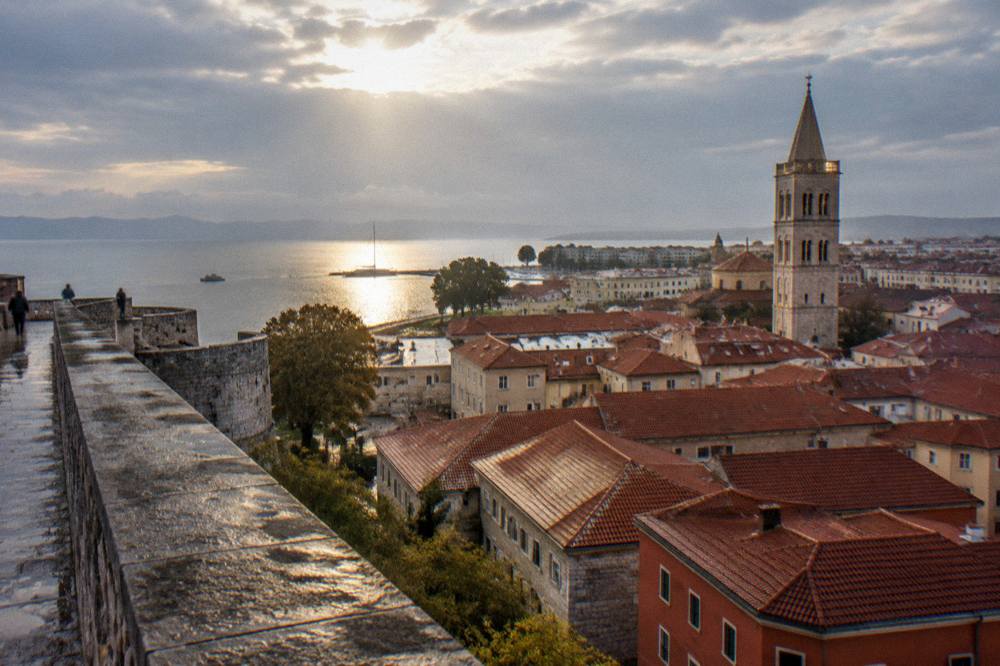
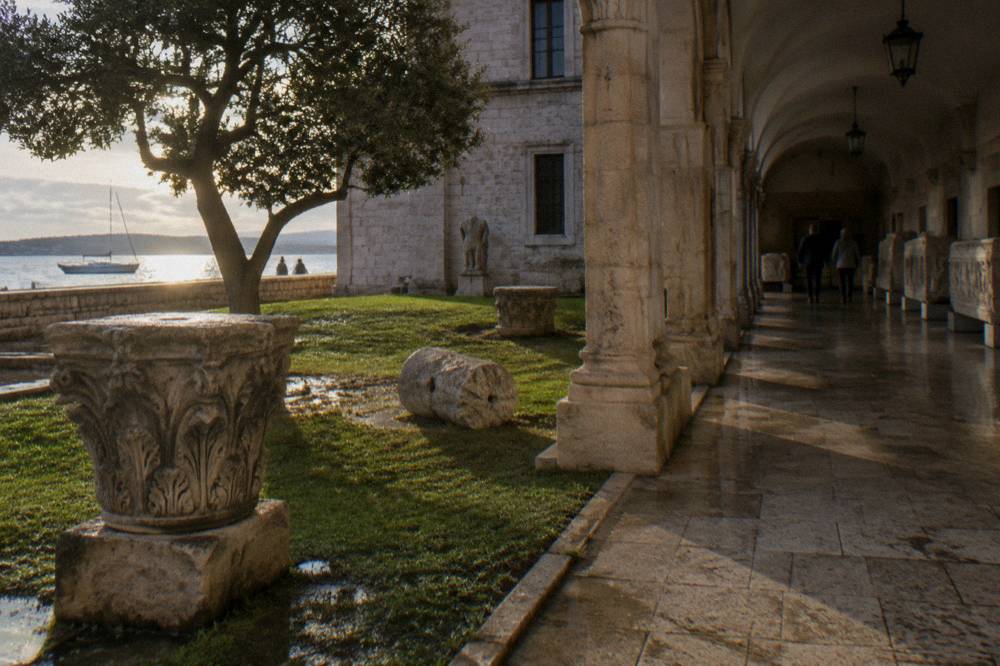
Start at the People's Square and walk Kalelarga toward the water. The street is lined with cafés, bakers and shops whose doorways and awnings do much of the work an umbrella would. The Old Town guide maps the full spine of the peninsula; in rain, the point is that everything on it is close. From the Roman Forum to the Riva waterfront is a short walk even at a reluctant pace.
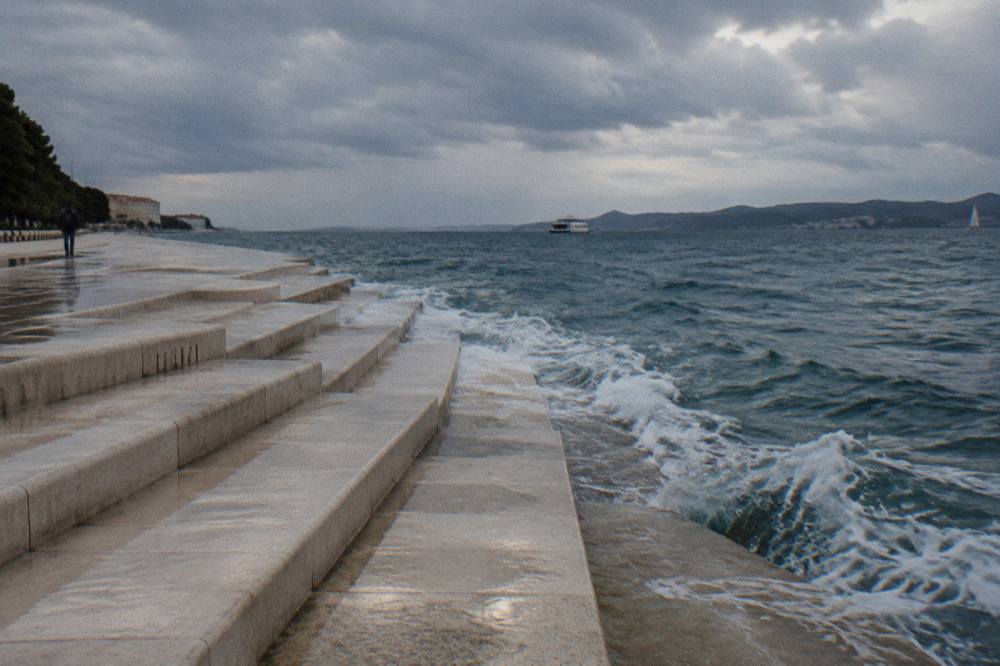
The Sea Organ is, if anything, better in weather. Waves driven by wind push air through the organ's pipes set into the steps, so a rough sea means a louder instrument. The installation stretches about 70 m along the steps with 35 pipes, figures reported by sources this site attributes rather than states as bare fact. Next to it, the Greeting to the Sun, a 22 m circle of solar-powered glass plates, collects daylight by day and returns it as light after dark. No start time is printed here; go after sunset and see.
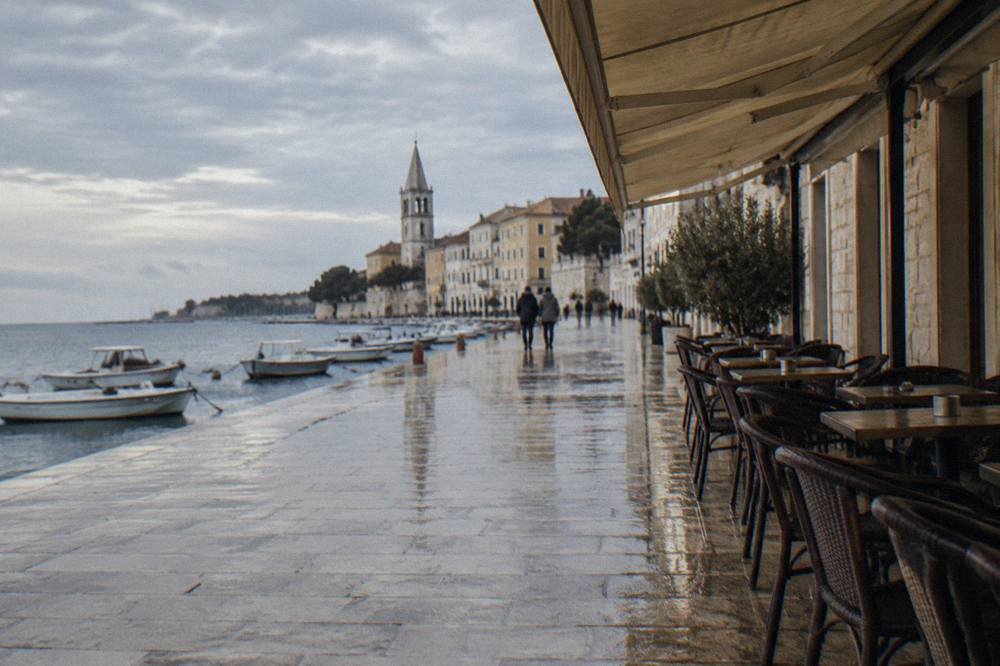
Dress for the conditions rather than the beach. Zadar posted informative signs at key access points to the historic core in summer 2026 requiring appropriate clothing, no swimwear or nudity, with a verbal warning first and fines up to 130 EUR reported after that; cover up on the way from the beach suburbs even when the weather tempts the opposite. On rain specifically, the stone paving on Kalelarga and around the Forum becomes slick, and shoes with grip matter more than speed.
| Outdoor stop | Rain verdict | Why |
|---|---|---|
| Sea Organ | Worth it | Wind and waves drive the sound; free, always open |
| Greeting to the Sun | Worth it after dark | Free light installation beside the Sea Organ |
| Roman Forum | Between showers | Free public space, quick to cross |
| Land Gate (1543) | Between showers | Free, photogenic in wet stone |
| Five Wells Square | Between showers | Free square, short exposure |
If the rain settles in, invert the plan: museums first, then a long lunch, then the waterfront at dusk. The site's sunset and evening route is written for clear skies, but its sequence works under cloud, and the Sea Organ plays regardless.
Where Do You Eat On A Rainy Afternoon In Zadar?
A guided food walk solves the rainy-afternoon problem outright: Zadar's Old Town food-and-history tours move between indoor tasting stops, cover the city's stories along the way, and render their price, rating and duration on the live listing rather than in prose. For independent eating, the peninsula's konobas, bakeries and maraschino bars are all indoors and all within the same few streets.
The listing-based option first. The food tour below strings local dishes and city stories into one booking, and the operator's live listing carries the current price and any seasonal schedule. It exists precisely for the hours when sightseeing has stalled: you sit, you eat, and the history arrives at the table. For readers who prefer to self-direct, the site's pages on Zadar food and on maraschino, the local cherry liqueur, list the specifics.
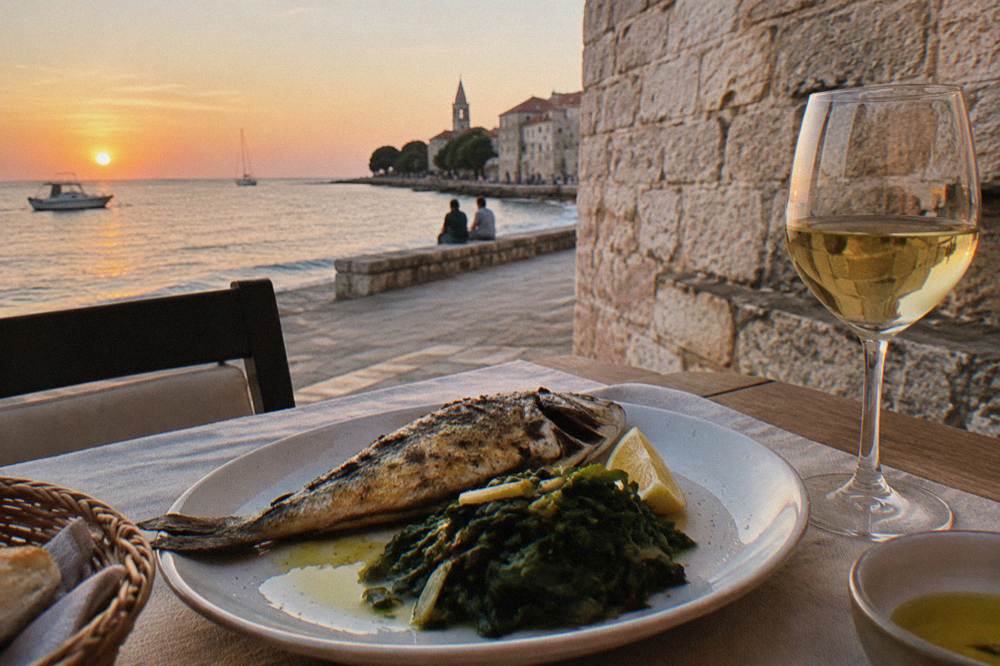
The structure of a rainy lunch matters less than its location. The People's Square and the streets off Kalelarga hold the densest cluster of indoor tables. Dalmatian menus lean on fish, prosciutto, cheese and slow-cooked meat, none of which cares about the weather. A tasting of Pag cheese or a maraschino at a bar counter turns a downpour into an interval rather than an interruption.
For a fuller account of the city's food identity, the site's dedicated coverage goes deeper than this page can: start with what the region is known for and work outward from there.
| Rainy-day eating stop | Type | Indoor? |
|---|---|---|
| Konoba on Kalelarga | Dalmatian sit-down | Yes |
| People's Square café | Coffee and cake | Yes |
| Maraschino bar | Local liqueur tasting | Yes |
| Old Town bakery | Quick street pastry | Partially |
| Guided food walk | Multiple stops with a guide | Mostly |
Do Boat And Kayak Tours Run In Bad Weather?
They run in shoulder seasons but not in every condition: operators cancel or reschedule when wind or sea state makes the trip unsafe, and the listing's cancellation terms, not this page, decide what happens to your money. In Zadar, boat tours, snorkeling trips and island excursions are weather-dependent products, so a rainy-day plan should hold a land backup and a flexible booking.
The kayak and speedboat options below illustrate the range. The Dugi Otok kayak trip includes an optional cave swim and offers transfer from Zadar; the four-stop speedboat tour builds swimming and snorkeling into its route. Neither is a rainy-day activity by design, but both matter to a rainy-day itinerary for the same reason: if the forecast improves for tomorrow, the booking you make from a café today is the trip you take when the sky clears. Check the operator's live listing for the weather policy, and read the cancellation line before paying.
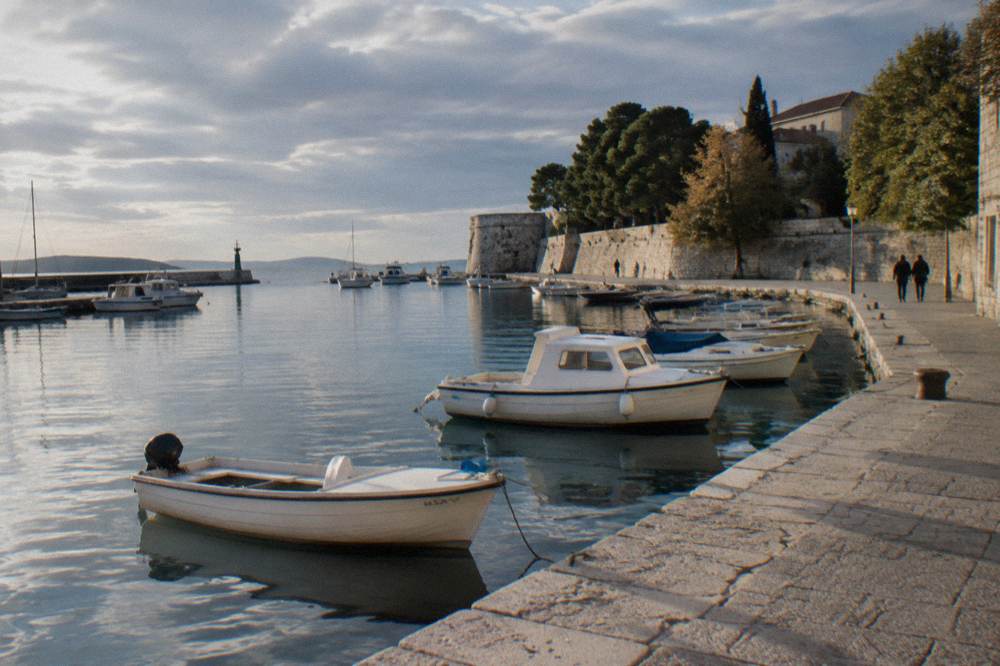
Practical arithmetic supports the strategy. Zadar's rain days run 5 to 12 a month depending on season, while sunshine totals about 2,600 hours a year (Zadar station, 1961-2024). The odds that two consecutive days are both lost to rain are lower in June than in November, but even in November the pattern is showers and grey spells rather than continuous rain. Book the boat for the better day; spend the worse one on this itinerary.
Which Day Trips From Zadar Survive Wet Weather?
The indoor-heavy day trips do: Šibenik with its cathedral and museums is 89 km by road from Zadar's Old Town (about 71 minutes driving), and Split at 158 km holds enough galleries, markets and covered quarters to fill a grey day, while the national parks lose much of their point in rain because their appeal is outdoor and on foot.
Distances come from the site's computed route data for journeys starting in Zadar's Old Town. Krka's Skradinski Buk is 91 km (about 73 minutes), Plitvice 145 km (about 153 minutes), Paklenica 46.8 km (about 57 minutes). All three are walking parks, and rain plus slick boardwalks plus reduced visibility is a poor trade for the fares involved. Worse, the parks' seasonal pricing rewards a good-weather visit: Krka charges 40 EUR for adults in June through September but 7 EUR in January through March and November through December, with 20 EUR in April, May and October, and Plitvice runs 10, 23 and 40 EUR across the same seasonal bands.
| Destination | Distance from Old Town | Drive time | Rain verdict |
|---|---|---|---|
| Paklenica | 46.8 km | ~57 min | Skip: hiking park |
| Šibenik | 89 km | ~71 min | Works: cathedral and museums |
| Krka (Skradinski Buk) | 91 km | ~73 min | Skip in heavy rain |
| Split | 158 km | not stated here | Works: largely urban |
| Plitvice | 145 km | ~153 min | Skip: boardwalk park |
Two swim rules worth repeating whatever the weather: swimming at Skradinski Buk has been banned since 2021 to protect the travertine, and swimming in Krka is allowed only at designated spots (Roški slap, Stinice, Pisak) from 1 June to 30 September, conditions permitting. Rainy-day readers were never swimming there anyway, but the rule occasionally appears in older guides without the ban.
For planning beyond this page, the site's day-trips overview and the best day trips from Zadar cover the full menu, including the Krka and Plitvice pages with their fee tables.
How Do You Build The Full Rainy-Day Schedule?
Start with the Museum of Ancient Glass at 7.00 EUR when it opens, cross to the Archaeological Museum and St Donatus while the rain lasts, take a long indoor lunch on or near Kalelarga, add the Gold and Silver of Zadar or the cathedral if the sky has not cleared, and finish at the Sea Organ and Greeting to the Sun after dark, both free. The whole route stays on the peninsula, so no transport is needed at any point.
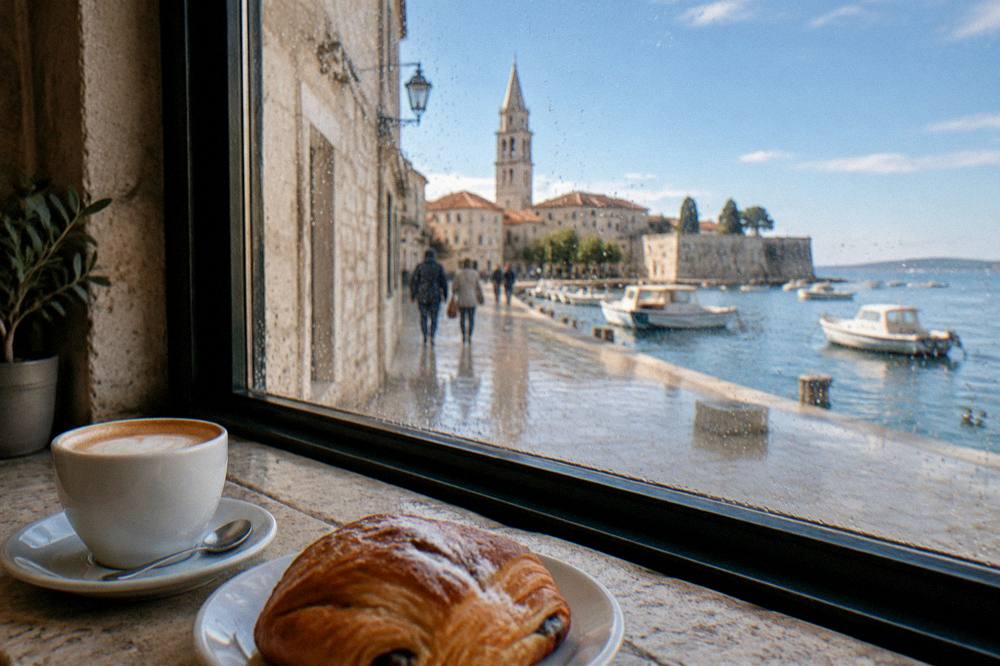
Fill the gaps with coffee. Rainy days in Dalmatia are slow by local custom, and the peninsula's café density makes slowness easy.
| Time block | Activity | Cost |
|---|---|---|
| Morning | Museum of Ancient Glass | 7.00 EUR adult |
| Late morning | Archaeological Museum and St Donatus | around 7 EUR, access subject to works |
| Lunch | Konoba or café on Kalelarga | Menu prices vary, check the room |
| Early afternoon | Gold and Silver of Zadar or cathedral | Confirm at the door |
| Late afternoon | People's Square, shops, maraschino bar | Free entry to the square |
| After dark | Sea Organ and Greeting to the Sun | Free, open at all hours |
A few closing practicalities. Croatia uses the euro since 1 January 2023 and is a Schengen member, so no border formalities or currency maths slow the day. The emergency number is 112. Zadar charges a tourist tax collected by your accommodation, and its amount is confirmed at booking rather than printed here. If you are arriving by ship, the cruise-port day itinerary adapts this same peninsula walk to a shorter window.
Common Questions About Rainy Days In Zadar
Does it rain a lot in Zadar?
The Zadar station, 1961-2024, records 912.5 mm of precipitation a year spread across 5 to 12 rain days per month. November is the wettest month at 123.0 mm and July the driest at 35.4 mm. Rain is frequent in autumn and rare in midsummer, but sustained all-day rain is not the norm in any month.
Is the Sea Organ worth visiting in the rain?
The Sea Organ is a free, open-air installation completed in 2005, open at all hours, and wind-driven waves are what push air through its pipes. A rough sea can make the instrument sound louder, so weather can improve the experience rather than ruin it, though the steps are exposed and slick.
What can you do in Zadar for free on a rainy day?
The Roman Forum, Five Wells Square, the Land Gate built in 1543, Kalelarga and the People's Square are all free public spaces, and the Sea Organ and Greeting to the Sun are free installations open at all hours. Indoor free options are limited, so plan short dashes between covered stops.
Do tours in Zadar get cancelled when it rains?
Boat, kayak and snorkeling tours are weather-dependent, and operators cancel or reschedule when wind or sea state is unsafe. The operator's live listing carries the exact cancellation policy; check it before booking and prefer flexible terms when the forecast is uncertain.
When is the wettest month in Zadar?
November, with 123.0 mm of rain over about 12 rain days, per the Zadar station, 1961-2024 (DHMZ). October and September follow at 106.8 mm and 110.9 mm respectively.
Rain in Zadar is a routing exercise, not a cancellation. The museums hold verified prices, the peninsula holds everything within a short walk, the food stops hold a roof, and the two installations on the waterfront ask nothing but a look at the sky afterwards. Pack shoes with grip, keep the boat booking flexible, and let the Sea Organ do the complaining about the weather for you.