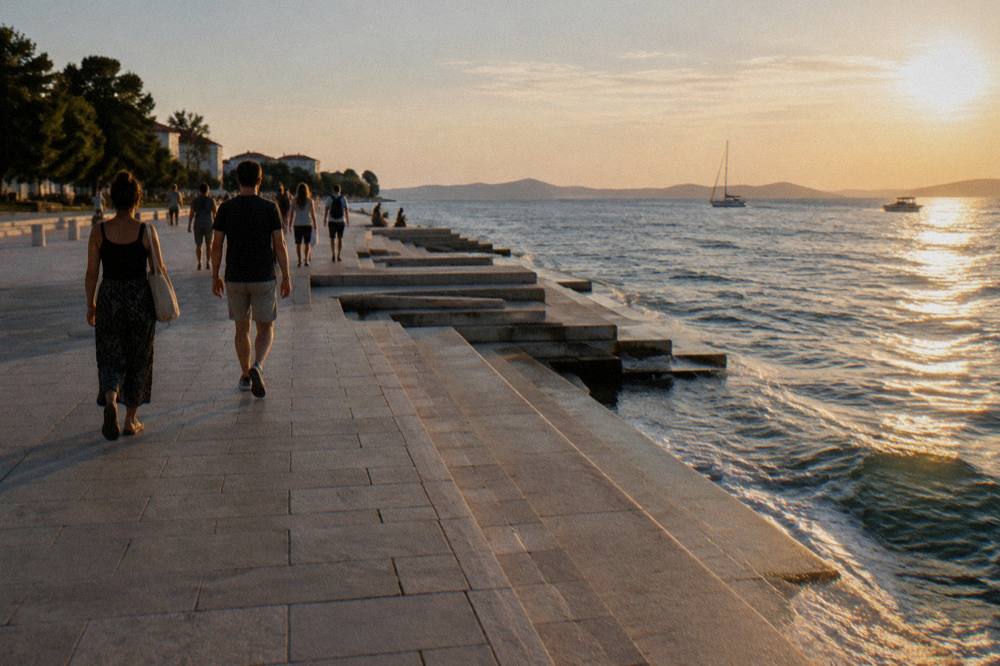
Greeting To The Sun Zadar
The Greeting to the Sun is a free, solar-powered light installation on Zadar's northwestern tip, built beside the Sea Organ and best seen in the minutes after sunset.
Short answer
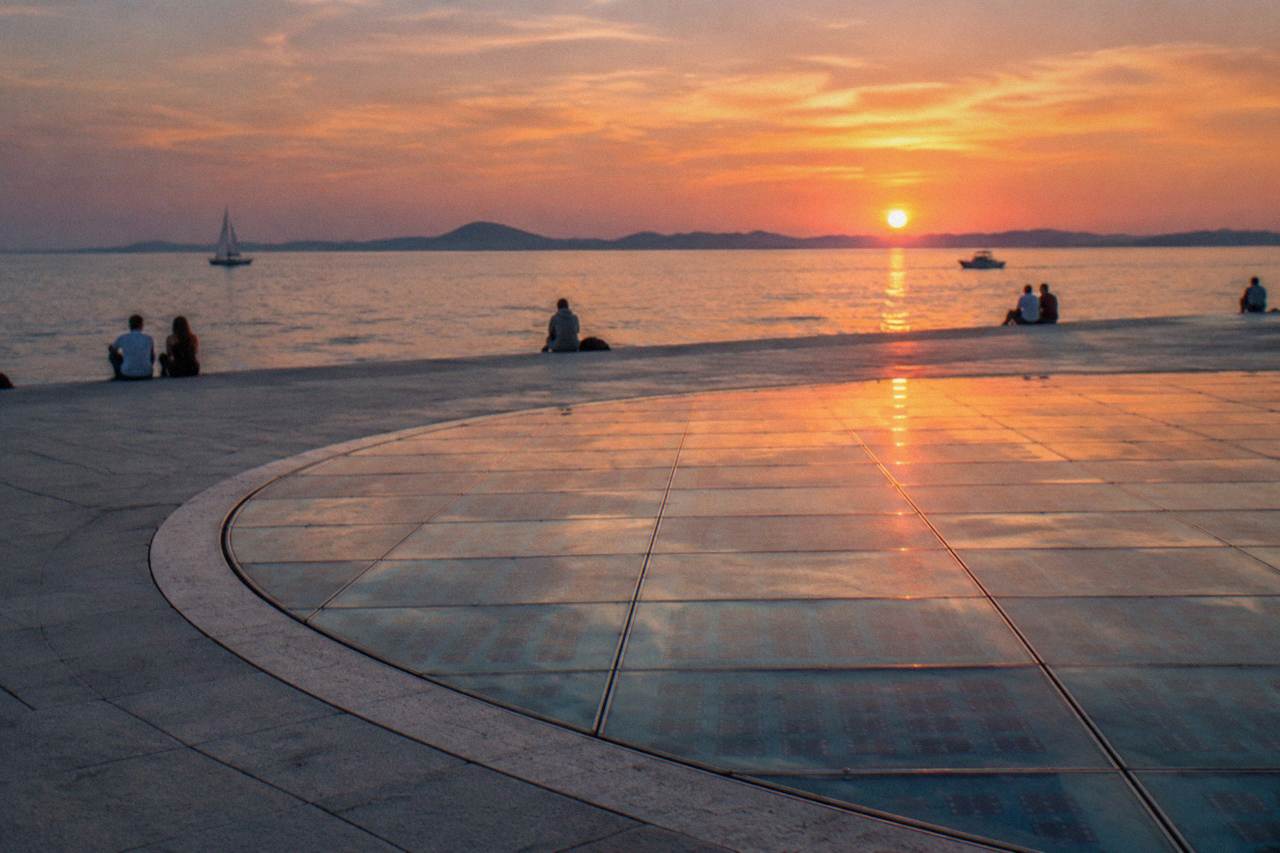
The Greeting to the Sun is a free public installation by Nikola Bašić, opened in 2008 on the Zadar riva beside the Sea Organ. Its roughly 22 m glass circle absorbs sunlight by day and plays a programmed light show after dark, with no ticket and no fixed start time.
The Greeting to the Sun sits on the northwestern tip of Zadar's peninsula, a circular glass plate set into the waterfront stone a few steps from the steps of the Sea Organ. It is one of the two modern installations that reshaped this end of the Dalmatian city's promenade, and like its neighbour it is free, unticketed and open at all hours. This guide covers what it is, how it works, when the light display runs, what it costs, and how to fold it into a day in the Old Town.
What Is The Greeting To The Sun In Zadar?
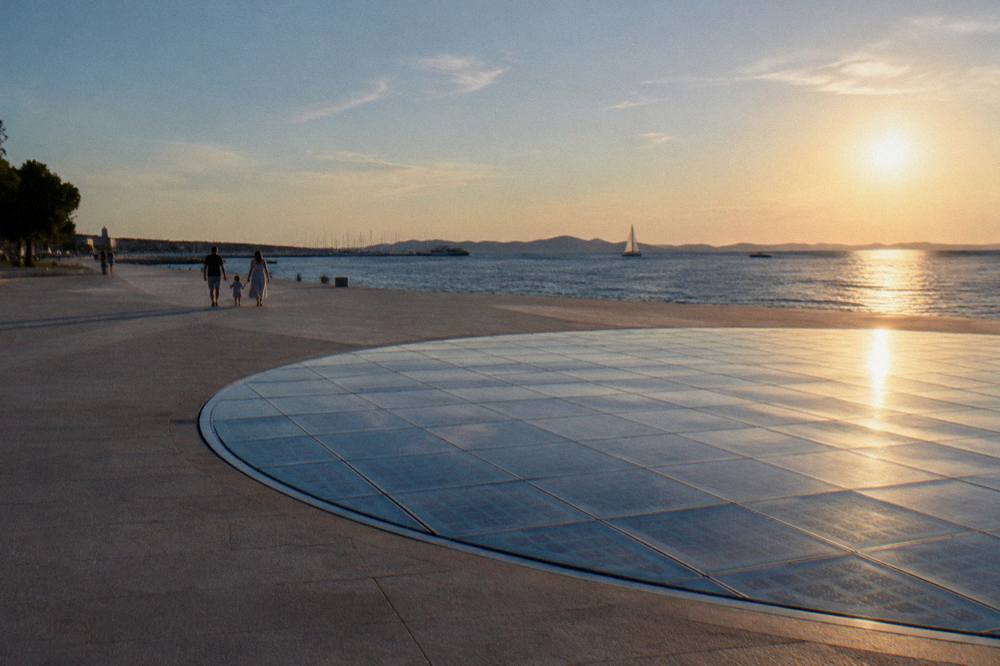
The Greeting To The Sun is a free public art installation on Zadar's waterfront, designed by the Croatian architect Nikola Bašić and opened in 2008. It is a circular plate of multi-layered glass, reported at about 22 m across, set flush into the promenade beside the Sea Organ, and it converts stored solar energy into a choreographed display of coloured light after dark. No ticket is needed and there is no gate or fence around it.
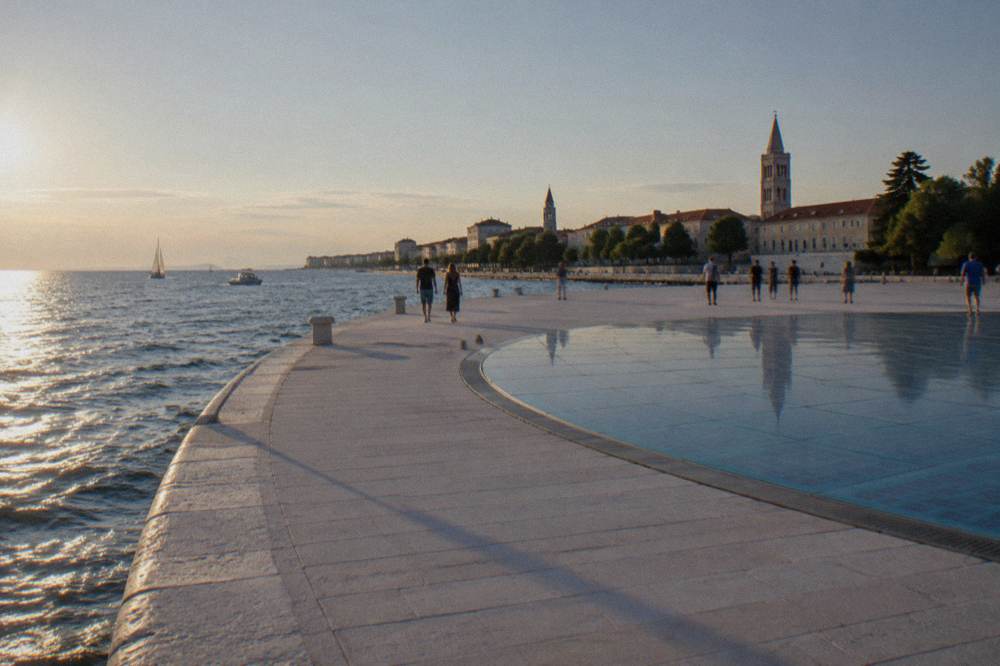
The city of Zadar's own page confirms the year and the architect. The diameter figure of about 22 m comes from secondary reporting rather than the city page, so treat it as an approximate measure rather than an official specification. What is certain is the siting: the circle lies at the very end of the peninsula, level with the paving, so visitors walk straight onto it or around it as part of an ordinary stroll along the riva.
The installation belongs to the same family of work as the Sea Organ, which Bašić designed first, in 2005. The organ turns the movement of the waves into sound through pipes under the steps; the Greeting to the Sun answers it by turning daylight into a night-time display. The two works sit metres apart and are usually experienced together, one for the ears and one for the eyes, which is why nearly every evening route through Zadar ends at this corner of the peninsula.
How Does The Greeting To The Sun Actually Work?
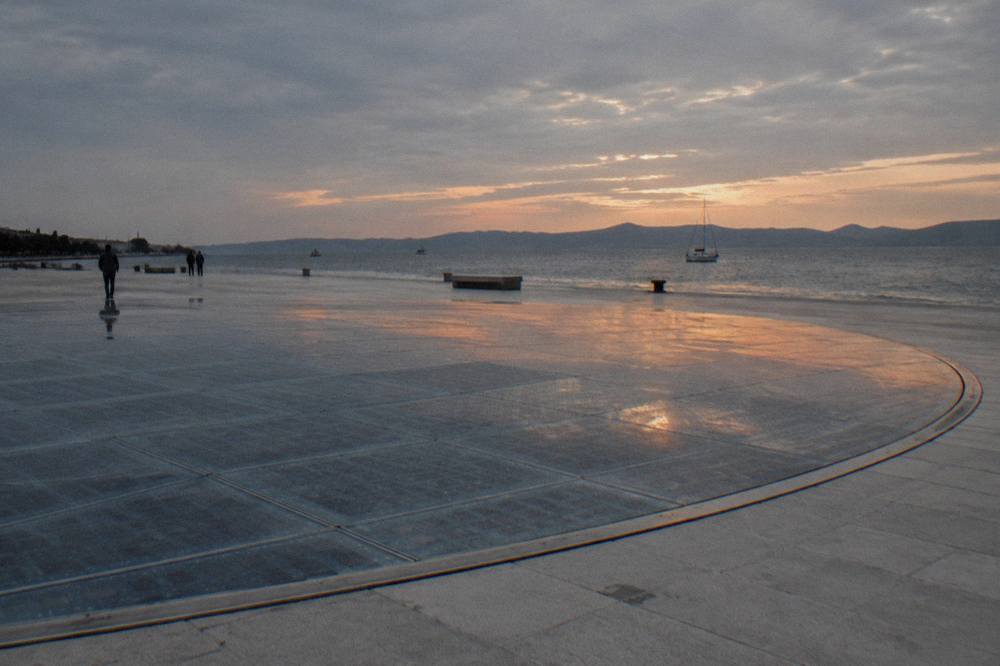
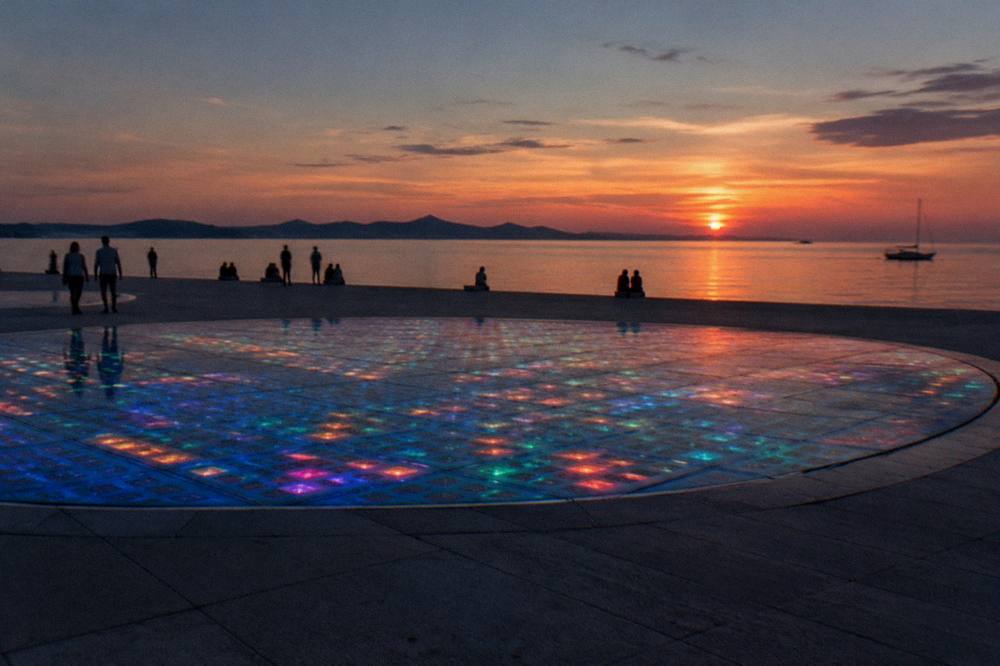
Underneath the glass circle sit solar cells that collect energy during daylight hours, and that stored power drives a light show after dark through thousands of embedded elements arranged in patterns that echo the solar system. The display follows the sun rather than a published schedule, so there is no verified fixed start time, and the intensity and length of the show depend on how much light the cells have absorbed that day. The system is fully solar-powered.
The design intent, as reported in descriptions of the work, is a dialogue with the Sea Organ: waves make music below the steps, and the sun makes light above the paving. The layout of the lighting elements is said to reference the planets and the sun's own rhythms, with the whole circle acting as a kind of calendar and clock rendered in glass. These descriptive details rest on secondary sources and the architect's own commentary rather than a technical datasheet, so this site reports them as reported rather than as measured fact.
| Element | What the sources say | Status of the figure |
|---|---|---|
| Opening year | 2008, designed by Nikola Bašić | Verified, zadar.hr |
| Diameter | About 22 m across the glass circle | Reported, approximate |
| Power source | Solar cells under the glass, charging by day | Reported |
| Display logic | Follows sunset, no published start time | Confirmed absence of a schedule |
| Cost to visit | Free, open at all hours | Verified |
| Sibling work | Sea Organ, 2005, same architect, a few steps away | Verified |
One dated maintenance item belongs here. In April 2026 the installation underwent a reconstruction of its electronic system, reported by local news as a project worth more than 61,000 EUR, replacing the worn cabling of the display. The work is in the past relative to this guide, and no closure or renovation is reported for the 2026-27 winter, but a complex embedded installation will always need periodic upkeep, so an occasional dark evening is possible and worth accepting without alarm.
Where Is The Greeting To The Sun And How Do You Reach It?
The installation sits on the northwestern point of Zadar's Old Town peninsula, on the riva directly beside the Sea Organ and a short level walk from the Roman Forum, Kalelarga and the Cathedral of St Anastasia, all of which sit within the same compact pedestrian zone. No vehicle is needed at any point, because the whole peninsula is walkable end to end, and the installation's edge is level with the surrounding paving.
From the Roman Forum the walk is a matter of a few hundred metres northwest along the shore. From Kalelarga, the main street, you simply follow it west toward the harbour and keep going past the end of the built-up rows until the open sea appears. The Five Wells Square and the Land Gate sit at the eastern end of the peninsula, so a natural route runs the length of the Old Town from gate to glow, finishing at the water.
| Nearby landmark | Direction from the installation | Character |
|---|---|---|
| Sea Organ | Immediately adjacent, on the steps below | Wave-driven sound installation, 2005 |
| Roman Forum | A few minutes southeast | Roman ruins in the open air, free public space |
| Kalelarga | East, straight along the main street | Historic principal street with shops and cafes |
| Cathedral of St Anastasia | Southeast of the Forum | Bell tower and church, older part of the skyline |
| Land Gate | Far eastern end of the peninsula | 1543 gate by Michele Sanmicheli |
| Riva promenade | Runs along the southern shore | Palm-lined walk facing Ugljan |
Because the endpoint faces open water to the northwest, the corner doubles as the city's sunset stand, and that is what most evening plans are built around. A practical way to spend the last hours of daylight is on the water and the first hour of dark on shore: the snorkeling boat trip this site features, From Zadar: 4-Hour Snorkeling Boat Tour with Unlimited Wine, returns to the harbour in time to walk to the promenade for the sunset and the light show, and you can Check availability for your dates on the operator's live listing.
The pairing works because of simple geography. The boat harbour and the promenade share the same peninsula, so nothing in the transition needs a taxi, a bus or a timetable, and the same walk serves dinner, the sunset and the display. If a day on the water does not fit the plan, an afternoon at Kolovare beach or a walk around the walls leads to the same corner by the same route.
For readers weighing other ways to spend a day out of the city before the evening finale, these three options cover the range from a short coastal sail to a full river expedition.
When Is The Best Time Of Day And Year To See It?
The best time of day is the hour that starts about half an hour before sunset, when the low sun lights the sea and the glass circle, and ends an hour after it, when the display is at full strength in the dark. The best months are those with clear skies and warm evenings, and by the Zadar station record, 1961-2024, July is both the warmest month at 24.5 C mean and the driest at 35.4 mm of rain.
The display itself follows the sun, so the practical method is simple: look up the day's sunset time for Zadar and arrive before it. In summer the evenings around the circle are busy, the sea is warm, and the sky stays light late; in winter the show starts in the late afternoon, crowds thin out, and the winter events programme, including Zadar Advent from 24 November 2026 to 2 January 2027, gives the peninsula a different evening life.
| Month | Mean temperature (C) | Rainfall (mm) | Evening character |
|---|---|---|---|
| June | 21.9 | 48.5 | Long light evenings, warm sea |
| July | 24.5 | 35.4 | Peak season, driest month |
| August | 24.1 | 52.8 | Peak season, warm nights |
| September | 20.2 | 110.9 | Softer light, fewer crowds, wetter |
| October | 16.3 | 106.8 | Early sunsets, quiet promenade |
| December | 8.6 | 99.6 | Dark by late afternoon, Advent season |
All temperature and rainfall figures above are from the DHMZ table for the Zadar station, 1961-2024. The same record gives the city about 2,600 hours of sunshine a year, which is the honest number for a place whose modern landmark is literally a sun-powered clock, and it explains why the display has fuel to draw on through most of the year. Sunshine is at its monthly low in December at 106.8 hours and its monthly high in July at 358.6 hours.
Is The Greeting To The Sun Free, And What Else In Zadar Costs Nothing?
Yes, the Greeting To The Sun is completely free and open at all hours, as is the Sea Organ beside it, the Roman Forum, Five Wells Square, Kalelarga, the Land Gate and the walk around the entire peninsula. Zadar's headline museums and churches do charge, with the Museum of Ancient Glass listing 7.00 EUR for an adult ticket, so a full free day is entirely possible if you stay with the public spaces and the two installations.
This distinction matters for planning, because the two most photographed works in the city cost nothing at all. The Museum of Ancient Glass's own ticket page lists 7.00 EUR for adults, 5.00 EUR for groups of five or more and 4.00 for schoolchildren, with guided tours at 20 EUR in Croatian or 30 EUR in other languages. The Archaeological Museum and St Donatus run on a shared tariff whose page shows rows of 7.00 and 5.00 EUR, so around 7 EUR at full price is a fair expectation for those. Some prices, including the Cathedral of St Anastasia's bell-tower climb and the Gold and Silver of Zadar exhibit, are not reliably published, so confirm those locally before counting on a figure. The wider set of guides lives on Zadar Croatia Travel Guide.
| Site in the Old Town | Cost | Notes |
|---|---|---|
| Greeting to the Sun | Free, open at all hours | Solar light installation, 2008 |
| Sea Organ | Free, open at all hours | Sound installation, 2005 |
| Roman Forum and Five Wells Square | Free public space | Open-air ruins and square |
| Museum of Ancient Glass | 7.00 EUR adult | Groups and children reduced, per the ticket page |
| Archaeological Museum / St Donatus | Around 7 EUR full price | Tariff page shows 7.00 and 5.00 rows |
| Bell tower climb, Gold and Silver | Not reliably published | Confirm locally |
A warning worth repeating from the city's rules: signs posted at the entrances to the historic core since summer 2026 ask for appropriate clothing, with no swimwear, and local reporting says fines can reach 130 EUR after a warning. Coming to the evening display straight from the beach in a swimsuit is the exact scenario the signs address, so bring a change of clothes.
How Does The Installation Fit Into An Evening In Zadar?
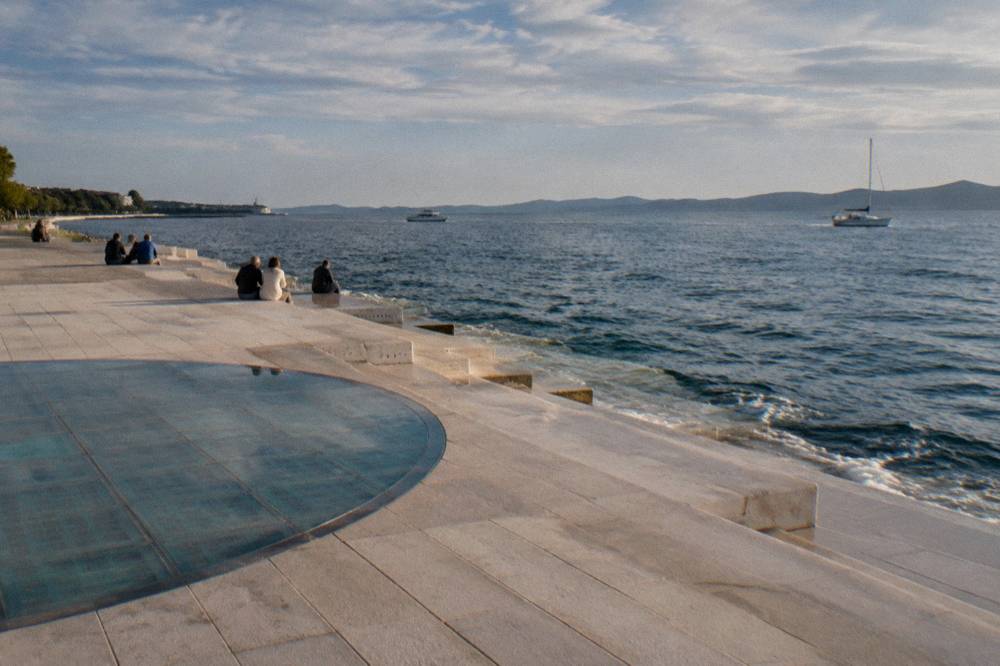
A reliable evening shape runs from dinner in the Old Town to the southern riva for the last daylight, then west along the waterfront to the Sea Organ steps for the sunset itself, and finally onto and around the Greeting To The Sun as the light display takes over in the dark. Every stage is within a short walk of the others, nothing is ticketed, and the whole sequence fits inside about two unhurried hours.
This is the pattern the site's evening route follows, and it works in every season because the display tracks the sun rather than a timetable. In summer you can add a swim at Kolovare beach or a boat trip earlier in the day and still be on the promenade for the finale. In winter the sequence compresses into the late afternoon, and the Advent programme, which in 2026/27 expands to three locations including an ice rink on the Forum between 24 November 2026 and 2 January 2027, puts music and lights within the same few streets. The Zadar riva itself remains the connecting thread, and a first visit of one day, laid out in the one day in Zadar itinerary, naturally ends here.
Who Made It, And Why Does The Waterfront Look Like This?
The Greeting To The Sun was designed by Nikola Bašić and opened in 2008, three years after his Sea Organ transformed the same stretch of broken concrete waterfront into the city's signature public space. The work is deliberately paired with the organ: one converts waves into sound, the other converts sunlight into light, and together they reframed a dull promenade edge into a destination that now anchors Zadar's modern identity alongside its Roman and Venetian layers.
The historical context sits a few streets away. The peninsula's older monuments, from the Roman Forum to the 1543 Land Gate by Michele Sanmicheli, belong to a long story of layered rule, and Zadar's defensive walls earned a place in a UNESCO World Heritage inscription of Venetian defensive works, listed in 2017. That listing covers the defensive system, not the whole Old Town and certainly not the 2008 installation, but the pairing is the point: a city whose ancient fabric earned world recognition chose to let a contemporary architect redefine its most-visited free space.
Two practical notes follow from the waterfront's design. The glass circle is flush with the paving but can be slippery when wet, and the surrounding steps and benches fill up fast around sunset in July and August. There is no seating plan and no queue, only the ordinary etiquette of a public square.
What Should Photographers Know Before Visiting?
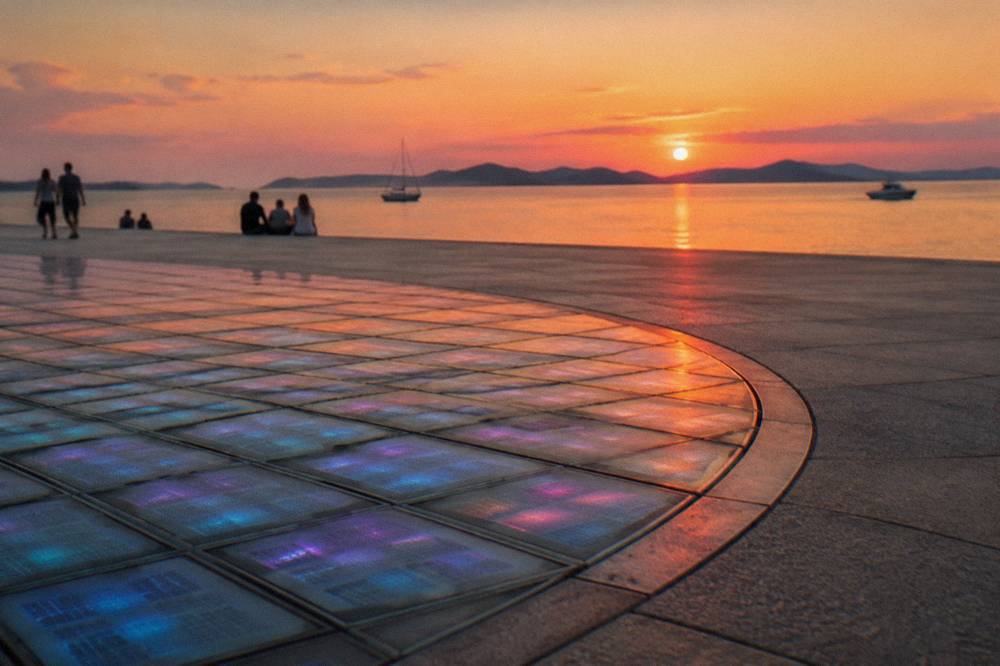
Photographers should plan for the half hour after sunset rather than the sunset itself, because that is when the display's coloured patterns stand out against the deep blue sky, and a tripod or a braced camera helps since the light levels are low. Wide shots from the Sea Organ steps capture the circle against the sea horizon, while close shots of the glass plates work best once full darkness has arrived. No permit is needed for personal photography.
The circle's light is dynamic, moving in slow choreographed waves rather than sitting static, so slightly longer exposures record streaks and patterns that the eye assembles differently. Shooters who want the sea in frame should work from the northwest, where the open Adriatic sits behind the installation. The same corner also serves as a vantage for approaching weather: the bora, a cold gusty northeast wind, can clear the sky dramatically in winter, while the jugo brings humid grey days with poor visibility.
Can You Visit With Children, And Is The Area Accessible?
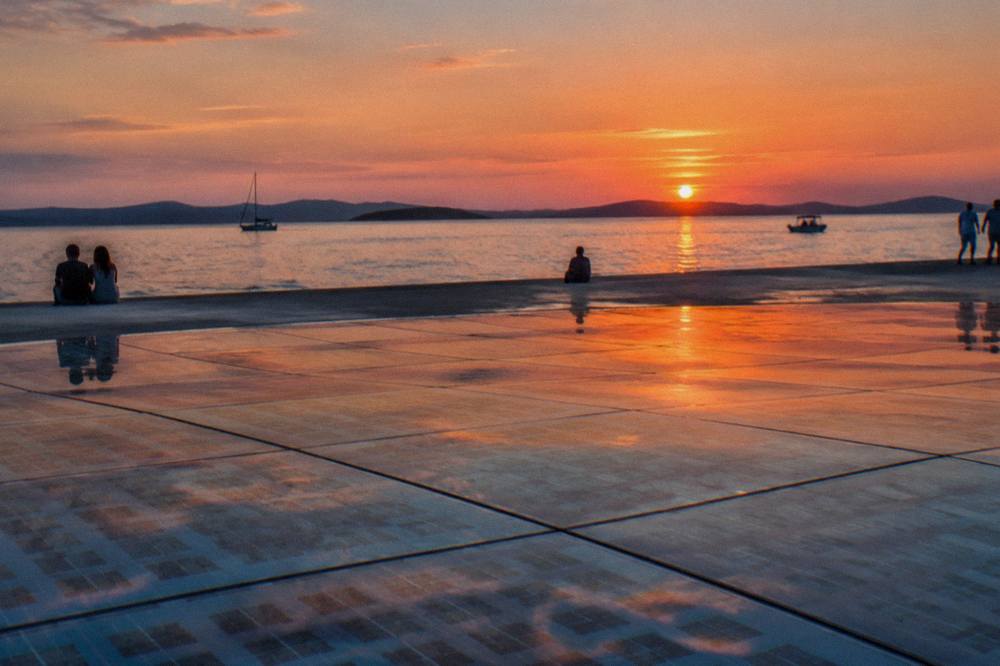
Yes, the installation is a flat, level, unfenced public surface that children can walk on freely, and the surrounding promenade is step-light and pedestrianised, which makes the whole northwest tip of the peninsula one of the easiest evening outings in Dalmatia for families. The glass plate is set flush with the paving, so wheels and strollers roll across it, and the main caution is the same one that applies to any waterfront: unsupervised edges near the sea.
The display itself holds children's attention well after dark, and the Sea Organ's random notes provide a second free attraction metres away. The Old Town's compactness works in families' favour here: ice cream shops and bakeries line Kalelarga, the walk back to accommodations anywhere on the peninsula is short, and the dress-code signs do not affect children's ordinary summer clothing. For readers planning a broader stay, the Old Town area guide covers where to base relative to this corner, and the site's overview of things to do in Zadar places the installation among the city's other options.
How Does The Greeting To The Sun Compare With Zadar's Other Sights?
Against the city's paid museums and its day trips to Krka, Plitvice and the Kornati islands, the Greeting To The Sun wins on cost and convenience: it is free, it is in the middle of the Old Town, and it needs no booking, no transport and no more than an evening of your time. The parks and museums repay a full morning or a full day, while the installation repays twenty unhurried minutes at the right hour, which is why it pairs with everything else rather than competing.
| Experience | Where | Cost basis | Time needed |
|---|---|---|---|
| Greeting to the Sun and Sea Organ | Old Town waterfront | Free | An evening hour |
| Museum of Ancient Glass | Old Town | 7.00 EUR adult, per its ticket page | One to two hours |
| St Donatus and the Forum | Old Town | Around 7 EUR for the museum interior | An hour outdoors |
| Krka National Park day trip | About 91 km by road | 7 / 20 / 40 EUR by season, adult | A full day |
| Plitvice Lakes day trip | About 145 km by road | 10 / 23 / 40 EUR by season, adult | A full day |
The park prices above are per person and seasonal, quoted from the parks' own 2026 price lists, and they drop sharply in the cooler months: from 1 October 2026 both Krka and Plitvice moved to their lower shoulder rates. The two installations, by contrast, cost the same in January as in July, which is nothing. A sensible split puts a park or an island such as those covered in the Kornati islands guide into the daylight hours of a longer stay, such as the two days in Zadar itinerary, and keeps the waterfront finale for every evening of the trip.
The final choice among the water-based options, from a short snorkeling run to a small-group island circuit, comes down to how much of the day you want to give the sea before returning to the promenade for the light.
Common Questions About The Greeting To The Sun In Zadar
Is the Greeting to the Sun free?
Yes. It is a free public installation with no ticket, no gate and no opening hours, and it can be visited at any time of day or night. The Sea Organ beside it is equally free and always open.
What time does the light show start?
There is no verified published start time. The display follows the sun: it begins after sunset and runs on solar energy stored during the day. Check the day's sunset time for Zadar and arrive a little before it.
Who designed the Greeting to the Sun?
The Croatian architect Nikola Bašić, who also designed the Sea Organ in 2005. The Greeting to the Sun opened in 2008 as the companion work on the same stretch of waterfront.
How far is the Greeting to the Sun from the Sea Organ?
They sit immediately beside each other on the northwestern tip of the peninsula, a few steps apart, and both are free, so an evening visit covers the pair together with no extra walking.
Can you walk on the installation?
Yes. The glass circle is set flush with the promenade paving and is walked on routinely. Take care in wet weather or after bura winds have thrown spray across the surface, as glass and water are a slippery combination.
Is it worth visiting in winter?
Yes. The display starts earlier in the afternoon in winter, the crowds are thinner, and Zadar Advent from 24 November 2026 to 2 January 2027 adds an ice rink on the Forum and concerts within the same few streets.