Is The Sea Warm In Zadar?
A factual answer to whether the Adriatic sea is warm in Zadar, with official station climate data, the live sea-temperature reading rule, beach notes and coastal activity guidance.
Zadar is a coastal city in Dalmatia, Croatia, built on a narrow peninsula with the Adriatic Sea on three sides, and the question of whether that sea is warm enough to swim in shapes almost every summer plan here. The honest answer is that the sea in Zadar is warm for comfortable swimming through the middle of the year and cool to cold outside it, and the only official numbers available are a weather-station climate record for the air and a single live sea reading published by the Croatian meteorological service. This page lays out what those sources say, month by month, without inventing a sea-temperature table that no official body publishes.
Is The Sea Warm In Zadar?
Yes, for part of the year the Adriatic around Zadar is genuinely warm, warm enough that swimming needs no acclimatisation, and the practical swimming season runs roughly from June into early October, while in deep winter the same water is cold enough that only hardened swimmers stay in. Croatia's meteorological service publishes no monthly sea-temperature averages for Zadar, so any month-by-month sea table on another site is an estimate rather than an official figure. What is official is the air record and a live sea reading.
That distinction matters more than it sounds. The DHMZ station table for Zadar covers air temperature, rainfall and sunshine for the period 1961-2024, and it is the record behind every climate claim on this site. For the sea itself, the only official source is a live reading: on 11 October 2026 the DHMZ marine feed showed 21.3 to 21.4 C at Zadar, which is still pleasant for a swim at the very end of the season.
What the station record does let you do is reason from the air. July has a mean air temperature of 24.5 C and August 24.1 C, with ten days at or above 30 C in each of those months (Zadar station, 1961-2024). Water that has been absorbing that heat since spring is correspondingly at its annual peak, and the guide to the best time to visit Zadar covers how that lines up with crowds and prices.
When Is The Adriatic Warmest Near Zadar?
The air over Zadar is at its annual peak in July, with a mean of 24.5 C, and August follows at 24.1 C, so late July and August are when the sea holds the most stored heat and when swimming off the city beaches needs no second thought. September stays warm at a 20.2 C mean air temperature, which is why early autumn swimming is a realistic plan.
By January the mean air temperature is 7.3 C and the sea is firmly out of season for casual swimming.
The station record, labelled Zadar station, 1961-2024, gives the full annual shape of the year. Here is the air-temperature and rainfall picture it shows.
| Month | Mean air temperature (C) | Rain days |
|---|---|---|
| Jan | 7.3 | 10 |
| Feb | 7.8 | 9 |
| Mar | 10.0 | 9 |
| Apr | 13.4 | 10 |
| May | 17.9 | 10 |
| Jun | 21.9 | 8 |
| Jul | 24.5 | 5 |
| Aug | 24.1 | 6 |
| Sep | 20.2 | 9 |
| Oct | 16.3 | 9 |
| Nov | 12.1 | 12 |
| Dec | 8.6 | 12 |
Read the shape rather than any single cell. From May's 17.9 C mean the year climbs steeply to the July peak and then slides slowly, so mid-June through mid-September is the window where sea swimming in Zadar is a default activity rather than an act of enthusiasm. The heat store in the water lags the air, which is why the first half of October can still deliver a swim, as the live 21.3 C reading in mid-October 2026 suggests. Sunshine supports the warming too: the station sums to about 2,600 hours of sunshine a year, with July alone recording 358.6 hours, and that long daily exposure is what heats the shallow coastal water through the summer months.
Rain barely matters for swimming comfort in summer: July averages 35.4 mm over five rain days, and August 52.8 mm. The wettest month is November at 123 mm, by which point the swimming conversation is over for the year anyway.
If warm water is the point of the trip, boat-based days put you in it whatever the exact temperature. The half-day guided kayak trip on the Zrmanja River runs with equipment and a local guide, and there are island and coast options leaving straight from the city.
Where Can You Swim Around Zadar?
The city's named swimming beaches are Kolovare, Borik, Puntamika and Diklo, all on the mainland side within reach of the centre, and offshore islands such as Ugljan and Dugi Otok add rock-and-cove swimming a short ferry or boat ride away. Beach concession rules reported for the 2026 season say no fencing, ramps or entry fees may be placed on concession beaches, with access kept public and free, and commercial sunbed areas limited to part of the surface.
That beach-access detail is worth stating carefully because it is a rule change, not a permanent statute. Zadar County Assembly decisions adopted in April 2026 apply the national Law on Maritime Domain to the county's beaches: a concessionaire pays fees on the whole beach area but may use only 40 to 60 percent of it for commercial activity depending on the site, leaving the rest free for towels and own chairs. Treat it as reported for the 2026 season and check locally, since old concessions expire over roughly the next two years. Other pages covering the same trip are gathered on Zadar Croatia Travel Guide.
Two local rules matter for a day built around the water. Dress-code signage installed in summer 2026 asks for appropriate clothing in the historic core, no swimwear or nudity, with reported fines up to 130 EUR after a warning, so the walk back from the beach through the Old Town needs a cover-up. And swimming from the peninsula itself is a different question from swimming at the beaches; the can you swim in the sea in Zadar page covers where people actually get in.
| Swimming spot | Location | Access character |
|---|---|---|
| Kolovare | Mainland, city side | City beach within reach of the centre |
| Borik | Mainland, northwest | Resort-side beach strip |
| Puntamika | Mainland, near the port | Pebble and concrete swimming |
| Diklo | Mainland, eastern edge | Quieter residential stretch |
| Ugljan island | Ferry from Zadar | Island coves, short crossing |
| Dugi Otok | Ferry from Zadar | Remote coves and Sakarun-style sand |
What Do The Winds Do To Sea Conditions In Zadar?
Two winds define the Adriatic around Zadar: the bora, a cold, dry gusty north-easterly strongest in winter, and the jugo, a warm humid southerly, and both can change the sea from calm to rough within hours even in the swimming season. Neither wind changes the water's temperature, but both change whether a beach, a ferry or a kayak trip runs as planned. On windy days the sheltered city-side beaches hold up better than exposed island stops.
The bora is the one to respect. It arrives in gusts rather than a steady blow, and it is a winter phenomenon at its strongest, matching the season when the sea is coldest anyway. The jugo builds a heavier swell and often comes with cloud and rain. Ferry operators including Jadrolinija cancel sailings when conditions demand it, so an island swimming day planned around a ferry should leave room to rearrange. Kayak and boat tour operators likewise judge conditions on the morning of departure, and a trip moved to a sheltered route or another day is a normal part of coastal scheduling rather than a sign something has gone wrong.
For the practical question of which island suits a warm-water day trip, the best island to visit from Zadar page compares the options that the ferry network actually serves.
Can You Enjoy The Zadar Coast Without Warm Sea Water?
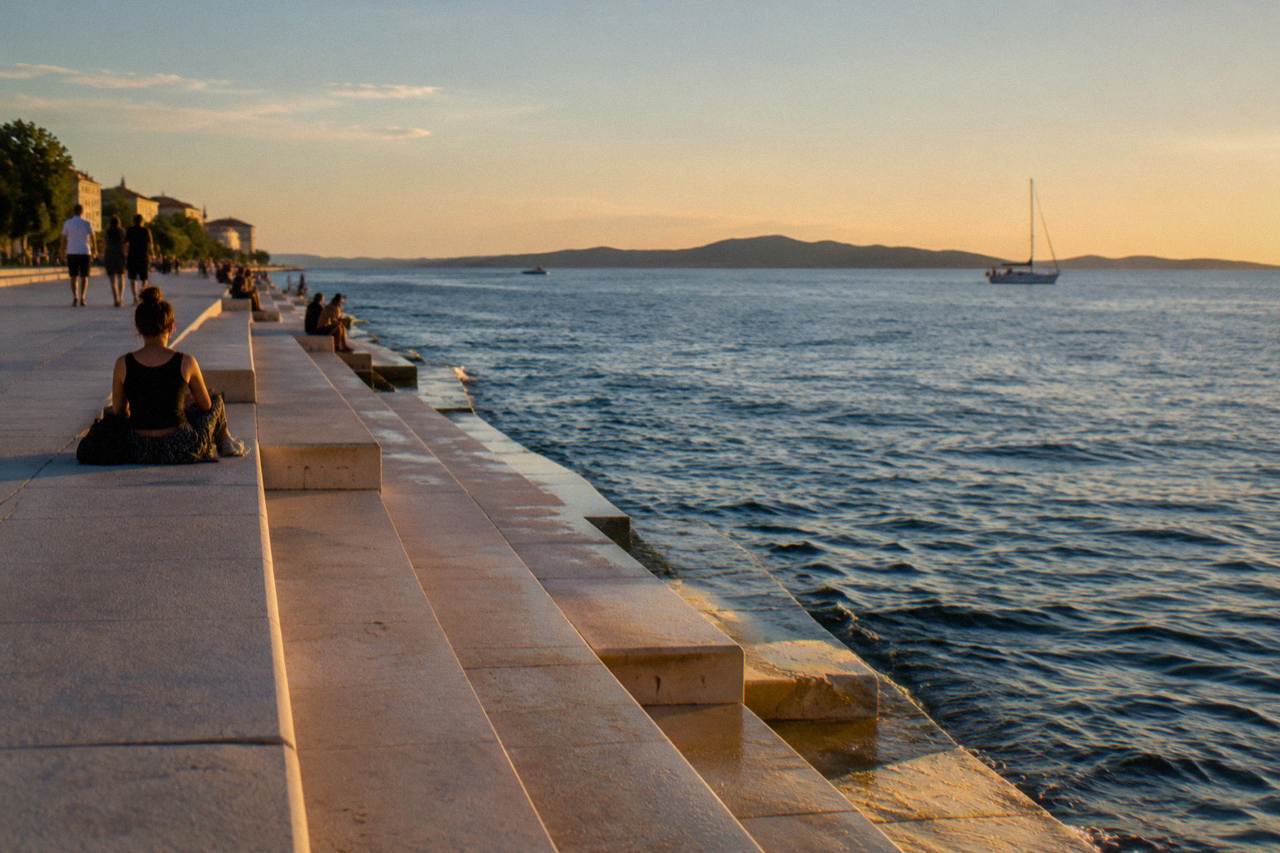
Yes, and in several months of the year the sea temperature is beside the point, because the coast's headline experiences are on the water rather than in it: the Sea Organ plays from the western edge of the peninsula whatever the season, the Greeting to the Sun installation beside it is a free public work, and boat, kayak and tuk-tuk tours run from early spring to late autumn. A visitor in April or October misses comfortable swimming but misses nothing else.
The two waterfront installations by Nikola Bašić are free and open at all hours: the Sea Organ from 2005 and the Greeting to the Sun from 2008. The Sea Organ explained page covers how wave motion becomes sound. Beyond them, the operators in this site's roster run island boat trips, snorkelling runs, sunset cruises and river kayaking across a long season, and the water-based trips that need genuinely warm water are concentrated in the June-to-September window.
For a fuller comparison of what the city offers across the year, the is Zadar worth visiting page is the right next stop, and the how many days in Zadar is enough page helps with pacing a stay built around both the water and the Old Town.
Common Questions About Sea Temperature In Zadar
Is the sea warm in Zadar?
Yes, from roughly June into early October the Adriatic around Zadar is warm for comfortable swimming, with the peak in late July and August. Outside that window the water cools steadily and by midwinter is cold. Croatia's meteorological service publishes a live sea reading rather than monthly averages, so no official month-by-month sea table exists.
What was the official sea reading for Zadar recently?
The DHMZ marine feed showed 21.3 to 21.4 C at Zadar on 11 October 2026, still swimmable at the end of the season. It is a single live reading, not an average, and conditions change through the year.
Which month is the warmest in Zadar?
July, with a mean air temperature of 24.5 C, followed by August at 24.1 C (Zadar station, 1961-2024). July is also the driest month at 35.4 mm of rain.
Do Zadar beaches charge entry?
Concession rules reported for the 2026 season say beaches in Zadar County may have no fencing, barriers or entry fees, with commercial activity limited to 40 to 60 percent of a beach's area and the rest free for public use. Treat it as reported and check locally.
Is swimming allowed everywhere around Zadar?
Swimming happens at the city beaches such as Kolovare, Borik, Puntamika and Diklo, and at island coves reached by ferry or boat. Note the Old Town dress-code signage asking visitors not to walk the historic core in swimwear, with reported fines up to 130 EUR.
Does the wind affect sea conditions in Zadar?
Yes. The bora, a gusty cold north-easterly wind, and the jugo, a warm southerly, can both rough up the sea and disrupt ferries or kayak trips, so a planned swimming day should allow for rearrangement when a wind warning is in force.