Is Zadar Nicer Than Split?
An honest comparison of Zadar and Split covering drive time, free sights, park fees and day-trip reach from Zadar, in Dalmatia, Croatia.
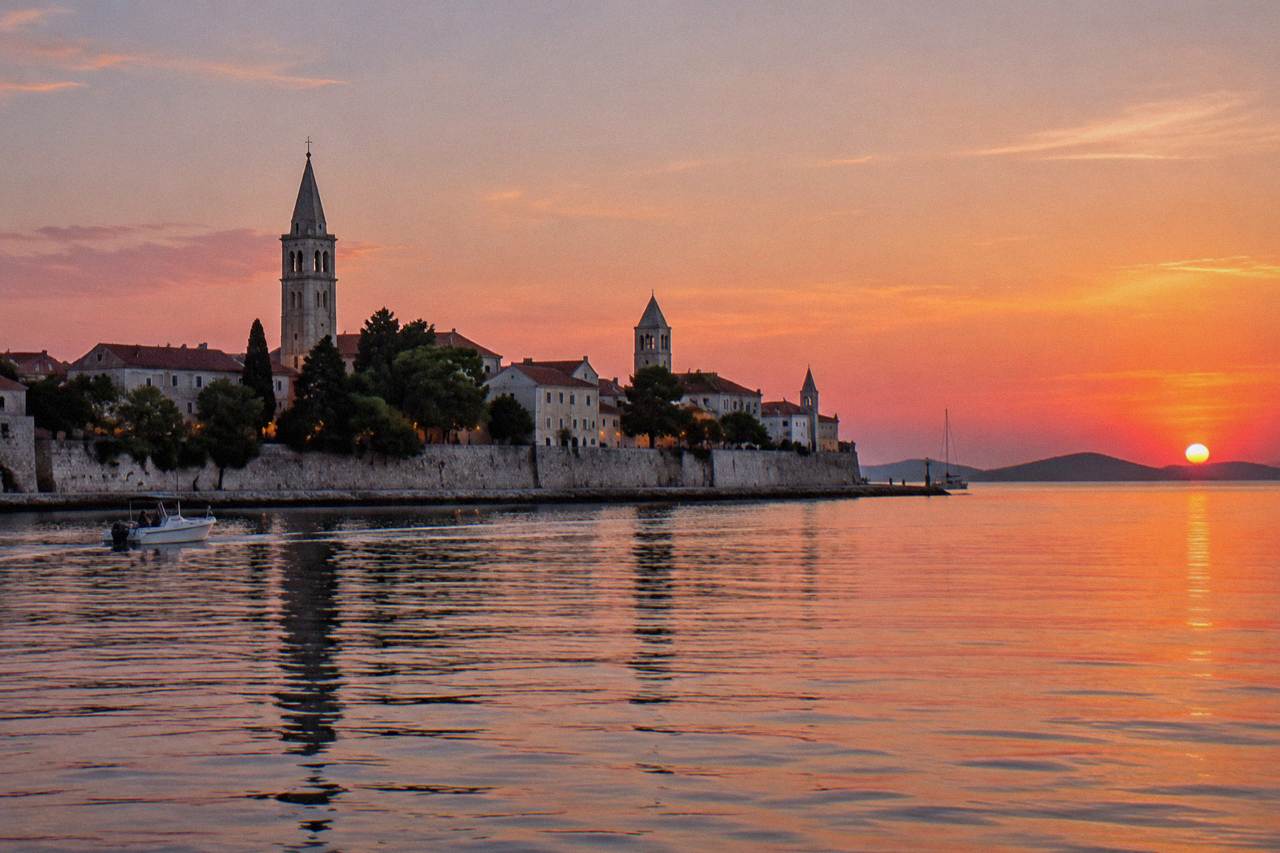
Zadar sits on a narrow peninsula on the Dalmatian coast of Croatia, with the islands of Ugljan and Dugi Otok a short ferry ride offshore, and Split lies about 158 km down the same Adriatic shore, a figure from the airport's own how-to-get-here page. "Nicer" is not a number, and this site covers Zadar only, so the fair comparison runs on what can actually be sourced: how far apart the two towns are, what Zadar's free sights are, what the national parks around it charge by season, and how the two bases differ in shape and reach.
Is Zadar Nicer Than Split?
Neither town can be called nicer on evidence this site holds. What the record does show is that Zadar is smaller and quieter by design, with a compact Old Town you can cross on foot, while Split is the larger transport hub 158 km to the south.
The honest answer depends on what a visitor counts as nice. Zadar's seafront holds two free public installations by Nikola Bašić: the Sea Organ, built in 2005, and the Greeting to the Sun, from 2008. Both are open at all hours and neither has a ticket. The Roman Forum, Five Wells Square, Kalelarga and the Land Gate of 1543 are all free public spaces as well, so a large part of Zadar's core costs nothing to walk through.
The city is also a component of a UNESCO inscription, but the wording matters: Zadar is one of six components of the "Venetian Works of Defence" property, a transnational listing inscribed in 2017. The Old Town as a whole is not a World Heritage Site, and any guide that says otherwise is overstating the listing.
Split's attractions, prices and character are not rated here; what this page covers is the road: 158 km from Zadar, roughly a two-hour-plus drive along the coast. Practical details are covered in how to travel from Split to Zadar and the drive-time breakdown in the Split to Zadar driving answer. The broader comparison lives on the Zadar vs Split guide.
What Can You Do In Zadar That Costs Nothing?
Zadar's headline sights are free and open around the clock: the Sea Organ (2005) and the Greeting to the Sun (2008), both by Nikola Bašić, plus the Roman Forum, Kalelarga, Five Wells Square and the 1543 Land Gate. The Sea Organ is a wave-driven installation about 70 m long with 35 pipes set into the quay, and the Greeting to the Sun is a 22 m solar-powered light circle beside it.
That pairing is unusual for a Dalmatian town: the two most photographed things on the waterfront have no ticket, no gate and no opening hours. The two installations sit next to each other on the northwestern tip of the peninsula, so sunset on the riva takes in both in one slow walk. The Sea Organ guide explains how the pipes actually work.
Inside the Old Town, the paid sights are modest in price where they are verified at all. The Museum of Ancient Glass lists 7.00 EUR for an adult ticket, 5.00 EUR for groups of five or more and 4.00 EUR for schoolchildren on its price page. The Archaeological Museum and St Donatus Church run on a shared tariff that shows 7.00 EUR and 5.00 EUR rows, so "around 7 EUR at full price" is the fair way to phrase it. St Donatus also faces roof restoration: the tender for the work was launched at the end of August 2026, with works planned from autumn 2026 for about six months, so access may be limited and should be checked before a visit.
One 2026 rule is worth knowing before packing. The Old Town now has dress-code signs at key entry points: no swimwear or nudity, with a verbal warning first and fines up to 130 EUR reported after that. Cover up off the beach and the question never arises.
How Do Zadar And Split Compare On Day Trips?
Zadar is the stronger base for park day trips: Plitvice is 145 km away, Krka's Skradinski Buk 91 km, Paklenica 46.8 km and Nin 19.8 km, all driving distances, and the parks charge seasonal entry of 10/23/40 EUR at Plitvice, 7/20/40 EUR at Krka and 5/8/10 EUR at Paklenica for adults.
The distances above are OSRM route computations from Zadar's Old Town, and they are the practical argument for basing in Zadar if parks are the point of the trip. Plitvice at 145 km is the long day, while Paklenica at 46.8 km and Nin at 19.8 km are half-day options. Krka sits at 91 km with Skradin, the classic boat entry to the falls, at 76 km. The rest of the planning pages sit on Zadar Croatia Travel Guide.
| Day trip from Zadar | Driving distance | Adult park entry by season (EUR) |
|---|---|---|
| Nin | 19.8 km | Free to wander the historic core |
| Paklenica National Park | 46.8 km | 5 (Jan, Feb, Nov, Dec) / 8 (Mar, Apr, Oct) / 10 (May-Sep) |
| Krka, Skradinski Buk | 91 km | 7 (Jan-Mar, Nov, Dec) / 20 (Apr, May, Oct) / 40 (Jun-Sep) |
| Plitvice Lakes | 145 km | 10 (Jan-Mar, Nov, Dec) / 23 (Apr, May, Oct) / 40 (Jun-Sep) |
Two notes on those parks. Swimming at Skradinski Buk has been banned since 2021 to protect the travertine; swimming is allowed only at designated spots such as Roški slap, Stinice and Pisak, from 1 June to 30 September, weather permitting. And the fee table above is seasonal, which cuts both ways: from 1 October 2026 Plitvice and Krka dropped to their winter-shoulder rates, so an October visitor pays a fraction of the summer price. The Krka vs Plitvice comparison works through the choice in detail.
The sea runs the same direction. Jadrolinija's route pages show ferries from Zadar's Gaženica port to Brbinj on Dugi Otok, a crossing of about an hour and forty minutes, and a shorter hop to Preko on Ugljan of roughly 25 to 30 minutes. Kornati National Park is reached by boat, and unlike the land parks it charges per vessel by length and season rather than per person. The islands near Zadar are a whole argument for the town on their own.
For a day off the salt water entirely, the Zrmanja river runs through karst canyon country inland of Zadar, and a guided Zrmanja river kayaking trip with optional transfer covers the paddling and the logistics from the city, with live dates and pricing on Check availability.
Is Zadar Easier To Reach Than Split?
Zadar has its own airport about 8 km from the city, with a 5.00 EUR shuttle into the Old Town that takes about 20 minutes; the ticket stays valid for 90 minutes on city buses. Zadar is in the Schengen area, and Croatia has used the euro since 1 January 2023.
The airport's own pages are the source for the distance and the shuttle: the Liburnija shuttle runs airport, Gaženica ferry port, bus station, Old Town, luggage included. The new Wizz Air routes to Budapest and Warsaw started on 7 June 2026 at four flights a week, a year-round Zadar-Munich link is confirmed for winter 2026-27, and a new departures terminal was presented on 24 July 2026 as part of an expansion aimed at doubling capacity. Getting from the terminal into town is covered step by step in the airport transfer answer.
Zadar does have a railway station, right next to the main bus station, but passenger trains do not currently run to it, and that includes Split: there is no direct train between the two towns, a point the train question handles directly. In practice you travel by coach, car or ferry, with 158 km of road between the two cities.
Which Town Suits A Quieter Short Stay?
Zadar suits a quieter short stay: its Old Town is a walkable peninsula, its headline sights are free and open at all hours, its July mean temperature is 24.5 C against January's 7.3 C (Zadar station, 1961-2024), and it records about 2,600 hours of sunshine a year.
The climate record belongs to the DHMZ station table for Zadar, 1961-2024. July is the warmest month at a 24.5 C mean, January the coldest at 7.3 C, July the driest at 35.4 mm of rain and November the wettest at 123 mm. That last figure is the quiet planning insight: autumn rain in Zadar falls heaviest in November, while early autumn stays warm, with a September mean of 20.2 C and a lively events calendar, including Zadar Advent from 24 November 2026 to 2 January 2027 with a new ice rink on the Forum.
| Month | Mean temperature (C) | Precipitation (mm) |
|---|---|---|
| January | 7.3 | 76.4 |
| April | 13.4 | 61.4 |
| July | 24.5 | 35.4 |
| September | 20.2 | 110.9 |
| November | 12.1 | 123.0 |
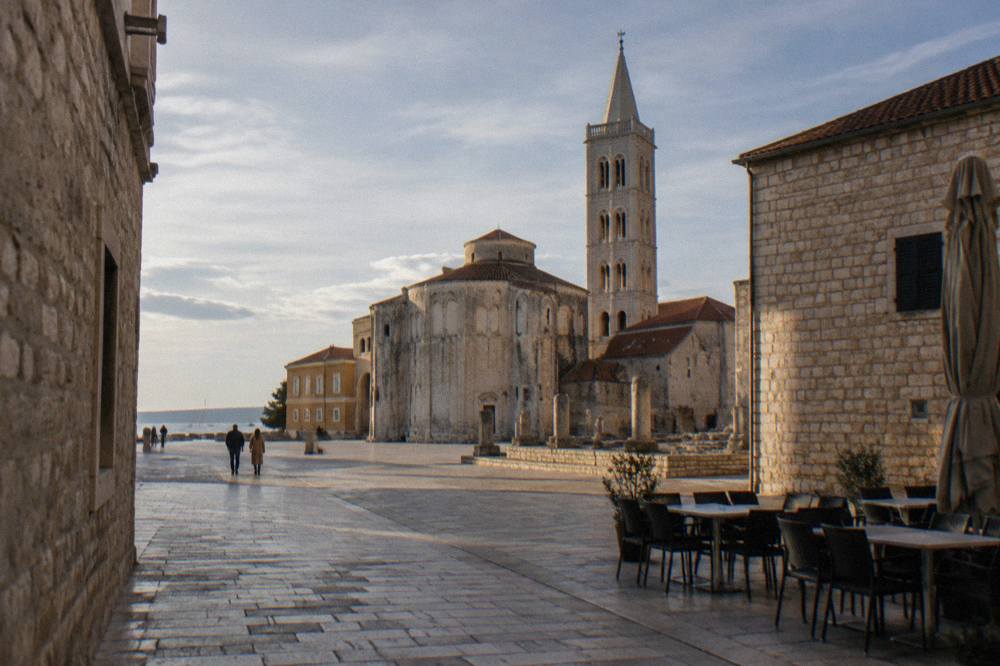
On the ground, the peninsula shape does the quieting. The Old Town is car-light, small enough that the walk from the Land Gate to the Sea Organ is a matter of minutes, and the riva faces open water rather than a working harbour. Visitors weighing length of stay can start with how many days Zadar needs and the broader is Zadar worth visiting case. For orientation on the ground, a guided Old Town walking tour covers the Roman Forum, Kalelarga and the seafront in one loop.
Common Questions About Zadar And Split
Is Zadar nicer than Split?
There is no evidence-based verdict. What the record shows: Zadar is a smaller peninsula town with free seafront installations, park day trips of 19.8 to 145 km, and a milder shoulder season, while Split lies 158 km to the south. The choice comes down to pace and priorities.
How far is Zadar from Split?
158 km by road, from the Zadar airport page's driving distances. Practical route options are covered in the Split to Zadar travel answer on this site.
Is there a train between Zadar and Split?
Bus and car are the surface options.
What is free to see in Zadar?
The Sea Organ (2005) and the Greeting to the Sun (2008), both by Nikola Bašić and open at all hours, plus the Roman Forum, Kalelarga, Five Wells Square and the Land Gate of 1543.
Which national parks are closest to Zadar?
Paklenica at 46.8 km, Krka's Skradinski Buk at 91 km and Plitvice at 145 km, all computed driving distances from the Old Town. Nin, a historic town rather than a park, is 19.8 km away.
When is the best time to visit Zadar?
On the DHMZ Zadar station record, 1961-2024, July averages 24.5 C and September 20.2 C, while November is the wettest month at 123 mm. Shoulder months combine warm sea air with lower park entry prices, which drop on 1 October each year.
