Is Zadar The Oldest City In Croatia?
The claim that Zadar is the oldest city in Croatia circulates widely. This page separates what is verified from what is not, and explains what the city's documented history actually supports.
Zadar sits on a narrow peninsula on the Dalmatian coast of Croatia, ringed by the Adriatic on one side and the islands of Ugljan and Dugi Otok on the other, and it is regularly described in travel copy as the country's most ancient settlement. The claim is repeated often enough that it deserves a straight answer: no agreed founding date exists for Zadar, nor for any rival Croatian city, and no authority declares a winner. What the city offers instead is a set of dated, tangible traces, from the Roman street grid still in use underfoot to the UNESCO listing of 2017, and they describe a place with an uncommonly deep and visible past, whether or not it holds a title no authority awards.
Is Zadar The Oldest City In Croatia?
Zadar's long history is real, but the specific superlative circulates in travel writing and tourism copy rather than in a document that settles it, and other Dalmatian settlements, including Nin and Split, carry competing traditions of their own. The responsible answer is that Zadar is ancient, visibly and walkably so, and that Croatia has no official ranking of its cities by age.****
The reason the question is hard to close is structural. A city's "age" can mean the first settlement on the site, the first urban status, or the first written mention, and each measure produces a different winner. Settlement sites on the eastern Adriatic reach back into prehistory, and the Liburnians, an Illyrian people whose maritime strength the ancient sources record, held the coast before Roman expansion. Roman Zadar became a colony and a regional capital, and the peninsula's grid of streets still follows that Roman plan. None of that, though, hands any modern city a first-place certificate, and the sites themselves rarely announce dates that neat.
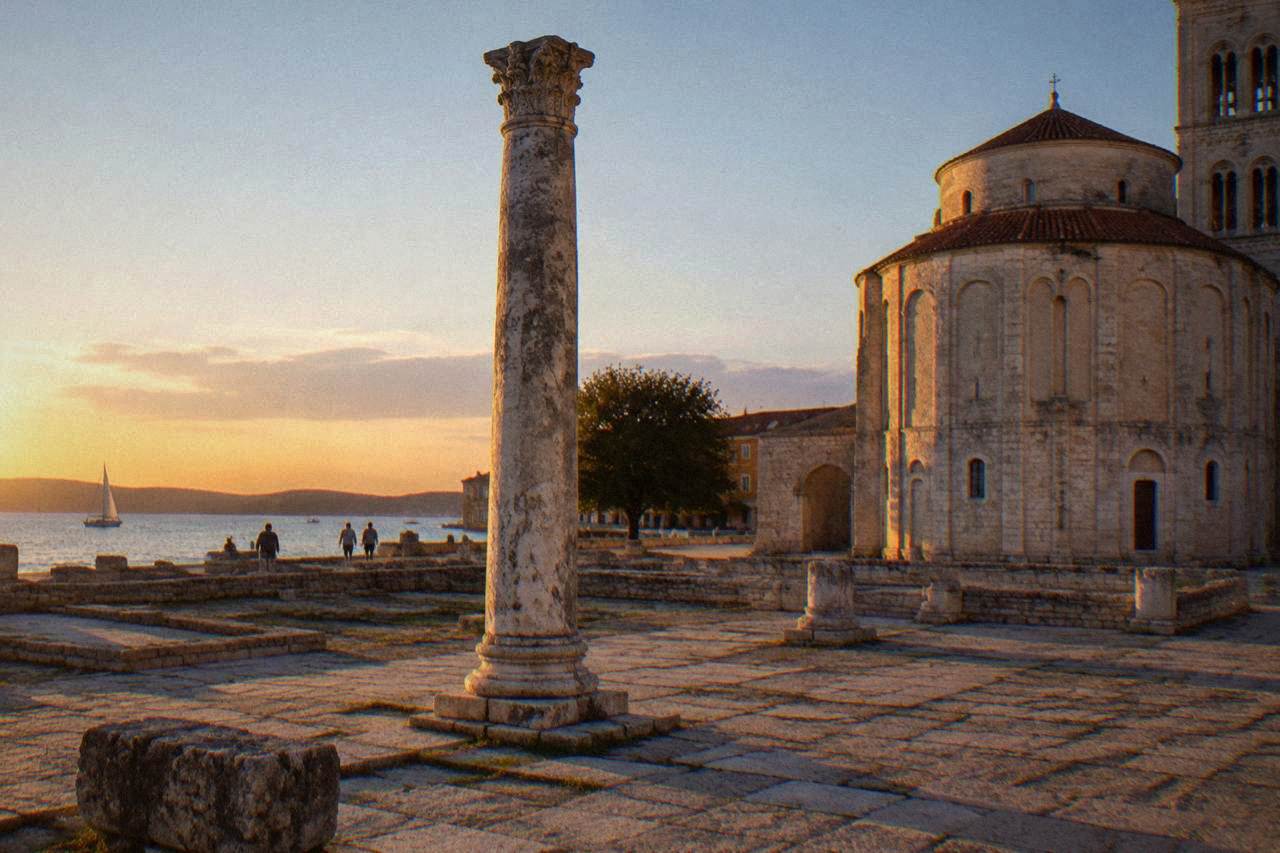
What can be said without hedging is narrower and more useful. Zadar's Old Town, the Poluotok, carries physical evidence of layer upon layer, Roman, medieval, Venetian and modern, within a walk of a few hundred metres. The Roman Forum lies open to the sky beside the Church of St Donatus, itself awaiting a roof restoration from autumn 2026 that may limit access. A city where a pre-Romanesque church stands on a Roman forum square, at the foot of a medieval cathedral, is old by any reasonable definition of the word. Whether it is the single oldest is a question the sources leave open.
What History Does Zadar Actually Have?
The verified dates are the Land Gate of 1543, the Sea Organ of 2005, the Greeting to the Sun of 2008, and Zadar's inscription in 2017 as one component of a UNESCO World Heritage property of Venetian defence works. No founding date, no casualty figure for the wartime bombing, no Sphinx or Pillar of Shame detail, and no etymology of the name Zadar was verified, and none of those appear on this page as fact.
The Land Gate, the work of the architect Michele Sanmicheli, dated 1543, anchors the Venetian period. The UNESCO inscription of 2017 added Zadar to a serial property of Venetian fortifications shared with sites in Italy and Montenegro, and it covers the defensive system, not the Old Town as a whole. The two modern installations by Nikola Bašić, the Sea Organ and the Greeting to the Sun, belong to the same waterfront but to a different era.
| Verified fact | Date | Status |
|---|---|---|
| Land Gate (Kopnena vrata), Michele Sanmicheli | 1543 | Verified via city and common reference pages |
| Sea Organ, Nikola Bašić | 2005 | Verified on the city's own culture page |
| Greeting to the Sun, Nikola Bašić | 2008 | Verified on the city's own culture page |
| UNESCO Venetian defence works inscription, Zadar component | 2017 | Verified on the UNESCO listing page |
Notice what the table does not contain. There is no row for a founding year, and the wartime destruction of the city, the origin of the Sphinx on the waterfront, and the Pillar of Shame beside the Five Wells Square are all topics this site describes only where a card supplies the detail.
The visible fabric of the peninsula tells the longer story anyway. The Kalelarga, the main street the Roman grid dictates, the excavated forum stones reused in medieval walls, the Cathedral of St Anastasia rising above the roofline: these are the layers a visitor actually meets. For a structured introduction to them, a guided walk such as the Zadar city highlights walk covers the peninsula's core, or Check availability for the eco tuk tuk alternative that reaches corners beyond walking pace.
Which Other Croatian Places Carry Competing Claims?
Nin, a small town about twenty kilometres from Zadar by road, is the strongest local rival to any age superlative, with its own tradition as an early Liburnian and royal Croatian centre, while Split and Šibenik add Roman and medieval weight to the argument. Nin sits about 19.8 km from Zadar's Old Town, roughly a 28-minute drive.
Nin deserves the attention of anyone asking this page's question. It is tiny compared with Zadar, it stands on a lagoon rather than a peninsula, and its tradition as a seat of early Croatian rulers gives it a claim that Croatian popular history takes seriously. The file behind this site holds the road distance and nothing about Nin's attractions or dates, so the honest move is to point there and let the reader look: is Nin worth visiting?
Split carries a different kind of weight, because its core grew inside a Roman palace whose survival is exceptional, and Šibenik its cathedral. The comparisons people usually reach for are practical rather than archaeological, and this site's answers on Zadar versus Split and on Šibenik or Zadar stick to what a traveller can plan around. For the age question itself, no ranking emerges, and a reader who meets one should ask which measure of age it uses and who counted.
| Place | Tradition or claim in circulation | Notes |
|---|---|---|
| Zadar | Presented in travel copy as Croatia's most ancient city | No founding date is recorded; a Roman street grid and ruins are visible, with dated layers from 1543 onward |
| Nin | Early Liburnian centre and a seat of medieval Croatian rulers | About 19.8 km by road from Zadar |
| Split | Urban core inside a Roman imperial palace | |
| Šibenik | Medieval Dalmatian city with a famous cathedral |
The pattern in that table is the answer in miniature. Every city in the region can point at something very old, and none can produce a number that ends the argument. Croatia's recorded urban history is deep, shared and layered, which is precisely why the superlative keeps circulating without ever being settled. More of these guides are collected on Zadar Croatia Travel Guide.
How Old Does Zadar Feel When You Walk It?
Zadar compresses an extraordinary span of building into a peninsula roughly a kilometre across, so the sense of age comes less from any single monument than from the density of overlap: a Roman forum beside a pre-Romanesque church, Venetian walls around a street grid the Romans laid out, and a modern sound installation set into the same quay. The population is 67,309 at the 2021 census, a figure the Croatian Bureau of Statistics reported and a secondary site relayed; the Old Town's own count was not found.
Walking the peninsula makes the layering physical. Begin at the Land Gate of 1543, the formal Venetian entrance across the moat, and the scale of the fortification programme becomes clear. Continue along Kalelarga and the grid refuses to bend, because it predates every building that lines it. At the forum the ground itself is the exhibit, column stumps and paving open to the sky, with the Church of St Donatus standing in deliberate dialogue with it. Finish on the riva, where the Sea Organ of 2005 turns the Adriatic's waves into sound through steps designed by Bašić, and the Greeting to the Sun of 2008 answers it after dark. Both are free, open public installations, accessible at all hours, and neither is ticketed, whatever a listing implies.
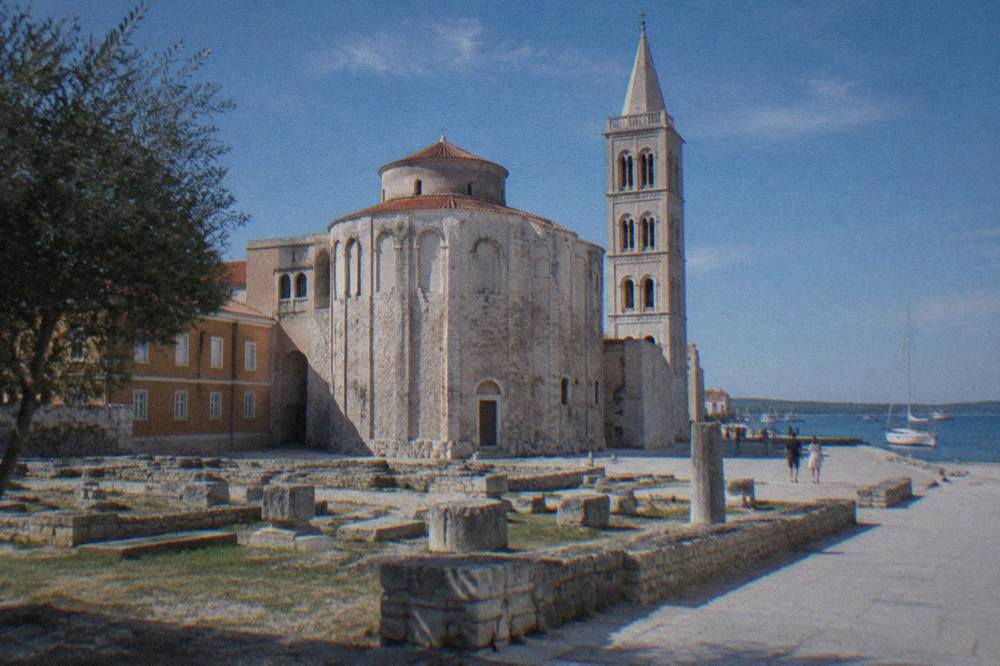
Practical note for 2026 and 2027: the Church of St Donatus faces a roof restoration planned from autumn 2026, about six months of works as the first phase of a longer programme, with group visits suspended and individual access dependent on the phase. Check before going. The rest of the circuit is unaffected, and the whole loop needs no ticket at all, which makes it one of the more generous historic cores on the coast. Visitors weighing time in the city can start with how many days in Zadar is enough, and anyone curious about what the city is known for beyond its stones has a companion page on what Zadar is famous for.
Common Questions About Zadar's Age And History
Is Zadar the oldest city in Croatia?
No verified source settles the question. Zadar has a long, layered and visible history, and the superlative belongs to travel copy rather than to an official record.
What is the oldest verified structure in Zadar?
The Church of St Donatus and the Roman Forum are the oldest-looking monuments on the peninsula, and both are free to view from outside.
Is Zadar a UNESCO World Heritage Site?
The Old Town as a whole is not. Zadar's defensive system is one of six components of a serial UNESCO property of Venetian fortifications, inscribed in 2017.
Was Zadar bombed in the Second World War?
The city suffered heavy wartime destruction, but no casualty or damage figure was verified for this site, so none is printed. The rebuilt peninsula carries the marks of that reconstruction alongside its older layers.
Why does the Sea Organ date from 2005 if Zadar is so old?
Because the city keeps adding layers. The Sea Organ, by Nikola Bašić, opened in 2005, and the Greeting to the Sun followed in 2008. Both sit on the same quay as fortifications centuries older, which is the point: in Zadar the ancient and the contemporary share one waterfront.
Which is older, Zadar or Nin?
The file holds no founding date for either, so the honest answer is that both carry long traditions and neither can be ranked by a verified number. Nin lies about 19.8 km from Zadar by road, close enough to compare in person on one trip.
The claim examined on this page will keep circulating, because cities rarely correct a flattering superlative. What the peninsula offers a visitor is something better anyway: a Roman grid, a 1543 gate, a UNESCO-listed defence system and two modern installations within a short walk of each other, and a place where the question of which Croatian city came first matters far less than how much of the past is still standing in use.
