Is Zadar Or Zagreb Better?
A sourced comparison of Zadar and Zagreb for travellers choosing between Croatia's coast and its capital: distances, climate, costs and what each city does best.
Zadar is a coastal city in Dalmatia, Croatia, sitting on a narrow peninsula that pushes out into the Adriatic Sea, with the islands of Ugljan and Dugi Otok a short ferry ride offshore. Zagreb is the country's inland capital, roughly 297 km away by road according to the airport's own driving-distance page. The two cities compete for the same travellers only loosely, because they sell different trips: Zadar sells the sea, the islands and the national parks of Dalmatia, while Zagreb sells museums, café life and the rail and motorway hub of the north.
Is Zadar Or Zagreb Better?
For a trip built around the sea, swimming, island ferries and day trips to Krka, Plitvice, Kornati and Paklenica, Zadar is the better base: its sights are free, coastal and walkable, and the parks sit within a few hours by road. Zagreb suits a city break of museums, winter culture and onward travel through central Europe, and the sources here say nothing that would tip a coastal holiday in its favour.
That is the honest shape of the answer. This site has verified Zadar deeply, from its climate record to its ferry routes and park tariffs, and has verified nothing about Zagreb's attractions, prices or character beyond the road distance. So the comparison below stands on Zadar's sourced strengths, and on what a traveller gives up by choosing an inland capital instead of a Dalmatian port.
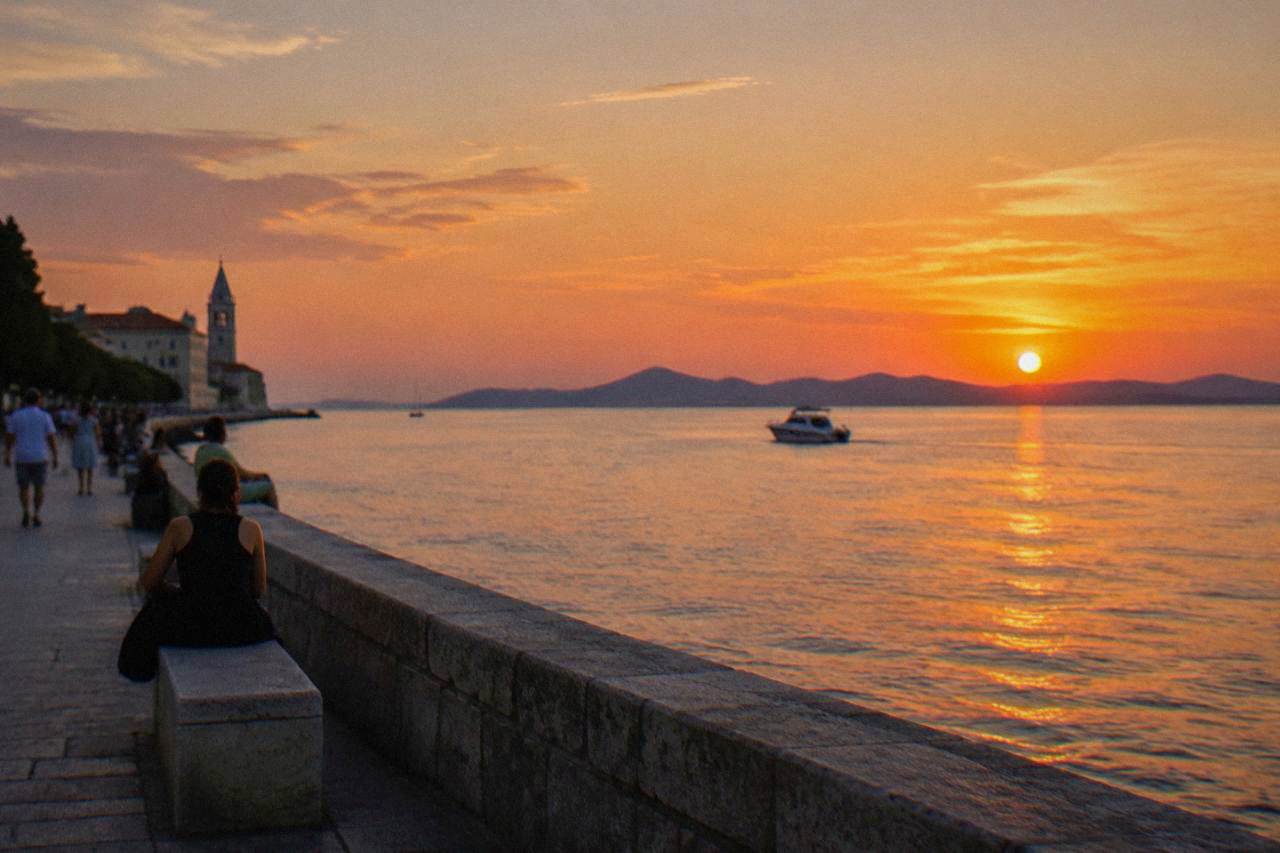
The first structural difference is the setting. Zadar's Old Town occupies the Poluotok peninsula, so the sea is on three sides of the historic core and the Riva promenade runs along the water's edge. The Sea Organ, an installation by Nikola Bašić from 2005, and the Greeting to the Sun, from 2008, sit on that waterfront as free, open, round-the-clock public installations, as the city's own pages confirm. No inland capital can offer that combination, and in Zagreb the equivalent evening would be a walk between squares rather than along an open sea horizon.
The second difference is what surrounds each city. From Zadar, the day-trip radius reaches five national parks and nature parks with published 2026 tariffs, plus islands reachable by scheduled ferry. The distances were computed by road routing: Nin is 19.8 km away, Paklenica 46.8 km, Skradin 76 km, the Skradinski Buk entrance of Krka 91 km, and Plitvice 145 km. Krka and Plitvice are long days from here, and the driving alone to Plitvice runs about 153 minutes, so the distance itself argues for basing in Zadar rather than reaching these parks from anywhere further away.
For a first orientation in the Old Town itself, the Gligora-sponsored cheese and deli walking tour covers the peninsula's sights with tastings built in, and it is one of the three Zadar options picked below.
What Does Zadar Have That Zagreb Cannot Match?
Zadar has the Adriatic on three sides of its Old Town, free waterfront installations, working island ferries from Gaženica, and five fee-charging national or nature parks inside a day-trip radius, with published 2026 prices. Zagreb, as an inland capital, offers none of these, and the sources here attach no coastal equivalent to it at all.
Start with the free sights, because they carry real weight in a cost comparison. The Sea Organ and the Greeting to the Sun are open public installations with no ticket, no gate and no closing hour. The Roman Forum, Five Wells Square, Kalelarga and the Land Gate of 1543, built by Michele Sanmicheli, are all public space with free access. The Museum of Ancient Glass charges 7.00 EUR for an adult ticket, its own price list shows, and the Archaeological Museum and St Donatus run on a tariff with a 7.00 EUR row. A Zadar day can therefore be built almost entirely from free public space, with a museum or two priced in euros.
Then the sea. The islands of Ugljan and Dugi Otok sit directly offshore, and Jadrolinija's route pages show scheduled crossings: about 25 to 30 minutes to Preko on Ugljan, and one hour 40 minutes on line 434 to Brbinj on Dugi Otok from the Gaženica port. A traveller based in Zagreb simply has no equivalent: no scheduled island ferry, no swimming within the city, and no boat tours leaving from a downtown harbour, which is why Zadar's boat-trip roster is as large as it is.
Which City Has The Better Climate For A Holiday?
Zadar's station record, 1961-2024, shows a Mediterranean coastal pattern: a July mean of 24.5 C, a January mean of 7.3 C, July the driest month at 35.4 mm and November the wettest at 123 mm, with about 2,600 hours of sunshine a year. No comparable Zagreb figure exists in the sources, so no inland comparison is printed.
The station table matters because it is a seaside record. The Zadar station sits on the sea, and its monthly means are the ones this site prints for the city. The rain is concentrated in autumn and winter: September carries 110.9 mm, October 106.8 mm and November 123.0 mm, while summer months stay far drier. Rain days run five in July and twelve in November and December. For trip timing, that record points to late spring through early autumn for swimming and boat days, which is precisely the season the island ferries and park entries are built around.
| Month | Mean temperature (C), Zadar station 1961-2024 | Precipitation (mm) |
|---|---|---|
| January | 7.3 | 76.4 |
| March | 10.0 | 66.3 |
| May | 17.9 | 64.4 |
| July | 24.5 | 35.4 |
| September | 20.2 | 110.9 |
| November | 12.1 | 123.0 |
What Zagreb offers in the same months is a different question. What can be said is that a winter city break and a winter coastal break are different products, and Zadar's own winter offer now includes Zadar Advent, running 24 November 2026 to 2 January 2027 with an ice rink on the Forum, as the city's events page lists.
How Do The Costs Compare?
Zadar's known costs are its published park tariffs, its museum tickets and its euro-denominated prices, while no Zagreb price appears in the sources, so a direct cost comparison cannot honestly be made. Croatia has used the euro since 1 January 2023, and both cities share that currency, Schengen membership and the 112 emergency number.
The park tariffs are the clearest published figures, and they belong to Zadar's day-trip radius. Krka charges adults 7 EUR in the January-to-March and November-to-December window, 20 EUR in April, May and October, and 40 EUR from June to September. Plitvice charges 10, 23 and 40 EUR on the same seasonal ladder. Paklenica runs 5, 8 and 10 EUR by season, Telašćica 6 or 8 EUR, and Kornati charges per vessel by length and season rather than per person, with the ticket bought outside the park. A traveller budgeting park days from Zadar can price them exactly, which is a planning advantage the capital cannot match for these parks. The rest of the planning pages sit on Zadar Croatia Travel Guide.
| Park (from Zadar) | Adult entry, low season | Adult entry, shoulder | Adult entry, Jun-Sep |
|---|---|---|---|
| Krka NP | 7 EUR | 20 EUR | 40 EUR |
| Plitvice Lakes NP | 10 EUR | 23 EUR | 40 EUR |
| Paklenica NP | 5 EUR | 8 EUR | 10 EUR |
| Telašćica Nature Park | 6 EUR | 6 EUR | 8 EUR |
Two Zadar-specific cost notes matter. A tourist tax exists and is collected by the accommodation, and its amount is confirmed at booking rather than printed here. And in 2026 the county adopted beach concession rules that keep access public and free on the county's beaches, with commercial use capped on part of each beach, so a shoreline day in Zadar does not require a paid beach club.
Which Is Better For Day Trips?
Zadar is the stronger day-trip base on every sourced measure: five parks and nature parks within 145 km by road, islands on scheduled ferries, and neighbouring towns such as Nin at 19.8 km and Skradin at 76 km. No Zagreb day-trip distance or destination appears in the sources, so the capital's excursion offer cannot be compared here.
The day-trip case is really Zadar's core argument. The road distances were computed by routing: Paklenica is under an hour, Krka's main entrance about 73 minutes, Plitvice about two and a half hours each way, which makes it a long but workable day. The islands add a second layer, from Ugljan's short crossing to the Kornati archipelago and Telašćica, which organised boat trips reach on full-day circuits. The Krka waterfalls day tour with a boat ride and the Kornati National Park and Telašćica boat tour are two of the most-booked ways to do these without driving, and both appear in the picks band below.
Deciding between the parks themselves is a separate question, and one this site answers in its own Plitvice or Krka comparison. For the coastal comparison with a nearer rival town, see which is better, Zadar or Šibenik, and for the length of stay question, how many days in Zadar is enough works through the trade-offs.
So Which Should You Choose?
Choose Zadar for the sea, free waterfront sights, island ferries, national-park day trips and a compact walkable Old Town, all of it documented in the sources above. Choose Zagreb only if the trip is a city break of museums and northern connections, a purpose no source here can price or verify, in which case Zadar still wins any trip that involves the Adriatic at all.
A useful closing test is the drive between them. The airport's page gives 297 km by road from Zagreb to Zadar, and the Zagreb to Zadar route guide covers that transfer in detail. If the plan involves swimming, boats or parks, that distance is better crossed once on arrival and not again, which means sleeping in Zadar. If the plan involves neither sea nor islands, the coastal city's advantages simply do not engage, and the capital serves that different itinerary.
For anyone still weighing the coast against the coast, the site's other comparisons cover Zadar against Split, where both cities are properly sourced. Against Zagreb, the verdict here rests on what Zadar verifiably has: the Adriatic on three sides, a free waterfront of installations by Nikola Bašić, ferries to real islands, and five parks within a day's drive.
A final practical note on access. Zadar Airport sits about 8 km from the city by its own how-to-get-here page, with a shuttle bus at 5.00 EUR one way including luggage, about 20 minutes to the Old Town, and the airport's new departures terminal was presented on 24 July 2026 as part of an expansion toward three million passengers a year. For more on that connection, see how to get from Zadar Airport to the city centre. The airport's growth is itself an argument in the comparison: the coastal city is easier to reach directly each season, and the flights, the ferries and the parks all point the same way.
Common Questions About Zadar Or Zagreb
Is Zadar or Zagreb better?
Zadar is better for a sea-and-islands trip with national-park day trips; Zagreb suits an inland city break. This site's sources cover Zadar in depth and Zagreb only as a road distance of 297 km, so any verdict here rests on Zadar's documented coastal strengths.
Is Zadar worth visiting instead of Zagreb?
On this site's sourcing, yes for coastal travel: the Sea Organ and Greeting to the Sun are free open installations, the Old Town sits on a peninsula, and Krka, Plitvice, Paklenica, Kornati and Telašćica all sit inside a day-trip radius with published 2026 tariffs. The full case is laid out in is Zadar worth visiting.
Is Zadar warmer than Zagreb?
Zadar's station record, 1961-2024, shows a July mean of 24.5 C and a January mean of 7.3 C, with about 2,600 sunshine hours a year. No verified Zagreb climate figure exists in this site's sources, so no comparison is printed.
Can you visit Zagreb and Zadar on one trip?
Yes, by road: the airport's driving-distance page gives 297 km between them, covered in the site's route guide. Tip-based free walking tours also run locally in Zadar; confirm arrangements directly with the guide.
Does Zadar have beaches like the coast near Zagreb?
Zagreb is inland and has no coast. Zadar's beaches sit on the city shoreline and nearby, and the county's 2026 concession rules keep beach access public and free. See can you swim in the sea in Zadar for the swimming picture.
