Why Is There A Sphinx In Zadar?
The stone sphinx standing in the gardens near Maestral Bay in Zadar's Brodarica district puzzles visitors who expect Egypt, not Dalmatia. The love story behind it, how to find it and what else sits nearby.
A stone sphinx stands in the gardens near Maestral Bay in Brodarica, a district of Zadar, a city on the Adriatic coast of Dalmatia in Croatia, a short drive or bus ride from the Old Town peninsula. Travellers who come across it tend to stop and stare: sphinxes belong to Egypt on the usual mental map, not to a Roman-era Dalmatian port with a Sea Organ at the tip of its peninsula. This page covers where the statue stands, how it fits among Zadar's other monuments, and what to combine it with on a visit to the city.
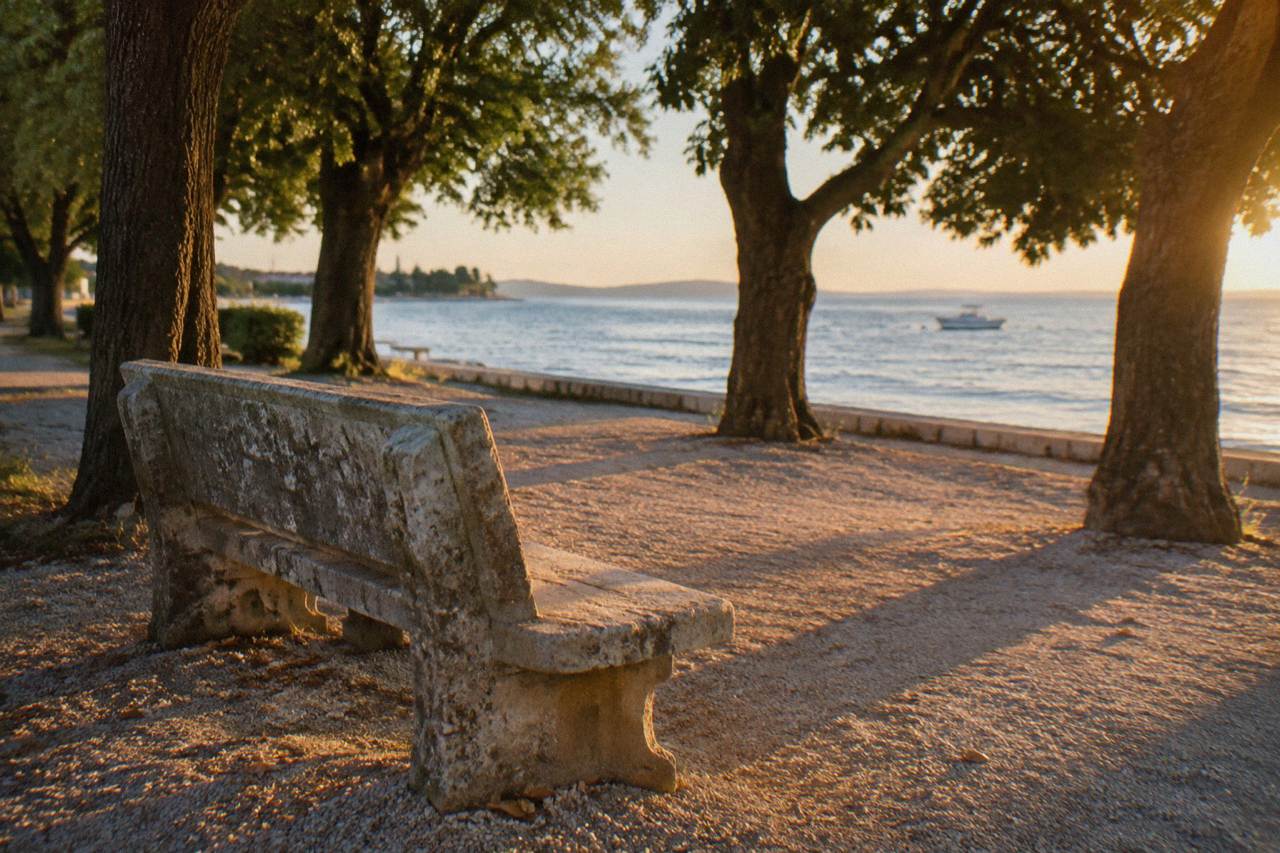
Why Is There A Sphinx In Zadar?
Zadar's sphinx is a large Egyptian-style stone figure standing in the gardens near Maestral Bay, in the Brodarica district a short drive or bus ride from the Old Town.
The statue is not ancient. Nothing ties Zadar to Pharaonic Egypt, and the city's genuinely old layers are Roman: the Forum, the remnants in the Archaeological Museum and St Donatus, the Land Gate of 1543. The sphinx instead belongs to a much later fashion, the period when Egyptian motifs spread across European gardens and cemeteries as decorative shorthand for eternity.
That fashion produced sphinxes all over the continent, on park benches, tomb fronts and villa gates. Zadar's example stands in the gardens near Maestral Bay in the Brodarica district, a short drive or bus ride from the Old Town, and with the sea close by it photographs convincingly as a Mediterranean mystery. The spreading of the motif was decorative, not archaeological, and once that is understood the statue stops being an anomaly and becomes a period piece.
The research desk treats the statue the way it treats the nearby Pillar of Shame: a monument whose popular story outruns its documented story. Both are worth seeing, both deserve honest framing, and neither needs a legend to justify the short detour. A visitor who arrives with the popular version in mind and leaves with the documented version will still have enjoyed the stop, because the statue is genuinely strange to look at regardless of which account of its origin is true.
Where To Find Zadar's Sphinx
Zadar's sphinx stands in the gardens near Maestral Bay in the Brodarica district, a short drive or bus ride from the Old Town, so it makes an easy side trip rather than part of a walking loop around the peninsula. It sits in public gardens that are free to enter and open through the day.
The peninsula of Zadar is compact. A walk from the Forum to the park edge takes minutes rather than an hour, and the route can be strung together with the Roman Forum, the Sea Organ and the Greeting to the Sun at the tip, which the city's own pages date to 2005 and 2008, both by the architect Nikola Bašić. This density is the peninsula's defining quality: monuments accumulate rather than sprawl, and a single loop collects two millennia of building, along with the modern installations at the water's edge.
For planning purposes, a reasonable half-day circuit looks like this:
| Stop | What It Is | Access |
|---|---|---|
| Roman Forum | Open-air Roman square | Free, public |
| Five Wells Square | Historic square with stone wells | Free, public |
| The sphinx | Egyptian-style stone monument in the Brodarica district, near Maestral Bay | Free, public, a short drive or bus ride from the Old Town |
| Sea Organ | Wave-driven sound installation, 2005 | Free, open at all hours |
| Greeting to the Sun | Solar light installation, 2008 | Free, open at all hours |
Visitors assembling that circuit from a base in the city may want a guided version, and an Old Town walk with a Maraschino tasting covers the peninsula's streets and the local liqueur in one outing. Independent walkers will manage the same ground on foot without difficulty, and the sphinx itself stands in the gardens near Maestral Bay in Brodarica, a short drive or bus ride from the Old Town.
The Zadar Sphinx
The sphinx stands today in the gardens near Maestral Bay in the Brodarica district, a short drive or bus ride from the Old Town.
That distinction matters, because the sphinx has attracted exactly the kind of detail that grows in the retelling: precise years, names and motives that the statue itself never needed. It still stands in the gardens near Maestral Bay in the Brodarica district, a short drive or bus ride from the Old Town, out of its original context and all the more curious for it. The wider set of guides lives on Zadar Croatia Travel Guide.
Zadar has form for this layering. The city is one of six components of the UNESCO property "Venetian Works of Defence", the transnational inscription of Stato da Terra and western Stato da Mar fortifications listed in 2017, yet the peninsula also holds Roman stonework, a 1543 Land Gate by Michele Sanmicheli and two installations from the 2000s. A garden sphinx from the modern era belongs to the same story, though it stands a short drive away in the gardens near Maestral Bay in the Brodarica district; it is simply the youngest riddle among older ones, and the only one wearing a headdress.
Readers deciding whether the city deserves their time will find the broader verdict in is Zadar Croatia worth visiting, which weighs the city's full set of monuments and sights rather than a single statue. The short version is that the sphinx is a garnish, not the meal, and the meal is strong.
The Zadar Sphinx
Zadar's sphinx is a large Egyptian-style stone figure, not an ancient Egyptian original, and that difference explains both why it surprises people and why it is free to visit: it stands in the gardens near Maestral Bay in the Brodarica district, a short drive or bus ride from the Old Town, with no ticket and no queue. It belongs with the European sphinxes rather than the Giza ones.
The comparison table the desk uses for visitors:
The lesson for a visitor is calibration. Come expecting a curiosity worth ten minutes and a photograph, and the sphinx delivers. Come expecting a lost chapter of Egyptian history and the gardens near Maestral Bay will underwhelm. The same calibration applies to the Pillar of Shame, Zadar's other monument whose name promises more scandal than the reality behind it. Between the two, a visitor learns something useful about how cities accumulate stories, and about which claims deserve skepticism before they are repeated onward.
What Else To See Around The Sphinx In Zadar
The sphinx does not sit inside the walkable core that makes Zadar a low-effort city: it stands in the gardens near Maestral Bay in the Brodarica district, a short drive or bus ride from the peninsula. The Roman Forum, Five Wells Square, Kalelarga, the Land Gate of 1543, the Cathedral of St Anastasia and the Sea Organ all sit within that same compact peninsula and can be covered in a relaxed morning or afternoon, but treat the sphinx as a destination in its own right rather than one stop on a walking loop.
Two practical notes. St Donatus Church faces planned roof restoration works, set to begin in autumn 2026 and run around six months, so access may be limited and should be checked before a visit built around it. The Old Town has posted dress-code signs at key access points: swimwear is not appropriate in the historic core, and fines can reach 130 EUR, so cover up between beach and sightseeing.
The Sea Organ and the Greeting to the Sun, both by Nikola Bašić and free at all hours, anchor the western tip of the loop.
Readers with more than a day in hand can push beyond the peninsula on a guided quad tour through the hidden trails of Dalmatia, which trades Roman stone for the scrubby hills behind the coast.
For a fuller sense of what the city offers beyond monuments, see the roundup of what Zadar is famous for, which places the sphinx, the sunsets and the maraschino in one frame, along with the guide to how many days in Zadar is enough for when the answer includes islands.
Common Questions About The Sphinx In Zadar
Why is there a sphinx in Zadar?
It is not an ancient import. It stands in the gardens near Maestral Bay in the Brodarica district, a short drive or bus ride from the Old Town.
Is the Zadar sphinx ancient?
No. Nothing connects it to ancient Egypt. Zadar's genuinely old layers are Roman and Venetian, including the Land Gate of 1543 and the UNESCO-listed Venetian defensive works inscribed in 2017.
Do you need a ticket to see the sphinx in Zadar?
No. It stands in a public garden near Maestral Bay in the Brodarica district, and there is no charge to see it. The Sea Organ and Greeting to the Sun, back in the Old Town, are likewise free and open at all hours.
Is the sphinx near the Sea Organ in Zadar?
No. The sphinx stands in the gardens near Maestral Bay in the Brodarica district, a short drive or bus ride from the Old Town. The Sea Organ and Greeting to the Sun are at the western tip of the peninsula, minutes apart on foot.
Can the sphinx story be verified before a visit?
The desk's advice is to enjoy the statue as a curiosity and, if the details matter, ask a local guide or the tourist board, whose staff will repeat whatever version is currently told in the city.
