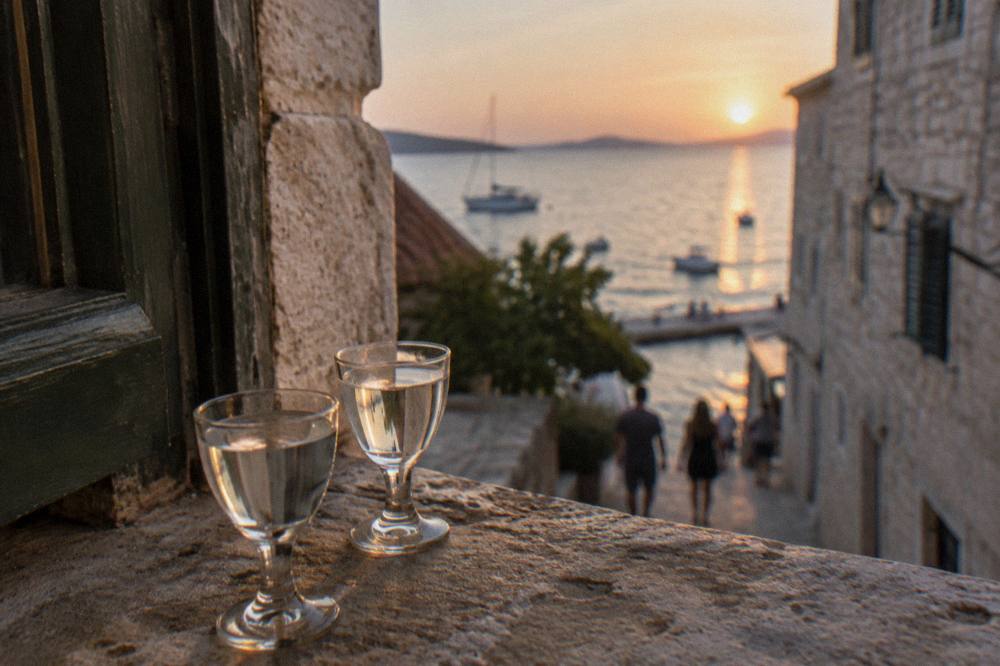
What To Do When It Rains In Zadar?
Rainy-day plans for Zadar, Dalmatia: verified museum prices, covered Old Town walks, food stops and what the DHMZ rainfall record says about when rain actually falls.
Rain reaches Zadar, the coastal city in Dalmatia on the Adriatic, on roughly nine days a month on an average year, and it concentrates hard in late autumn: the Zadar station, 1961-2024 (DHMZ) record puts November at 123.0 mm of rainfall against July's 35.4 mm. A wet morning therefore says nothing about the afternoon, and even a properly grey day leaves museums with verified ticket prices, a compact Old Town you can cross quickly, and a food scene built for sitting out a shower. This page reports what the sources support and stays silent where nothing is verified.
What To Do When It Rains In Zadar?
The short answer is to go indoors for a while and then carry on outside: Zadar's Museum of Ancient Glass lists its adult ticket at 7.00 EUR, the Archaeological Museum and St Donatus run at around 7 EUR full price, and the Sea Organ and Greeting to the Sun are free open-air installations that cost nothing if you choose to stand in the drizzle.
The Old Town sits on a small peninsula, so nothing is more than a short walk from a café, and rain here rarely lasts a whole day.
The rhythm of a wet day writes itself. Start at a museum, because they carry the only verified indoor prices in the city. The Museum of Ancient Glass, on the eastern edge of the Old Town, publishes its full tariff on its own ticket page: 7.00 EUR for an adult, 5.00 EUR for groups of five or more, 4.00 EUR for schoolchildren, and guided tours at 20 EUR in Croatian or 30 EUR in other languages.
After that, the peninsula itself is the plan. The Roman Forum, Kalelarga, Five Wells Square and the Land Gate of 1543 are all free public space, and in rain they empty out and photograph differently. The Sea Organ (2005) and the Greeting to the Sun (2008), both by architect Nikola Bašić, are open at all hours and charge nothing; a storm rolling over the Adriatic while the organ's pipes sound under the waves is arguably the point of the installation rather than a reason to avoid it. For a fuller argument on that, see how the Zadar Sea Organ actually works.
One caveat from the news file: St Donatus Church, usually a stop on any walk, entered a roof-restoration tender in 2026, with works planned from autumn 2026 and group visits suspended during the works. Individual access depends on the phase, so confirm before counting on it as your rainy-day shelter.
Which Zadar Museums Have Verified Prices?
Three indoor sites carry verified or near-verified tariffs: the Museum of Ancient Glass at 7.00 EUR adult, the Archaeological Museum and St Donatus at around 7 EUR full price (the tariff page shows 7.00 and 5.00 EUR rows, with free entry for children up to 10), and the Gold and Silver of Zadar exhibition, whose price is secondary-sourced only and not printed here.
The Museum of Ancient Glass is the anchor of a museum morning, and its price list is the most clearly published in the city. Glassblowing demonstrations and the Roman glass collection fill the interior; the museum's ticket page is the authority for anything current.
| Museum or site | Ticket situation | Notes |
|---|---|---|
| Museum of Ancient Glass | 7.00 EUR adult, 5.00 EUR groups of 5+, 4.00 EUR schoolchildren | Prices from the museum's own price list |
| Archaeological Museum Zadar | Around 7 EUR full price (7.00 and 5.00 EUR rates) | Free for children to 10 and on Museum Night days |
| St Donatus Church | Around 7 EUR full price, same tariff as above | Roof restoration planned from autumn 2026; access may be limited |
| Gold and Silver of Zadar | Check the current price on site | |
| Cathedral of St Anastasia bell tower | Check price and hours locally | Check before climbing |
Beyond the museums with tariffs, the Old Town's churches and exhibition spaces run on their own schedules, and the honest instruction is to confirm at the door. What is verified is that Zadar's defensive system is one of six components of a UNESCO World Heritage property of Venetian fortifications, inscribed in 2017, so the defensive walls themselves are a legitimate rainy walk as long as you accept the weather.
If you would rather have a guide than a plan, the city's walking tours run in rain without any structural problem, since the route is compact and the stops are covered or quick.
Can You Still Explore The Zadar Old Town In The Rain?
Yes, and it often works better: the Old Town occupies a narrow peninsula where the main street, Kalelarga, runs shore to shore, the Roman Forum and the Land Gate are open free at all hours, and the covered façades of the Kalelarga shops give you awnings to move under between stops. The Sea Organ and Greeting to the Sun stay free and open in any weather, and the whole peninsula is small enough that a soaked retreat to a café costs ten minutes, not an hour.
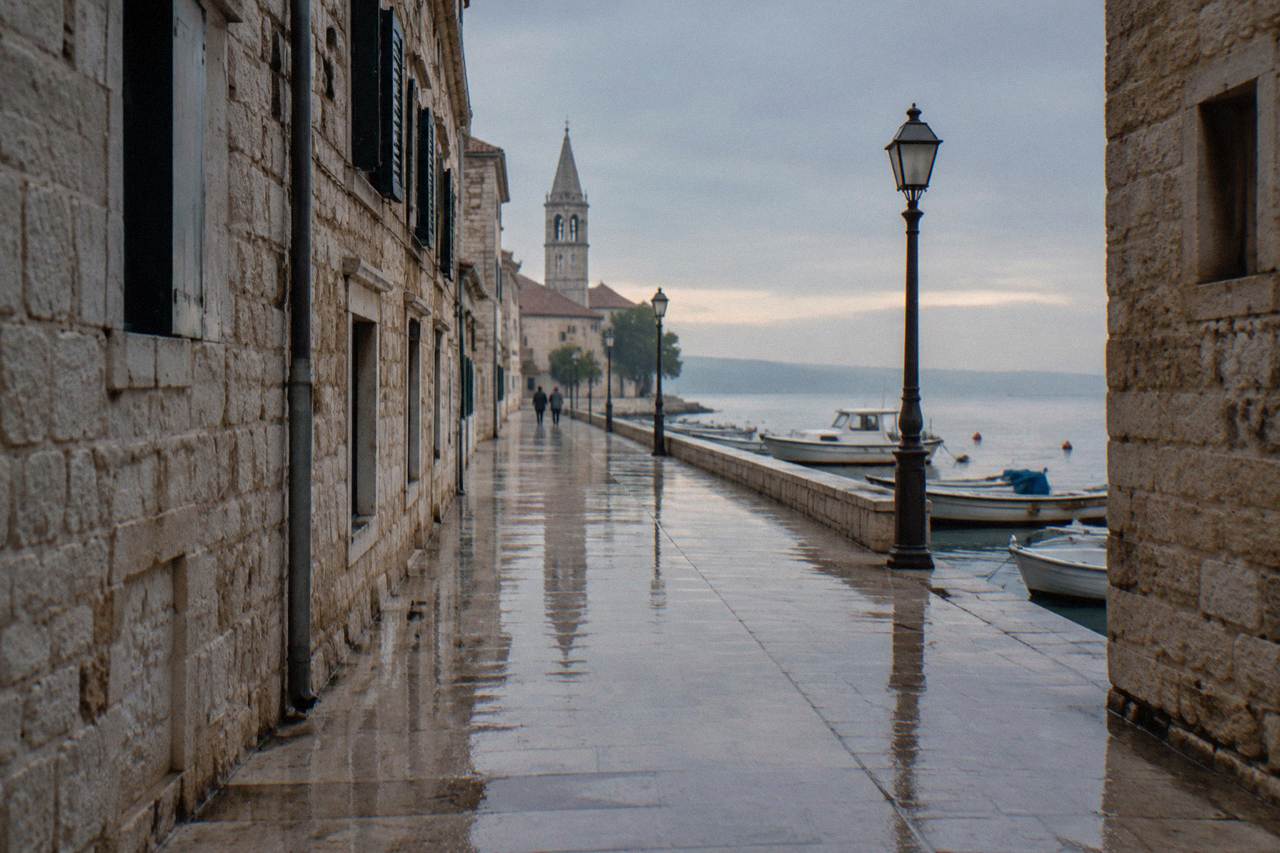
Rain changes the Old Town's texture rather than its availability. The stone paving shines, the Forum empties, and the Land Gate, built in 1543 to a design attributed to Michele Sanmicheli, becomes a photograph rather than a queue. Dress for it: the 2026 dress-code signs at the peninsula's access points ask for appropriate clothing and no swimwear, with reported fines up to 130 EUR after a warning, and while that rule targets summer, soaked footwear on polished stone is its own penalty.
A guided walk keeps the momentum on a grey day, and the cabrio sightseeing bus is the fair-weather counterpart worth holding in reserve for the afternoon if the sky clears.
Is A Guided Walk Or A Bus Better When The Weather Is Bad?
On a wet day the walk wins on shelter, since the route sticks to the peninsula where doorways and arcades interrupt the rain, while the panoramic bus trades shelter for coverage of the wider city. Both run year-round calendars on their listings. A separate question, whether Zadar's Old Town is worth visiting at all, gets the same answer in rain as in sun: the peninsula is the city.
Where To Eat And Drink In Zadar On A Rainy Day?
Zadar's food answer to rain is the same as its answer to everything: sit down and stay a while. The Old Town's konobas, pastry shops and wine bars cluster on and around Kalelarga and People's Square, the city gives its name to maraschino, the cherry liqueur historically produced here, and a long lunch is the standard local strategy for outlasting a shower.
The structure helps. Because the peninsula is dense, a restaurant is never more than a few streets from any point in the Old Town, and the rainy-day gap between museum and dinner closes itself. Local dishes to look for are the Dalmatian standards the region is known for, and the question of what food Zadar is known for covers that ground in detail. Maraschino deserves its own slow glass; the liqueur's history in the city is long and the tasting pours are generous.
One reported rule change belongs on this page because it affects evening plans: for the 2026 season the municipality signalled an intent to restrict night-time retail alcohol sales in the Old Town, meaning shops and kiosks rather than bars and restaurants, under a national law change. As reported, this pushes late evening drinking into licensed venues, which on a rainy night is where you would be anyway.
When Does It Actually Rain In Zadar?
The rainfall record for the Zadar station, 1961-2024 (DHMZ), shows a hard Mediterranean pattern: July is the driest month at 35.4 mm, November the wettest at 123.0 mm, and rain days run from 5 in July to 12 in November and December, so a trip in late autumn should plan for wet days realistically while a summer visit may see no rain at all.
Autumn storms arrive with the jugo wind from the south-east, and the cold bora from the north-east more often brings clear skies than rain.
The full monthly picture, from the station table:
| Month | Mean temperature (C) | Rainfall (mm) | Rain days |
|---|---|---|---|
| January | 7.3 | 76.4 | 10 |
| February | 7.8 | 67.0 | 9 |
| March | 10.0 | 66.3 | 9 |
| April | 13.4 | 61.4 | 10 |
| May | 17.9 | 64.4 | 10 |
| June | 21.9 | 48.5 | 8 |
| July | 24.5 | 35.4 | 5 |
| August | 24.1 | 52.8 | 6 |
| September | 20.2 | 110.9 | 9 |
| October | 16.3 | 106.8 | 9 |
| November | 12.1 | 123.0 | 12 |
| December | 8.6 | 99.6 | 12 |
Two readings of that table matter for planning. First, September through December carries four consecutive months above 99 mm, so if your trip falls there, a museum shortlist is not pessimism, it is arithmetic. Second, the shoulder months still deliver: the city records about 2,600 hours of sunshine a year (the station sum is 2,590.8), and even November averages 119.2 sunshine hours, so rain here arrives in episodes rather than occupation. The question of the best time to visit Zadar weighs those numbers against crowds and sea temperatures.
And when the rain finally stops, the sea is the immediate next move. The full-day boat trip through the Kornati islands and Telašćica Nature Park, the All Day Telašćica and Kornati Islands Tour, is the classic clear-day payoff from Zadar, and a rainy morning is exactly when to check its availability for the following day. Check availability. Note that Kornati entry is charged per vessel by length and season, unlike the per-person fees at Krka and Plitvice, a detail covered in where the ferries from Zadar go.
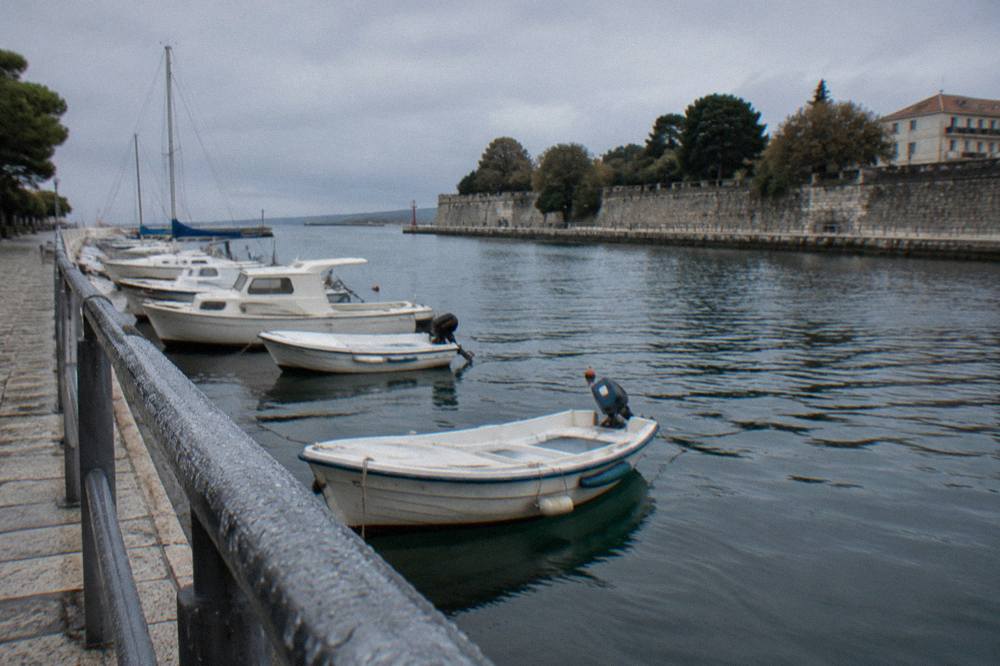
For a wider framing of the city beyond weather, the Zadar Croatia Travel Guide homepage gathers the attractions, itineraries and day trips in one place, including the things to do in Zadar roundup for the days the sun returns.
Common Questions About Rainy Days In Zadar
Does it rain a lot in Zadar?
It depends sharply on the season. The Zadar station, 1961-2024 (DHMZ) record shows July at 35.4 mm of rain over about 5 rain days, and November at 123.0 mm over about 12 days. Summer visits can be dry for weeks; late-autumn visits should plan for several wet days.
Is the Sea Organ still worth visiting in the rain?
Yes, and it costs nothing either way. The Sea Organ (2005) and the Greeting to the Sun (2008), both by Nikola Bašić, are free open public installations, open at all hours. Rough weather actually drives the wave action that sounds the organ's pipes.
Can I visit St Donatus Church on a rainy day?
Only if the current restoration phase allows it. A roof-restoration tender was launched in 2026 with works planned from autumn 2026, roughly six months of roof works as the first phase, and group visits are suspended during the works. Individual access depends on the phase, so confirm before going.
Do boat tours from Zadar run in the rain?
Boat trips generally run in light rain and stop for sea state, not drizzle, but the operator decides on the day and the listing states the cancellation terms. A rainy morning is a good moment to check availability for the next clear day, especially for the full-day Kornati and Telašćica route.
What should I pack for possible rain in Zadar?
A light waterproof and shoes with grip on wet stone. The Old Town's polished paving gets slippery in rain, and the dress-code signs at the peninsula's access points ask for appropriate clothing year-round. An umbrella works on the Riva but is a nuisance in the bora wind, which is gusty.