Is Zadar A Walkable City?
Is Zadar a walkable city? Yes: the Old Town sits on a compact peninsula and nearly everything central is within a short walk. Here is what the distances and sources actually say.
Zadar, on the Adriatic coast of Dalmatia in Croatia, is built around a peninsula. The Old Town, called Poluotok, is a finger of land packed with Roman ruins, churches, squares and the riva waterfront, and the city's modern districts spread out behind it on the mainland shore. That shape is the reason the walkability question has a clear answer, and the rest of this page sets out what the measured distances and the official sources say, block by block. The editorial desk behind Zadar Croatia Travel Guide reports figures only where a source carries them.
Is Zadar A Walkable City?
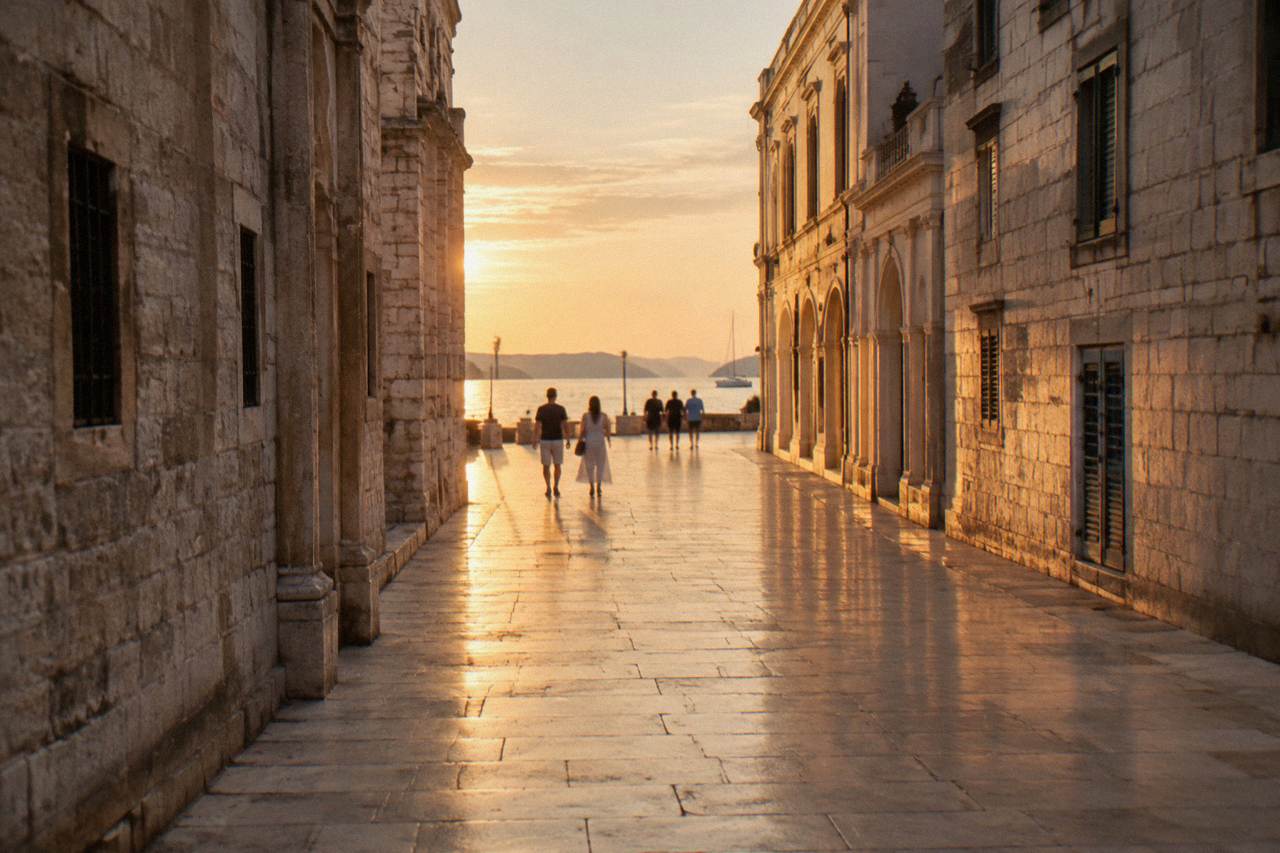
Yes, Zadar is a walkable city, and unusually so by Croatian coast standards: the entire Old Town occupies a narrow peninsula where the main sights, the Roman Forum, the Sea Organ, Kalelarga, the Land Gate and the Cathedral of St Anastasia, all sit within a few minutes of one another on foot, and the historic core itself restricts cars to a minimum. A visitor staying central can cover the whole sightseeing list without once needing a bus or taxi.
The peninsula is the heart of the answer. Because Poluotok is surrounded by water on nearly all sides, the streets inside it run short and connected, and the two installations Zadar is famous for, the Sea Organ from 2005 and the Greeting to the Sun from 2008, both by architect Nikola Bašić, stand free and open at all hours right on the western tip, next to each other. Nothing in that cluster requires transport of any kind.
Outside the peninsula, walkability continues in the inner mainland districts. Beaches such as Kolovare and the residential areas of Arbanasi lie within an easy stroll of the Old Town bridges, and the routes are flat coastal pavement rather than hill climbs, a contrast with cities like Split or Dubrovnik where steep gradients shape every walk. Readers weighing the comparison can also see Is Zadar Nicer Than Split? for how the two cities differ overall.
Two footbridges connect the peninsula to the mainland, and there is also the Barkajoli, a small traditional rowing boat that shuttles across the narrow channel to the west of the Old Town, a crossing of roughly 75 metres taking a minute and a half to two minutes, weather permitting. The fare is not officially published: reports put it at a euro or two, so treat that as a range and confirm with the boatman.
How Compact Is The Zadar Old Town On Foot?
The Zadar Old Town is compact enough that its full length can be walked end to end in well under half an hour at a normal pace, because the peninsula it occupies is narrow and its streets form a small grid rather than sprawl. The Five Wells Square, the People's Square, Kalelarga and the Roman Forum all sit in one continuous pedestrian chain, and the Sea Organ and Greeting to the Sun sit a short walk further west at the tip.
The layout rewards walking in a simple loop. A route can start at the Land Gate, built in 1543 to a design by Michele Sanmicheli, pass through Five Wells Square onto Kalelarga, the main street, cross the Roman Forum with the Church of St Donatus beside it, and finish on the riva at the Sea Organ. Every leg of that loop is pedestrian-priority stone paving.
One 2026 note matters for planners: St Donatus Church faces a roof restoration, with works planned from autumn 2026 for about six months as the first phase of a wider restoration, so access may be limited and should be checked before a visit. The church's exterior and the Forum around it remain public space regardless.
The city has also posted dress-code signs at key entry points to the historic core asking for appropriate clothing, no swimwear or nudity, with fines of up to 130 EUR reported for breaches after a warning. Walkers coming straight from a beach should plan a change of clothes. For readers deciding how long to give the city overall, How Many Days In Zadar Is Enough? breaks the stay down by pace.
A guided walk is one way to anchor the geography quickly. The highlights walk covering the Old Town, the Sea Organ and local tastings has its own live listing, and the transparent LED kayak sunset tour at the end of the trio list lets walkers trade the pavement for the water for an hour, gliding past the same lit-up waterfront they have just crossed on foot.
Can You Walk From Zadar Airport Or The Ferry Port?
No, Zadar Airport is not walkable from the city: the airport's own how-to-get-here page puts it about 8 km away, with driving distance to the Old Town around 13 km and roughly 22 minutes by car, so arrival always involves a vehicle. The ferry port at Gaženica is closer, about 5.2 km and 10 minutes' drive from the Old Town, still beyond a comfortable walk with luggage. The bus station, at 2.6 km, is the one arrival point with a genuine walking option.
The airport runs an official shuttle operated by Liburnija: 5.00 EUR one way including luggage, about 20 minutes to the Old Town via Gaženica and the bus station, with the ticket valid for 90 minutes on city buses. Details are on the airport's own page, and the timetable is published a few days before each month ends. For the full picture of that transfer, including what a taxi would involve, see How Do I Get From Zadar Airport To The City Center? and How Much Does A Taxi Cost From Zadar Airport To Old Town Zadar?.
Here is what the measured distances look like from the Old Town, per the route data compiled for this site:
| Destination | Distance from Old Town | Driving time |
|---|---|---|
| Bus station (Ante Starčevića 1) | 2.6 km | 6 min |
| Gaženica ferry port | 5.2 km | 10 min |
| Zadar Airport (Zemunik) | 13.3 km | 22 min |
| Nin | 19.8 km | 28 min |
| Paklenica National Park | 46.8 km | 57 min |
| Krka NP, Skradinski Buk | 91 km | 73 min |
| Plitvice Lakes NP | 145 km | 153 min |
Jadrolinija's route pages show the ferry connections that start at Gaženica: the Dugi Otok crossing to Brbinj takes 1 h 40 min, and the short hop to Preko on Ugljan runs about 25 to 30 minutes. None of that is walking territory, which is the point: the city itself is a walking city, and everything beyond it, islands and parks alike, is a ferry or a vehicle.
Which Zadar Sights Are Within Walking Distance Of Each Other?
Nearly all of central Zadar's sights are within a five-to-ten-minute walk of each other, because they share one peninsula: the Roman Forum, St Donatus, the Cathedral of St Anastasia, Kalelarga, Five Wells Square, the People's Square, the Land Gate, the riva, the Sea Organ and the Greeting to the Sun form a single connected walking set, all free public space except the museums and church interiors that charge entry.
The museums sit inside the same footprint. The Museum of Ancient Glass lists a 7.00 EUR adult ticket on its own price page, and the Archaeological Museum and St Donatus run on a shared tariff showing 7.00 and 5.00 EUR rows, so around 7 EUR at full price is the safe planning figure for each. Museum hours vary and conflict between sources, so the current opening times should be confirmed on each museum's own page before setting out.
Zadar is also one of six components of a UNESCO World Heritage property of Venetian defensive works, inscribed in 2017, and its part of that listing, the defensive system, is walked rather than driven: the Land Gate and the landward walls frame the peninsula on foot. For readers who want the fuller monument-by-monument context, What Is Zadar Croatia Famous For? covers the headline attractions.
Weather shapes the walking more than distance does. The DHMZ station table for Zadar, covering 1961-2024, shows July means of 24.5 C and January means of 7.3 C, with July the driest month at 35.4 mm of rain and November the wettest at 123 mm. In practical terms, summer walks want shade and water, and November walks want an umbrella.
| Month | Mean temperature (C) | Rainfall (mm) |
|---|---|---|
| January | 7.3 | 76.4 |
| April | 13.4 | 61.4 |
| July | 24.5 | 35.4 |
| October | 16.3 | 106.8 |
| November | 12.1 | 123.0 |
Zadar station, 1961-2024, DHMZ.
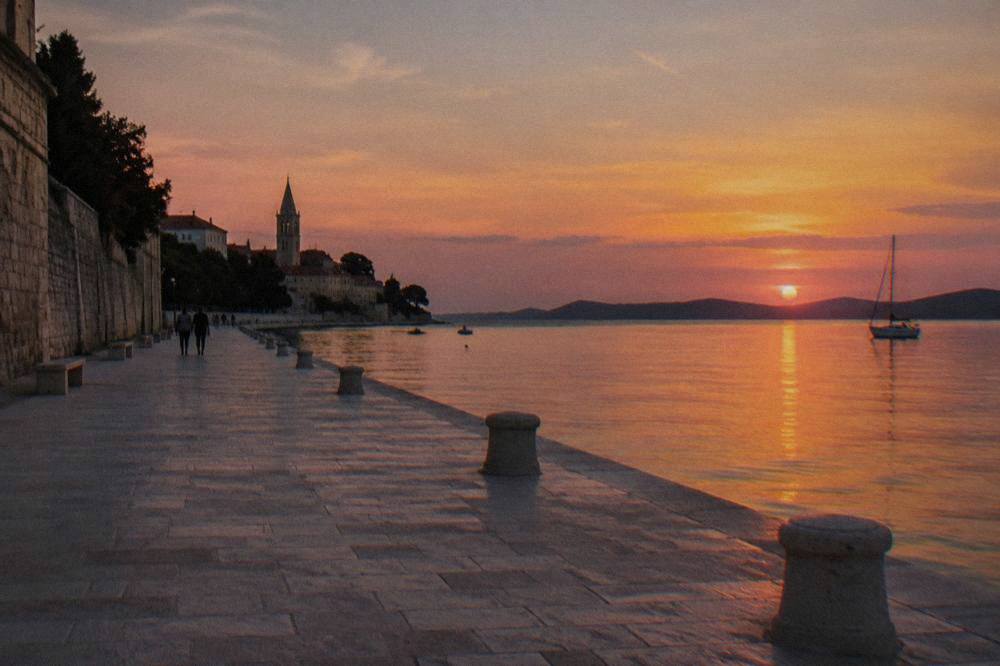
Evening walking deserves its own mention. The Sea Organ and the Greeting to the Sun are the city's sunset ritual, both free and open around the clock, and the riva fills at dusk in season. The transparent LED kayak tour fits exactly here, a water-level view of the same lit peninsula after the sun goes down, and it can be checked on the operator's live listing: Check availability.
Common Questions About Walking In Zadar
Is Zadar a walkable city?
Yes. The Old Town occupies a narrow peninsula where all the main sights sit within minutes of one another on pedestrian-priority streets, and the inner mainland districts are flat and close enough to reach on foot from the centre.
Is Zadar Old Town car-free?
The historic peninsula heavily restricts vehicles rather than banning them outright, and its core streets function as pedestrian space. Residents and deliveries use limited access, but a visitor sightseeing on foot rarely shares the main streets with cars.
Can you walk from Zadar Airport to the Old Town?
No. The airport is about 8 km from the city per its own page, roughly 13 km by road to the Old Town, so a shuttle, bus or taxi is required. The official Liburnija shuttle costs 5.00 EUR one way including luggage.
Is Zadar hilly?
The walking core is flat. The peninsula and the inner mainland districts sit at sea level on coastal terrain, and the DHMZ station record for Zadar reflects a maritime climate rather than an alpine one; gradient is not a factor in a typical day of sightseeing.
Can you walk to beaches from Zadar Old Town?
Yes, several beaches are within walking reach of the peninsula, including Kolovare on the eastern side. Note that swimwear through the Old Town streets now carries posted signs and reported fines of up to 130 EUR after a warning, so change before walking back through the core.
Do you need a car for day trips from Zadar?
The national parks and islands are not walking destinations: Krka's Skradinski Buk is about 91 km away by road and Plitvice about 145 km, while the islands need Jadrolinija ferries from Gaženica. Organized day tours, buses or a hire car cover those legs, and the city itself handles the rest on foot.
The short version stands: within the peninsula and the districts behind it, Zadar is a city best measured in minutes on foot, and everything beyond it is a matter of ferries, buses and park tickets rather than walking shoes.
