What Time Is The Light Show In Zadar?
The Greeting to the Sun in Zadar has no fixed start time: the light show follows sunset and runs off stored solar power. Here is how to plan an evening around it.
The Greeting to the Sun in Zadar, a coastal city in Dalmatia on the Adriatic, has no start time anyone can print with confidence. There is no published timetable for the display, no operator running it and no ticket to buy. The installation, laid into the stone of the northwestern tip of the Old Town peninsula beside the Sea Organ, charges its batteries from daylight and switches on after dark, and the city's own visitor pages describe it simply as a solar-powered installation that follows the sun. Any page offering an exact opening minute for the "show" is guessing. This guide sets out what is verified, how the installation works, and how to build an evening around it without depending on a clock time that does not exist.
What Time Is The Light Show In Zadar?
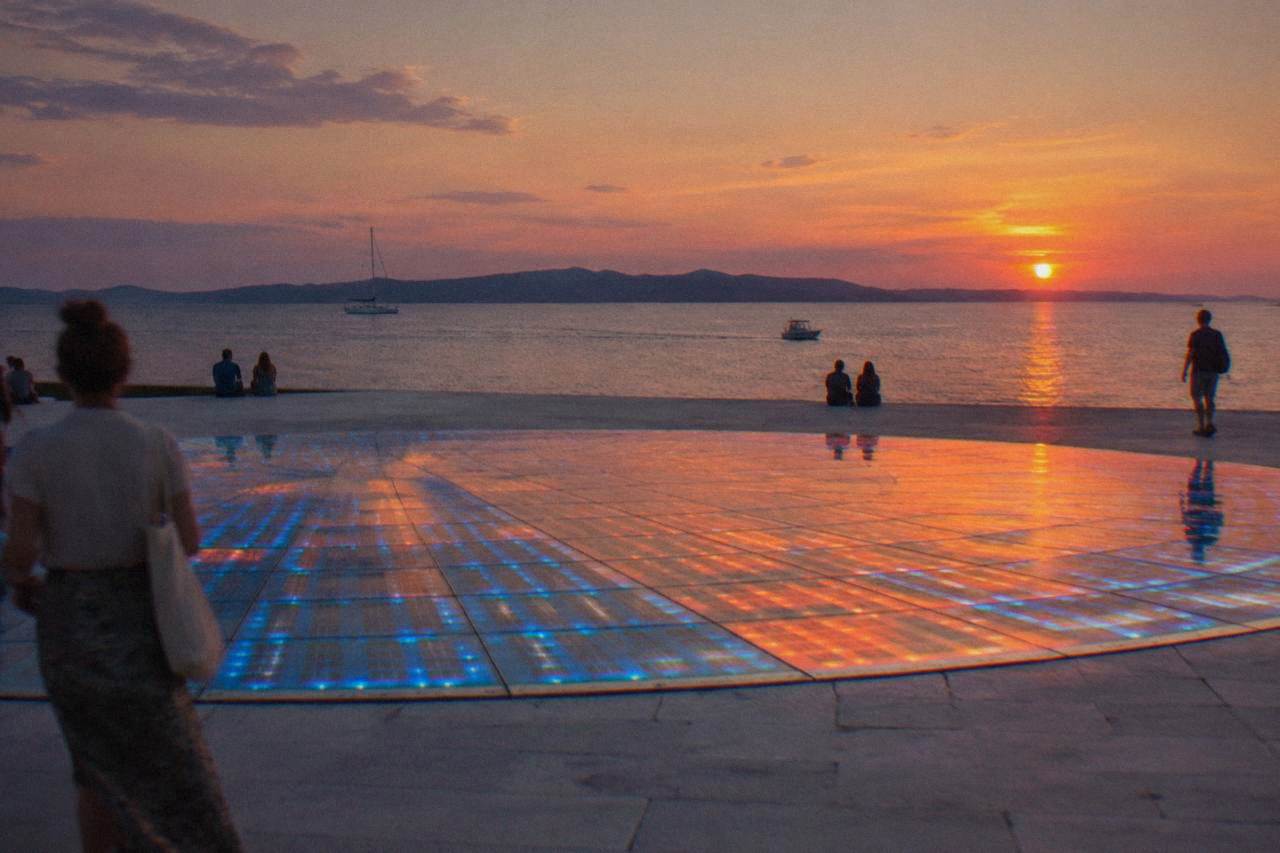
There is no fixed start time for the light display at the Greeting to the Sun in Zadar, because the installation is not a scheduled show at all. The 22-metre circle of glass and solar panels, created by Nikola Bašić and opened in 2008, stores energy from daylight and illuminates after dark on its own cycle. The city's tourism pages list it as a free public installation, open at all hours, and no official source publishes an evening start time.
Visitors should simply arrive around sunset and stay into darkness.
The 22-metre diameter is a figure reported in press coverage rather than read line by line from an official technical sheet, and the same applies to the solar storage detail. What the city of Zadar's own experience pages confirm is the essential frame: the installation was completed in 2008, it was designed by Nikola Bašić, the same architect behind the Sea Organ of 2005, and it sits a few steps from that sound installation on the same stretch of waterfront. Both are free, both are open around the clock, and neither has a box office, a queue or an operator announcing a start.
The practical consequence is that the display's effective "start" drifts across the year with sunset itself, and the show is longest and easiest to catch in the shoulder months, when darkness falls early enough that the lights come on shortly after a late-afternoon arrival. In the height of summer the wait between a golden-hour stroll and a fully lit circle is longer, but the waterfront stays warm and busy through it. Anyone who tells you the lights "begin at 9 pm" or any similar figure is describing one evening, not the installation.
One planning note for 2026 and the seasons after it: the Greeting to the Sun underwent a reconstruction of its electronic system in April 2026, reported in local press as a repair of the installation's worn wiring worth more than 61,000 euros. No closure or changed operating pattern was reported afterwards. If the display looks dimmer or partly dark on a given evening, the honest answer is to check locally rather than assume a published fault.
How Does The Greeting To The Sun In Zadar Actually Work?
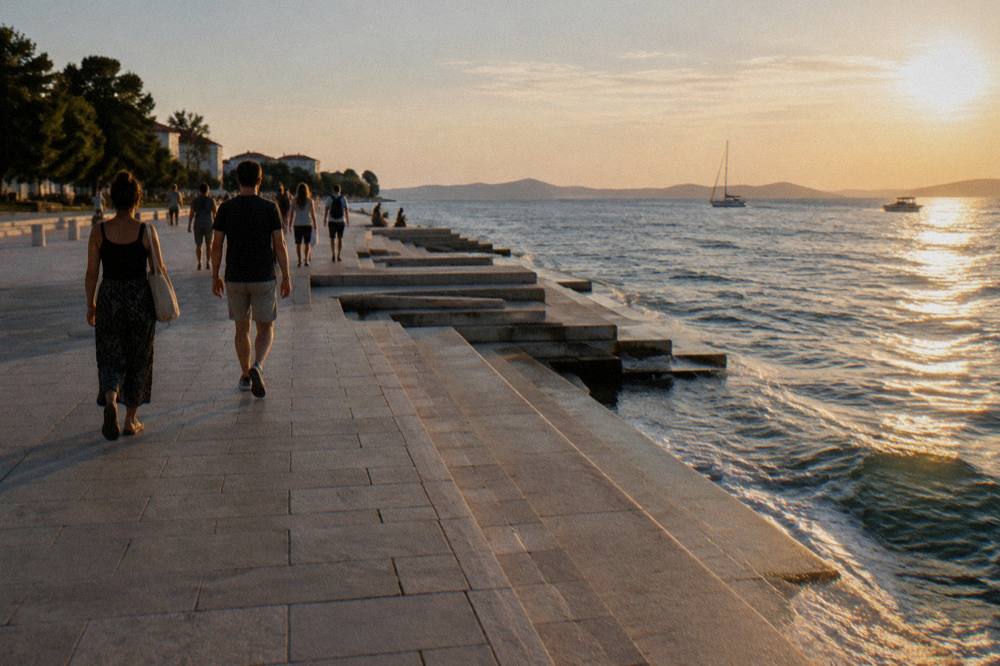
The Greeting to the Sun converts daylight into an evening light display through a circular array of solar panels and layered glass set flush with the pavement, and it is completely passive: no staff, no switch, no session times. Its patterns of coloured light play across the circle after dark, powered by the energy the surface collected during the day. The installation sits directly beside the Sea Organ, the 2005 wave-driven sound work by the same architect, so the two pieces run together as one free waterfront experience.
The pairing is the point most write-ups miss. The Sea Organ, a set of steps built over pipes that the waves push air through, sounds only when the sea moves, and the Greeting to the Sun glows only after the sky darkens. Together they turn the tip of the peninsula into a continuous, unscheduled installation that changes with weather, tide and hour. The Sea Organ's roughly 70-metre length and its 35 pipes are press-reported figures, so treat the precision loosely, but the principle is well documented on the city's own pages. For the mechanism of the sound side in detail, the companion piece how the Zadar Sea Organ works covers it.
A useful way to think about timing is in terms of light rather than clocks. Zadar records about 2,600 hours of sunshine a year, measured at the Zadar station over 1961-2024 by the Croatian national weather service, which means the installation has a reliably charged battery almost every evening. In deep winter, when darkness arrives by late afternoon, the display is running before many visitors have had dinner. In midsummer it may not fully ignite until well after 9 pm local time. The display itself is the same in every season; only your waiting time changes.
When Should You Arrive To Catch The Display In Zadar?
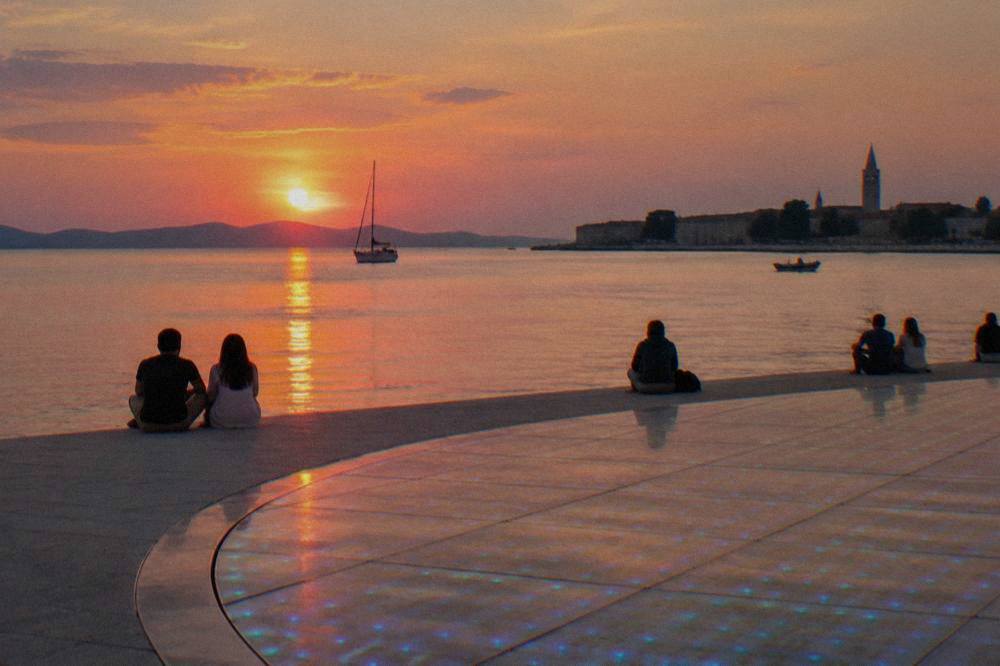
Arrive on the waterfront in Zadar about 30 to 60 minutes before local sunset and plan to stay a full hour after it, and you will see the Greeting to the Sun move from reflective glass in the last daylight to its full lit patterns in darkness. Because there is no published start time, the reliable strategy is to anchor your evening to the sunset itself rather than to a clock figure, and to let the Sea Organ fill the wait with sound.
The sequence that works on the ground costs nothing. Start from the Roman Forum or Kalelarga while the sky is still bright, walk the length of the peninsula to the northwestern tip, and take a seat on the Sea Organ steps as the sun drops toward the islands of Ugljan and Dugi Otok offshore. This stretch of waterfront is the same one usually associated with Zadar's famous sunsets, a subject covered in more depth in what Zadar is famous for. As the colour drains from the sky, the circle behind you begins to glow, and by full darkness it is running its light patterns underfoot while the organ plays underneath the waves.
Season changes the arithmetic considerably, and the station record shows why. The table below uses the official Zadar station climate table, 1961-2024, published by the Croatian meteorological service, which is the only such record this site treats as a source.
| Season | Mean temperature | Monthly rainfall pattern | What it means for the display |
|---|---|---|---|
| Winter (Dec-Feb) | 7.3 to 7.8 C | 67 to 99.6 mm per month | Darkness by early evening; the display starts early and crowds are thin |
| Spring (Mar-May) | 10 to 17.9 C | 61.4 to 66.3 mm per month | Comfortable waiting; the lights arrive at a sociable hour |
| Summer (Jun-Aug) | 21.9 to 24.5 C | 35.4 to 52.8 mm per month | Longest wait after sunset; July is both the warmest and the driest month |
| Autumn (Sep-Nov) | 12.1 to 20.2 C | 106.8 to 123 mm per month | Early darkness again, but November is the wettest month, so pack for rain |
A second, smaller table helps with expectation-setting, because the two installations are often confused:
| Sea Organ | Greeting to the Sun | |
|---|---|---|
| Opened | 2005 | 2008 |
| Designer | Nikola Bašić | Nikola Bašić |
| What it does | Sounds when waves push air through pipes under the steps | Glows in light patterns after dark on stored solar power |
| Depends on | Sea movement | Daylight and darkness |
| Ticket | Free, open at all hours | Free, open at all hours |
| Published schedule | None | None |
Neither piece has an off switch a visitor needs to know about, and neither closes for the night in any documented sense. That is the whole reason a "start time" question has no numerical answer.
What Else Should You Plan Around The Zadar Waterfront At Night?
The Greeting to the Sun sits inside a walkable evening circuit that needs no car and no booking: the Roman Forum, the Cathedral of St Anastasia, the Land Gate of 1543 and the Riva promenade are all within a few minutes on foot, and the whole peninsula stays active after dark. The display is the natural finale of that circuit rather than a destination you time your whole evening around.
The Old Town on its peninsula is compact enough that an evening walk covers the highlights without rushing, a point made in more detail in whether the Zadar Old Town is worth visiting. Two local rules from 2026 are worth knowing before you set out, both reported in the city's press. Dress-code signs were installed at the entrances to the historic core in summer 2026, asking for appropriate clothing, with no swimwear, and reporting that fines can run up to 130 euros after a warning. And the municipality has moved to restrict late-night retail alcohol sales in shops on the peninsula under a national law change, aimed at noise; bars and restaurants are not the target. Neither affects the light display, but both shape the atmosphere of an evening walk.
If the evening is your free slot, it also pairs well with a day spent away from the city. Zadar functions as a base for the park day trips, and a Krka itinerary with a swim stop in Skradin is a natural complement to a waterfront night. A guided Krka tour with swimming in Skradin returns you to the city with the afternoon light still on the water, which is exactly when the sunset circuit should begin. Check availability if that split of day and evening appeals.
Common Questions About The Zadar Light Show
Is The Greeting To The Sun In Zadar Free?
Yes, the Greeting to the Sun is free and open at all hours, per the city of Zadar's own experience pages, which list it as a public installation rather than an attraction with tickets, hours or staff. The same applies to the Sea Organ beside it. Any listing that implies an entry charge or a timed session is describing a commercial product, such as a guided walk that passes by, not the installation itself.
Nothing suggests a fee has ever been introduced, and the 2026 electronics reconstruction, reported in local press, was a municipal repair rather than a commercial upgrade. Budget for the gelato on the walk over, not for the light. More of these guides are collected on Zadar Croatia Travel Guide.
Can You See The Light Show In Winter In Zadar?
Yes, and winter is in some ways the easiest time to see it, because darkness falls early and the display is fully running by mid-evening. Zadar station, 1961-2024, records winter means of 7.3 C in January and 7.8 C in February, cold by Dalmatian summer standards but usually bearable on the waterfront with a jacket, and the city's Advent programme runs from 24 November 2026 to 2 January 2027 with an ice rink on the Forum.
The Advent programme, announced in October 2026, spreads across three locations including the Forum, a two-minute walk from the installation, with concerts and daily events. A winter evening can therefore run from the rink to the Sea Organ steps and catch the display at a comfortable hour, with the Christmas Run on 27 December 2026 as a fixed date in the calendar.
Is The Light Show The Same As The Sea Organ?
No, they are two separate works by the same architect, Nikola Bašić, sitting side by side on the Zadar waterfront: the Sea Organ, from 2005, is a sound installation driven by waves passing through pipes under stone steps, while the Greeting to the Sun, from 2008, is a light installation driven by stored solar energy. One plays, the other glows, and you can experience both at once.
The distinction matters for planning only in one way: the Sea Organ performs whenever the sea is moving, day or night, while the Greeting to the Sun needs darkness. If you visit at noon you get sound and a glass circle; after sunset you get both.
Does The Light Display Ever Not Run?
The display depends on daylight and its electronics, so a heavily overcast day can mean a weaker charge and a technical fault can mean a dark circle, and the April 2026 reconstruction of the installation's electronic system shows repairs do happen. No standing closure or schedule change was reported after that work, and the honest advice is to check locally on the day if the circle looks unlit rather than to trust any third-party timetable.
The city's event and tourism pages at zadar.hr are the place a closure would be announced, and nothing of the kind appears there for the 2026 season or the winter beyond it.
Where Is The Best Place To Stand For The Display?
The best position is on the Sea Organ steps themselves, facing the sunset over the islands, with the Greeting to the Sun circle just behind you on the pavement: from there the sunset, the organ's sound and the light patterns are all in one small radius, and you can turn between them as darkness deepens. The circle is flush with the ground and walkable, and its patterns read differently from directly on top than from the edge.
Arriving before the crowds settle in, roughly at the start of the golden hour, makes the spot easier to hold in summer. In the shoulder seasons the waterfront is calmer and the choice barely matters, and a short walk to the tip of the peninsula past the circle gives the widest view of the whole installation lit against the dark sea.
The short version of all of this: the Zadar Croatia Travel Guide desk can point you to the year each installation opened, the architect they share, the sunshine record that powers the lights and the free, always-open status of both works, but no source on earth publishes a start time, because the display follows the sun and not a schedule. Plan around sunset, stay for the dark, and let the Sea Organ keep you company while you wait.