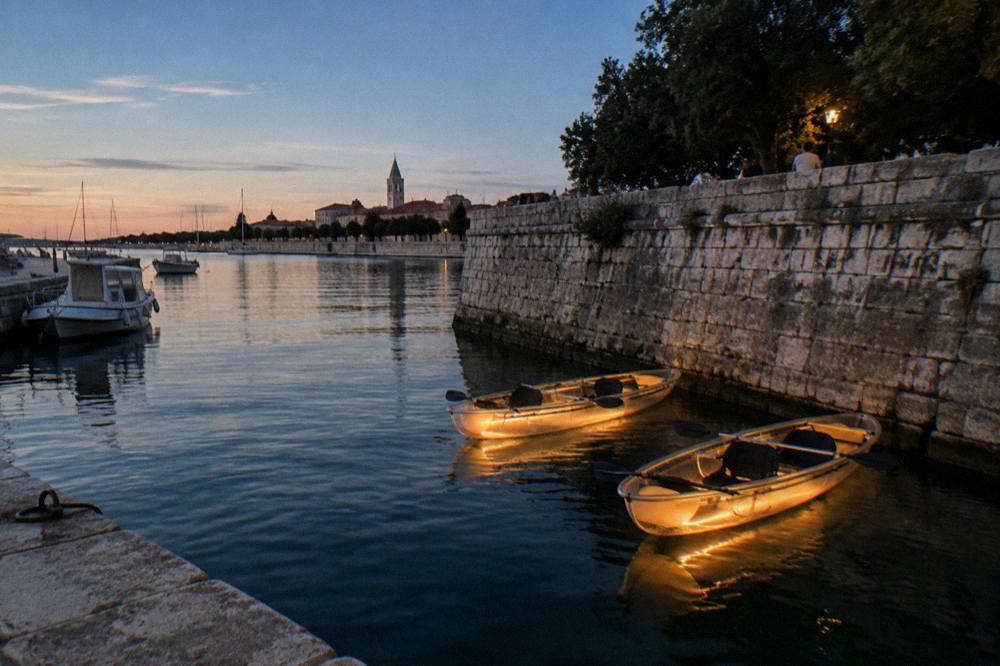
Is Zadar A Party Town?
Is Zadar a party town? A direct, sourced answer on Zadar's nightlife character, bar scene, quiet-season rhythm and evening culture in Dalmatia's coastal city.
Zadar, on Croatia's Dalmatian coast, sits somewhere between a quiet historic peninsula and a working regional city of 67,309 people (2021 census, a secondary-site figure quoting the DZS). Its Old Town, the Poluotok, fills at dusk with diners and sunset-watchers rather than club queues, and the two installations that anchor its evening fame, the Sea Organ (2005) and the Greeting to the Sun (2008), both by architect Nikola Bašić, are free public works on the waterfront, open at all hours. That framing answers the question at its root, and the rest of this page fills in the detail with what primary sources and the city's own calendar actually say.
Is Zadar A Party Town?
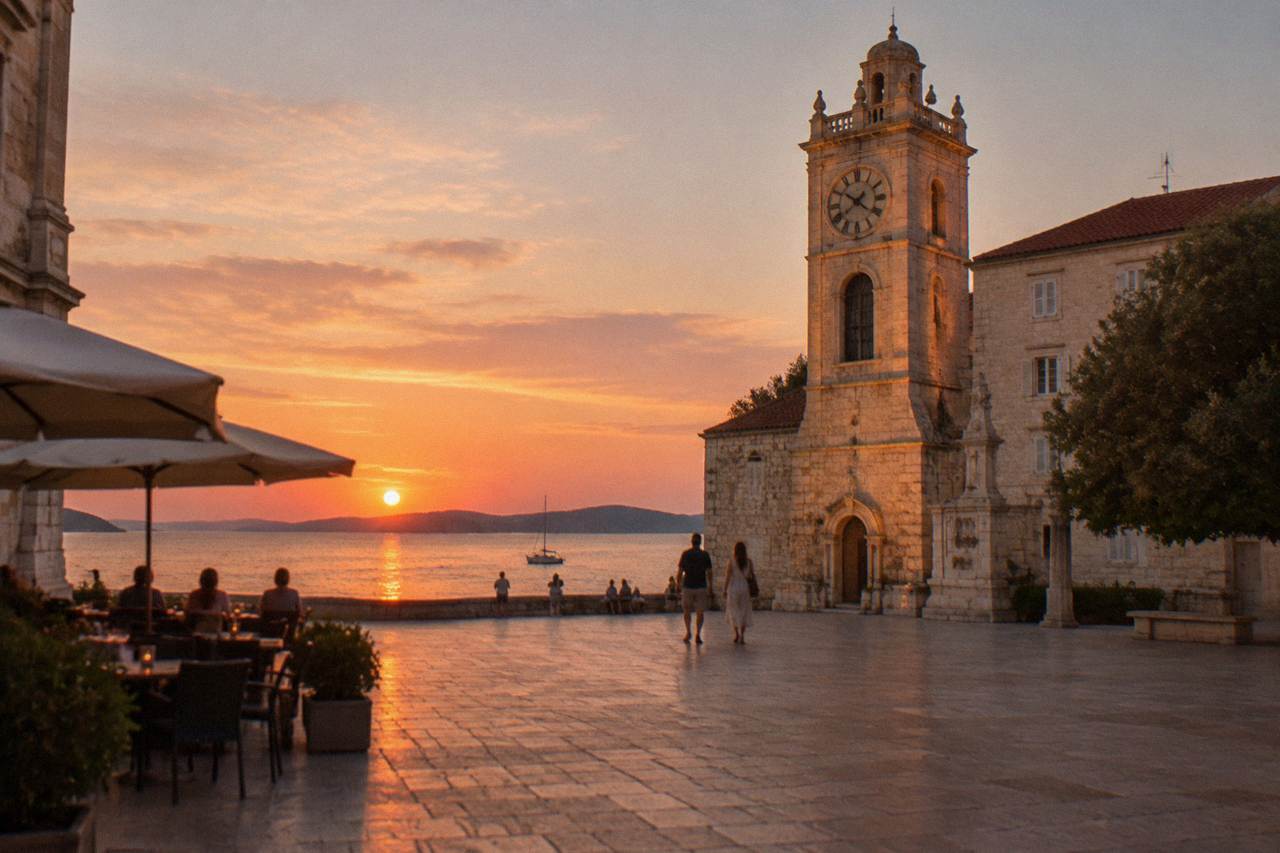
No, Zadar is not a party town in the sense of an all-night club destination. It is a coastal Dalmatian city whose evening life centres on outdoor dining, waterfront bars and the sunset on the riva, with a summer festival calendar layered on top. The Old Town operates under reported rules that push against late-night noise, including a planned night-time restriction on retail alcohol sales for the 2026 season, so the city's own policy direction leans quiet rather than loud.
The distinction matters because travellers arriving with Split or Novalja expectations misread the place. Zadar's peninsula is small, walkable and largely residential-and-touristic at once, and the evening economy runs on konoba tables, gelato and the promenade. The city's own tourist board pages present Zadar around history, culture and the sunset, not around nightlife, and that presentation matches what the street layout supports: a compact peninsula where bars close earlier than a club district would.
None of this means evenings are dull. Summer brings open-air events, Advent fills the winter calendar, and the bars around the Forum and Kalelarga are genuinely busy in July and August. The Sea Organ plays, literally, as waves push air through its pipes, and crowds gather on the riva steps for a sunset the city markets hard. It is an evening culture, not a club culture.
What Does Zadar Nightlife Actually Look Like?
Zadar's nightlife is an outdoor, terrace-based bar and restaurant scene concentrated in and around the Old Town, peaking in July and August and thinning fast once summer ends. There is no documented large club district of the kind other Adriatic spots are known for, and this site prints no club names, prices or hours. What is verifiable is the shape: waterfront drinking, square-side tables, live music at festival time, and quiet stone streets by late evening.
The bars cluster near the Roman Forum, along Kalelarga and down toward the riva, where the Sea Organ and the Greeting to the Sun sit. The Greeting to the Sun, a 22 m solar-powered light installation, is itself part of the evening draw, and its light patterns after dark are free to watch. Nobody sells a ticket to a Zadar sunset, and no verified light-show start time exists, so the honest advice is to be on the waterfront around dusk and let the installation do its work.
Two reported rules shape how late the Old Town stays animated. Dress-code signs installed in summer 2026 ask visitors not to walk the historic core in swimwear, with fines of up to 130 euro reported after a verbal warning, and the municipality planned to restrict night-time retail alcohol sales in the Old Town for the 2026 season under a national law change, leaving bars and restaurants unaffected.
If your ideal evening is a guided introduction to the city's drink culture rather than a crawl, a tasting walk is the structured option, and the roster carries one centred on maraschino, Zadar's historic cherry liqueur. The Old Town walking tour with maraschino tasting covers the streets and the local spirit in a single loop.
When Is Zadar At Its Most Lively?
Zadar is at its most lively in July and August, when the station record shows means of 24.5 and 24.1 C, rainfall drops to 35.4 and 52.8 mm, and insolation reaches 358.6 and 324.7 hours a month (Zadar station, 1961-2024, DHMZ). Those two months concentrate the terrace season, the boat traffic and the festival programming, while November, the wettest month at 123 mm, is the quietest on every measure the station records.
The climate table is the honest proxy for crowd rhythm, because bar terraces and square life follow it directly. Rain days tell the same story: five in July against twelve in November and twelve in December. A city whose evening life is outdoors will feel like two different places across that gap, and Zadar does.
The calendar adds its own layer. Zadar Advent runs 24 November 2026 to 2 January 2027, expanded to three locations including a new ice rink on the Forum, with concerts at Trg Petra Zoranića and the Forum through the season and a Zadar Christmas Run on 27 December 2026. Winter here is mulled-wine-and-strings-of-lights lively, not club lively, and the riva walks between rain showers stay the main evening activity.
Is The Sunset Really The Main Event In Zadar?
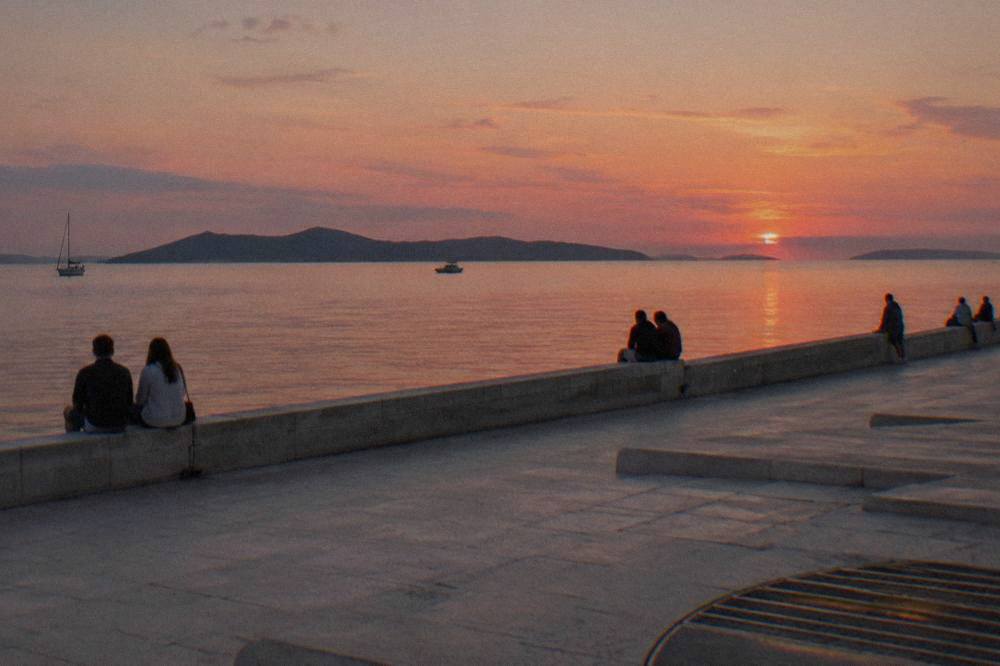
Yes, the waterfront sunset is the city's flagship evening event, and the infrastructure proves it. The Sea Organ (2005) and the Greeting to the Sun (2008), both by Nikola Bašić, are permanent, free, open-at-all-hours installations built specifically for the riva at dusk, and the city's own pages present them as signature experiences. No club, bar or venue in Zadar has anything equivalent in official promotion, which tells you where the evening centre of gravity sits.
The Sea Organ's pipes are wave-driven, so the sound changes with the sea state, and the Greeting to the Sun's 22 m circle of solar cells lights the pavement after dark. Neither has a schedule, a ticket or a queue. The whole ritual costs nothing: arrive on the western waterfront before dusk, sit on the steps, and the evening assembles itself. That is the event around which drinks, dinner and the walk home are arranged, and it is a public-space experience rather than a venue one. Other pages covering the same trip are gathered on Zadar Croatia Travel Guide.
For readers planning the broader evening, the desk's own Zadar sunset evening route lays out the sequence street by street, and what Zadar is famous for covers why the sunset, the installations and the maraschino carry the city's reputation together.
| Evening draw | What it is | Cost | Season shape |
|---|---|---|---|
| Sea Organ | Wave-driven sound installation on the riva, 2005, Nikola Bašić | Free | Open at all hours, year-round |
| Greeting to the Sun | 22 m solar light installation beside the Sea Organ, 2008 | Free | Lights after dark, year-round |
| Old Town terraces | Bars and restaurants around the Forum and Kalelarga | Check at each venue | Peak July-August, quieter off-season |
| Zadar Advent | Concerts, ice rink on the Forum, Christmas Run 27 December 2026 | Event-dependent | 24 November 2026 to 2 January 2027 |
What Do You Do In Zadar When The Bars Close?
When the bars close, Zadar's answer is the sea and the hinterland, not a late-night district. Daylight options carry the real weight: boat trips to the islands, the national parks within driving range, and guided rides into the Dalmatian interior, all of which start early and make an early night a practical choice rather than a sacrifice. The city's tour roster skews heavily toward boat trips, kayaking and park day trips, which is itself evidence of what the place is built for.
The roster's structure is telling. Of the verified products on this site, boat trips are the largest single group, followed by park day trips to Krka and Plitvice, kayaking routes on the Zrmanja and around Dugi Otok, and only a thin slice of evening-centred products. A party town's tour economy looks nothing like that. A quad ride along the hidden trails of Dalmatia is the clearest example of the alternative: the hidden trails quad tour from Zadar takes the day inland, away from the peninsula entirely, and its existence on the roster reflects where the demand sits. Check availability
The park day trips reinforce the point. Krka's adult entry is 7 euro in January-March and November-December, 20 euro in April, May and October, and 40 euro from June to September, per the park's own 2026 price list, and Plitvice runs 10, 23 and 40 euro on the same seasonal logic. These are full-day commitments from Zadar, 91 km to Skradinski Buk and 145 km to Plitvice by road, and they are the reason so many beds in the city empty out by 8 a.m. in high summer.
So Who Should Skip Zadar's Nightlife And Who Will Love It?
Travellers who want nightclubs until dawn should look elsewhere on the Adriatic, because Zadar's verified evening offer is terraces, tastings, festivals and a free waterfront sunset, and its reported rules push the Old Town quieter, not louder. Travellers who want dinner outdoors, a glass of maraschino, live music on a summer square and a crowd that disperses by midnight will find the city pitched exactly at their tempo, with the islands and national parks rewarding the early start the next morning.
In short, Split is the bigger transport hub with the larger late scene; Zadar is the smaller, more manageable peninsula where the evening ends on the riva. Length of stay follows the same logic, and how many days in Zadar is enough works through it day by day.
A final calibration for anyone still deciding: the emergency number in Croatia is 112, the currency is the euro, and the tourist tax exists but its amount is confirmed at booking rather than published here. For nightlife planning, the practical summary is a table of what the evening actually holds.
| If you want | Zadar delivers? | Best fit |
|---|---|---|
| Clubs until dawn | No verified club district; not the city's offer | Look to bigger Adriatic hubs |
| Terrace bars and dining | Yes, Old Town and riva, peak July-August | Forum and Kalelarga area |
| Free evening spectacle | Yes, sunset, Sea Organ, Greeting to the Sun | Western waterfront at dusk |
| Festival atmosphere | Yes, summer programme and Advent from 24 November 2026 | City squares and riva |
| Day-powered trips | Yes, boats, kayaking, quad rides, two national parks | Book ahead in high season |
Common Questions About Zadar Nightlife
Is Zadar a party town?
No. Zadar is a coastal Dalmatian city with a terrace-and-waterfront evening culture, a free sunset installation scene and a festival calendar, not an all-night club destination. Reported 2026 rules, including dress-code signage and a planned night-time retail alcohol restriction in the Old Town, push the historic core quieter still.
Is the Sea Organ open at night?
Yes. The Sea Organ and the Greeting to the Sun are free public installations open at all hours, and evening is when the riva crowd gathers for the sunset beside them. There is no ticket and no published show time.
When is Zadar busiest in the evenings?
July and August, when the Zadar station record (1961-2024, DHMZ) shows means of 24.5 and 24.1 C and only five and six rain days respectively. Terraces are full and the festival programme runs, then the city thins through the wetter autumn months.
What is Zadar Advent like?
Zadar Advent runs 24 November 2026 to 2 January 2027 across three locations, with a new ice rink on the Forum, concerts through the season and the Zadar Christmas Run on 27 December 2026. It is a lights-and-concerts winter atmosphere rather than a nightlife season.
Can you drink in the streets of Zadar Old Town?
Reported plans for the 2026 season would restrict night-time retail alcohol sales in the Old Town under a national law change, affecting shops and kiosks rather than bars and restaurants. The rules should be confirmed on the spot, and the same signage also asks for appropriate dress in the historic core.
The honest verdict stands: Zadar is an evening city, not a party city, and its best hours are the ones spent outdoors on the waterfront with the sun going down over the Adriatic.