Do You Need To Pre-Book Krka National Park?
Whether you need to pre-book Krka National Park when day tripping from Zadar, with the 2026 seasonal ticket prices, the swimming rules and the practical alternatives.
Krka National Park sits about 91 road-kilometres, roughly 73 driving minutes, from Zadar's Old Town, which makes it one of the easiest big-hitting day trips on the Dalmatian coast. The park's own 2026 price list splits the year into three pricing seasons, the press coverage around the 1 October 2026 price drop confirmed that online timed tickets are recommended and that daily limits apply, and the summer months are the ones where arriving without a ticket carries real risk. This page sets out what the sources actually say about booking, what a ticket costs by season, and how a guided day trip compares with going independently.
Do You Need To Pre-Book Krka National Park?
In the June to September peak season, effectively yes: the summer tariff is the year's highest, daily visitor limits apply, and reporting on the 1 October 2026 price change confirms the park recommends online timed tickets rather than walk-up purchase. From January to March and November to December the 7 euro winter ticket makes pre-booking far less pressing. A guided day trip from Zadar removes the question entirely, because the operator handles entry.
The distinction that matters is between the park's peak and its shoulder. The 2026 tariff published by the park itself charges adults 40 euro for the accessible land sites in June, July, August and September, with a 30 euro option for entries after 15:00 in that window. In shoulder months the same ticket is 20 euro, and in the deep winter it is 7 euro. Those price steps are the park's own demand signal: the expensive months are the crowded months.
Reporting from early October 2026, when both Krka and Plitvice dropped to their winter-shoulder rates, repeated the same operational detail: online timed tickets are recommended, and daily limits apply. The practical reading for a Zadar traveller is simple. In summer, buy before you drive. Outside summer, decide on the day if you like.
There is one planning wrinkle specific to Zadar. The park is close enough that a last-minute decision to go is realistic, 91 kilometres is little more than an hour on the road toward Skradin, but the same proximity means Zadar's whole summer visitor base is making the same decision on the same hot afternoons. The guided-tour market exists partly to absorb exactly that: a tour with tickets included converts the booking question into a single checkout. The Krka day trip guide on this site covers the route in detail.
A second wrinkle follows from the first. Zadar in summer is a cruise and ferry hub as well as a car-holiday base, so the pressure on Krka's gates builds not only from hotel guests but from passengers ashore for a single day. That is precisely the situation timed ticketing is designed to manage, and it is why the recommendation to buy online carries more weight here than it would for a park with a single, steadier source of visitors. The rule of thumb this site would offer: whenever the DHMZ station table would show a July or August date on your calendar, treat the Krka ticket as something you sort the evening before, not at the gate.
How The 2026 Krka Ticket Prices Work By Season
The park's 2026 price list sets adult entry to the accessible land sites at 7 euro from January to March and November to December, 20 euro in April, May and October, and 40 euro from June to September, with a 30 euro rate for peak-season entries after 15:00. The outlying sites, Roški slap, Kistanje, Manojlovac, Burnum and the Eco Campus, run a separate ladder of 7, 12 and 20 euro across the same three seasons.
Here is the ladder in one view:
| Ticket (2026, adult) | Jan-Mar | Apr, May, Oct | Jun-Sep |
|---|---|---|---|
| Skradinski Buk and all accessible land sites | 7 EUR | 20 EUR | 40 EUR (30 EUR after 15:00) |
| Roški slap, Kistanje, Manojlovac, Burnum, Eco Campus | 7 EUR | 12 EUR | 20 EUR |
Two reading notes on that table. First, the seasonal boundaries mean the same visit costs nearly six times more in August than in February, and a visit in late September costs the full summer rate while one a week later, in October, costs the shoulder rate. Anyone planning around the boundary weeks should check the park's own cjenik rather than trusting a calendar instinct, because the seasons are defined by fixed months, not by weather. Second, the after-15:00 summer option at 30 euro is the park's own mechanism for spreading demand across the day, which is itself a hint about when the site is busiest.
The children's and student side of the tariff runs on reduced rates in every season, and the park lists them alongside family and group options in the same PDF. This page does not reproduce the whole table, only the adult ladder that drives the booking decision, because it is the adult rate that swings from 7 to 40 euro across the year. For the broader money picture, including what a full day out from Zadar adds up to, the site's cost pages carry the detail.
The broader price context for the year is covered in how much it costs to enter Krka National Park, and if you are weighing Krka against the other big park day trip from Zadar, the Plitvice or Krka comparison goes through the trade-offs. For background reading on both parks' pricing structures side by side, see the Krka vs Plitvice guide.
Is A Guided Day Trip From Zadar Better Than Going Independently?
A guided trip is the only version of a Krka day where pre-booking is the whole point: you pay the operator once and entry, transport and timing are handled together, which removes the summer risk of a sold-out time slot or a queue at the gate. Going independently is cheaper outside summer, when the 7 or 20 euro ticket is bought on the day, and it lets you arrive late or leave early. The trade is control versus certainty.
The independent route from Zadar means your own car or the coach connection, both of which are covered on this site, and the bus from Zadar to Krka question addresses the no-car case. Driving distances from the Old Town look like this:
| Route from Zadar Old Town | Distance | Driving time |
|---|---|---|
| Skradin (Krka's river port gate) | 76 km | about 62 min |
| Skradinski Buk main entrance | 91 km | about 73 min |
Those numbers make Krka the closest of the major parks to Zadar, closer than Plitvice at 145 kilometres, and that nearness is exactly why the tour market around it is so dense. Guided departures bundle the coach, the guide and the ticket; some include the Skradin boat ride up the river to the falls. One thing no operator can bundle away is the swimming ban: no tour gets you into the water at Skradinski Buk, because the rule applies to everyone.
The guided route also changes what your morning looks like. Independent travellers leaving Zadar at dawn to beat both the coastal road traffic and the gate queue are solving a problem that a coordinated coach departure has already solved, and the guide's commentary on the drive, the river system and the travertine geology is something a self-drive visit simply does not include. Against that, independence buys spontaneity, the freedom to linger at Roški slap when a tour bus needs to turn around, and the ability to fold the drive into a wider loop, perhaps via Skradin for lunch or Šibenik, 89 kilometres from Zadar, on the way home. Neither answer is wrong; they solve for different travellers.
Cost comparison is harder to state in the abstract, because tour prices are live figures that this site renders from operator data rather than typing into prose. What can be said structurally: the independent floor is the park ticket alone plus fuel or a bus fare, while a tour's price bundles several line items at once. Whether the bundle wins depends on the season, the group size and how much the day's logistics are worth to you.
Can You Swim At Krka National Park On A Zadar Day Trip?
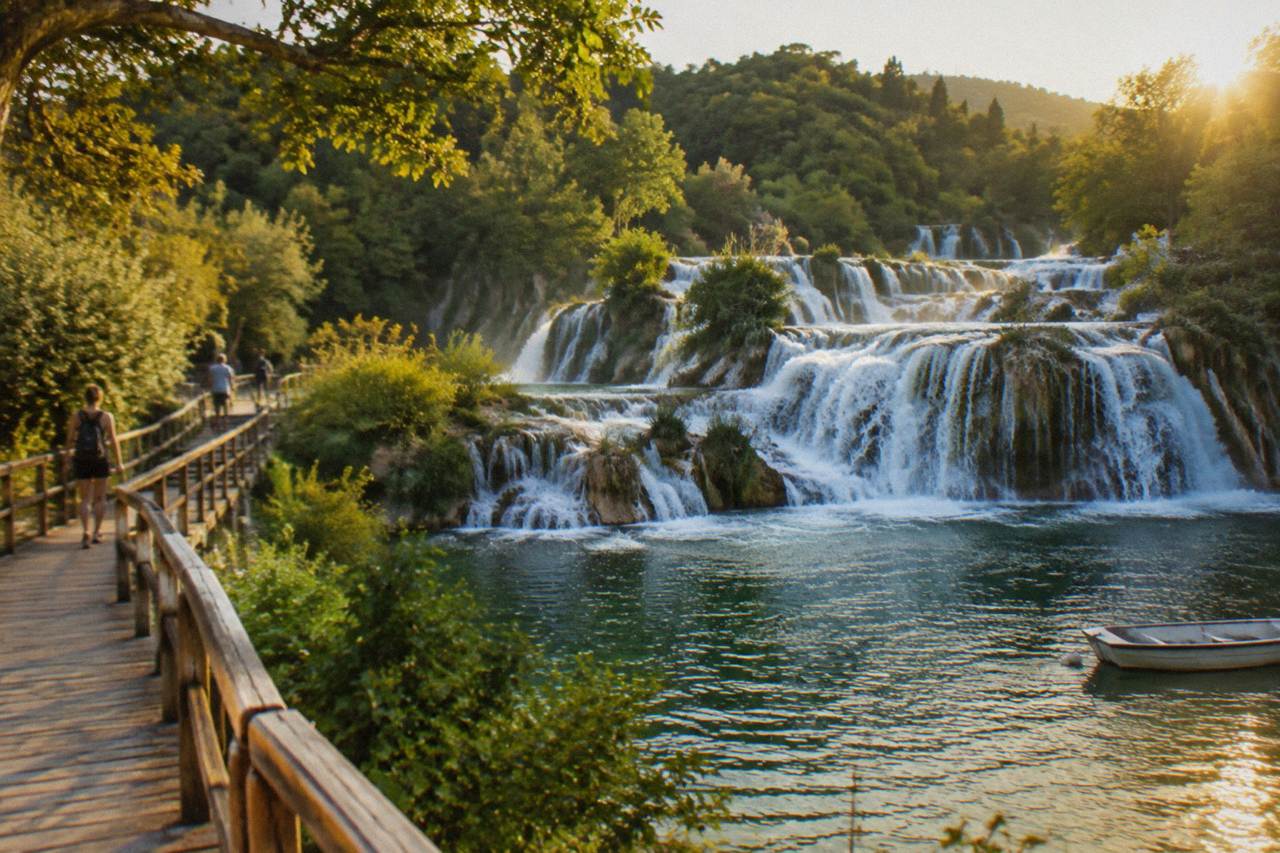
No, swimming at Skradinski Buk has been banned since 2021, when the park stopped water access at its main cascade to protect the travertine barriers, and the ban was still the stated policy through the 2026 season. Swimming is allowed only at designated spots, Roški slap, Stinice and Pisak, and only from 1 June to 30 September, weather and water conditions permitting. Outside that window there is no swimming anywhere in the park.
This matters for planning because Krka is often marketed, in older guides and stale search results, as the national park where you swim under the waterfalls. That has not been true for years. Visitors who arrive in July expecting a swim at the main falls find signage and staff enforcing the rule instead. If a swim is the point of the day, the honest alternatives from Zadar are the coast itself, the beach guide on this site covers the city's own swimming spots, or a boat trip, where swimming stops are part of the itinerary rather than a park policy violation.
The designated swim spots also change the booking maths slightly. Roški slap and the other named spots sit in the outlying section of the park, whose ticket ladder is lower, 7 to 20 euro depending on the month, so a visitor whose main interest is a legal swim in the permitted season may find the quieter outlying ticket both cheaper and better suited. Confirm conditions on the day: the June-to-September swim window is explicitly weather permitting, and the park gates that access in bad water conditions.
It also changes the season choice. A visitor whose mental image of Krka is a swim in fresh water under a waterfall has a narrow window, mid-June to mid-September in practice, in which that day can be built at all. A visitor coming for the walkways, the views over the cascades and the boat ride up from Skradin has the whole year, at a third of the summer price for much of it. Deciding which of those two visitors you are is the first step of planning, and it should happen before any booking question.
What To Do If You Arrive At Krka Without A Booking
Outside the June-to-September window, arriving without a pre-booked ticket is usually fine: the 7 euro winter and 20 euro shoulder rates apply, crowds are thinner, and the daily limits that bite in summer are rarely reached from November through March. In summer, an unbooked arrival is a gamble with three fallbacks: the after-15:00 rate, a next-day return while staying somewhere nearby, or pivoting the day to a different destination from Zadar entirely.
The after-15:00 option deserves emphasis because it is written into the tariff. In June to September the ticket drops from 40 euro to 30 euro for entries after 15:00, which both saves money and lands you in the late-afternoon window when day-trip coaches from Zadar, Šibenik and Split have largely turned for home. In midsummer the light lasts well past 20:00 in Dalmatia, so a late entry is not a truncated visit. The trade-off is that you accept whatever the gate says about remaining capacity on that specific day, and in peak weeks that can mean waiting or coming back.
The pivot options from Zadar are unusually strong. Paklenica National Park, 46.8 kilometres and under an hour down the coast, is a canyon-and-climbing park rather than a waterfall one, and the Paklenica guide covers it. Telašćica Nature Park on Dugi Otok pairs with the Kornati archipelago for a sea day, detailed in the Telašćica guide, and the full set of options is in the national parks overview. Zadar itself, as the what Zadar is famous for page explains, holds the Sea Organ and Greeting to the Sun, both free and open at all hours, so a foiled Krka plan still ends somewhere worthwhile.
A word on the parks' different fee logics, because it affects a same-day pivot. Krka and Plitvice charge per person, Kornati charges per vessel by length and season, with the fee bought outside the park, so a boat-based pivot from Zadar is priced quite differently from a land-park visit. Paklenica's adult day ticket runs 5 to 10 euro across its own seasons. None of these figures is negotiable at the gate, and none of them appears on a tour listing until you open it, which is one more quiet argument for deciding your day before you leave the Old Town.
Common Questions About Pre-Booking Krka From Zadar
Do you need to pre-book Krka National Park?
In June to September, effectively yes: summer tickets cost 40 euro, daily limits apply and the park recommends online timed tickets. From January to March and November to December a 7 euro walk-up ticket is normally fine, and April, May and October sit in between.
How much is Krka entry in 2026?
Adult entry to the accessible land sites is 7 euro from January to March and November to December, 20 euro in April, May and October, and 40 euro from June to September, with a 30 euro rate after 15:00 in summer. The outlying sites run a separate 7, 12 and 20 euro ladder.
Can you buy Krka tickets at the gate?
The park sells tickets on site, but summer demand plus the daily limits are why the park recommends online timed tickets instead, particularly for Skradinski Buk in June to September.
Do guided tours from Zadar include the Krka ticket?
Many do, and the tour listing states for each product whether entry is included. Checking availability on the operator's live listing shows the exact inclusions before you commit.
Can you swim at Krka National Park?
Not at Skradinski Buk, where swimming has been banned since 2021. Swimming is allowed only at Roški slap, Stinice and Pisak, from 1 June to 30 September, weather permitting.
Is Krka worth it outside summer?
The park is open year round on its seasonal tariff, the waterfalls run hardest after autumn rain, and the ticket is at its cheapest from November to March. The permitted swimming season, 1 June to 30 September, is the only thing summer exclusively offers.
The editorial desk behind the Zadar Croatia Travel Guide keeps this page aligned with the park's own 2026 price list, and any change to the tariff or the timed-ticket system is grounds to update it.