Do They Speak English In Zadar, Croatia?
English in Zadar, Dalmatia: where it works, where it fades, and the practical basics, reported from primary sources for a city that lives on Adriatic tourism.
Zadar is a coastal city in Dalmatia, Croatia, on the Adriatic Sea, and its official language is Croatian. That single fact shapes almost every practical moment of a visit: menus, museum tariffs, ferry announcements and park signage all begin in Croatian, and English appears alongside them to a degree that surprises visitors who expect a language barrier. This page reports what the primary sources actually say, without inventing a percentage of English speakers, because no official count exists. The practical answer is that Zadar functions in two languages through the tourist economy, and the gaps that remain are predictable and easy to plan around.
Do They Speak English In Zadar, Croatia?
Yes, in the parts of Zadar a visitor touches, English is used widely enough that an English-only trip is realistic, and the city's own tourism infrastructure is built with that assumption. The tourist board publishes its site in English, the airport's own pages give arrival and shuttle information in English, Jadrolinija's route pages carry English versions, and park price lists such as Krka's official 2026 tariff are published in English PDFs. Croatian remains the official language everywhere, so signage and official documents come first in Croatian.
The pattern is consistent across the sources this site reports from. Zadar Airport's how-to-get-here page, which states the airport is about 8 km from the city, exists in a full English version alongside the Croatian one. Jadrolinija, the state ferry operator, publishes its Zadar routes, including the Gaženica to Brbinj line on Dugi Otok, in English. The national parks around Zadar do the same: Krka's 2026 price list, Plitvice's ticketing pages and Paklenica's official pricelist all ship in English, because their summer audience is international.
What that means in plain terms: the written layer of a Zadar trip, tickets, timetables, tariffs, museum price lists, is available in English at the source. Nobody needs Croatian to buy a Krka ticket or read an airport shuttle timetable.
Where English Works In Zadar, And Where To Expect Croatian
English is strongest in the tourism-facing layer of Zadar: airport and shuttle information, ferry and park pages, museum ticket counters, hotels, tour operators and the tourist board itself all operate in English as a second working language. It thins in the administrative layer: municipal notices, local news such as the coverage of the Old Town dress-code signs, and anything tied to a city decision appear in Croatian first. The practical divide is tourism infrastructure versus local administration.
The Old Town dress-code story illustrates the divide well. In summer 2026 Zadar posted signs at the entrances to the historic peninsula requiring appropriate clothing, no swimwear or nudity, with fines up to 130 EUR reported after a verbal warning. That rule was covered in Croatian local media and communicated on signage at the access points. A visitor who reads only English might never encounter the explanation until standing in front of the sign. This is the typical shape of the language gap in Zadar: not a barrier inside restaurants or tours, but a lag in local information. More of these guides are collected on Zadar Croatia Travel Guide.
A few practical basics sit alongside language and are verified. Croatia uses the euro since 1 January 2023, so there is no currency math to do in a shop. It is in the Schengen area, with land and sea borders open since 1 January 2023 and air borders since 26 March 2023. The single emergency number, 112, works in English as the EU-wide standard. The tourist tax exists and is collected by your accommodation; its amount is confirmed at booking, not on this page.
| Situation | Language you will meet | What to do |
|---|---|---|
| Airport arrivals, shuttle timetable | English pages published by the airport itself | Read the airport's own how-to-get-here page |
| Ferry tickets, Jadrolinija routes | English version of route pages | Check the route page before travel |
| National park price lists (Krka, Plitvice, Paklenica) | Official English PDFs and ticketing pages | Download or print the PDF before the day trip |
| Old Town signage and municipal rules | Croatian first | Ask at your accommodation or the tourist office |
| Local news coverage | Croatian | Tourist board events pages carry English versions |
Guided products are the layer where language is least likely to be a problem, because the operators listing from Zadar sell to an international audience and describe their tours in English on the operator's live listing. A how many days in Zadar is enough question usually resolves into a mix of self-guided Old Town time and one or two guided days, and it is the guided days where English is built in.
Do Guided Tours From Zadar Run In English?
Guided tours sold from Zadar to an international audience operate in English as their default booking language, and the listing for each product states what is included and in which languages it runs. The Plitvice Lakes Day Trip from Zadar is one such product, covering transport from the city and a guided visit to the lakes. Anything language-specific, such as whether a particular departure also offers commentary in another language, is stated on the operator's live listing, not guessed here.
The reason this works is structural. Plitvice Lakes sits about 145 driving kilometres from Zadar, and Krka's Skradinski Buk about 91, so a day trip to either park involves a coach, a guide and a ticketing process that only functions if instructions are understood. The parks themselves publish English price lists, Krka at 7 EUR in the January-to-March and November-to-December window, 20 EUR in April, May and October, and 40 EUR in the June-to-September peak, and tour operators layer English-language guidance on top. Swimming rules at Krka are also published: it is banned at Skradinski Buk and allowed only at designated spots such as Roški slap, Stinice and Pisak, from 1 June to 30 September. The full product page for the Plitvice Lakes Day Trip from Zadar carries the route and inclusions.
For a comparison of the two headline parks, the Plitvice or Krka comparison page carries the fuller picture. The short version for language purposes: both are well set up for English readers at the official-source level, and both are common guided destinations from Zadar.
Should you book a guided day or go independently?
| Question about your day trip | Guided product | Independent travel |
|---|---|---|
| Language of instructions | Stated on the booking page | Your own research, English park pages exist |
| Park entry tickets | Often handled by the operator | Bought from the park's official ticketing page |
| Transport from Zadar | Included in the product | Own car or bus, confirm times locally |
| Flexibility at the park | Fixed group schedule | Your own pace |
Do You Need Any Croatian In Zadar's Old Town?
You do not need Croatian to enjoy Zadar's Old Town, but a handful of words change how the city reads, because the peninsula's public layer, street signs, plaques, church notices and market stalls, stays Croatian. The installations visitors come for are language-free anyway: the Sea Organ from 2005 and the Greeting to the Sun from 2008, both by Nikola Bašić, are free public works open at all hours. Croatian becomes useful in bakeries, at the market and when a sign carries a rule rather than a name.
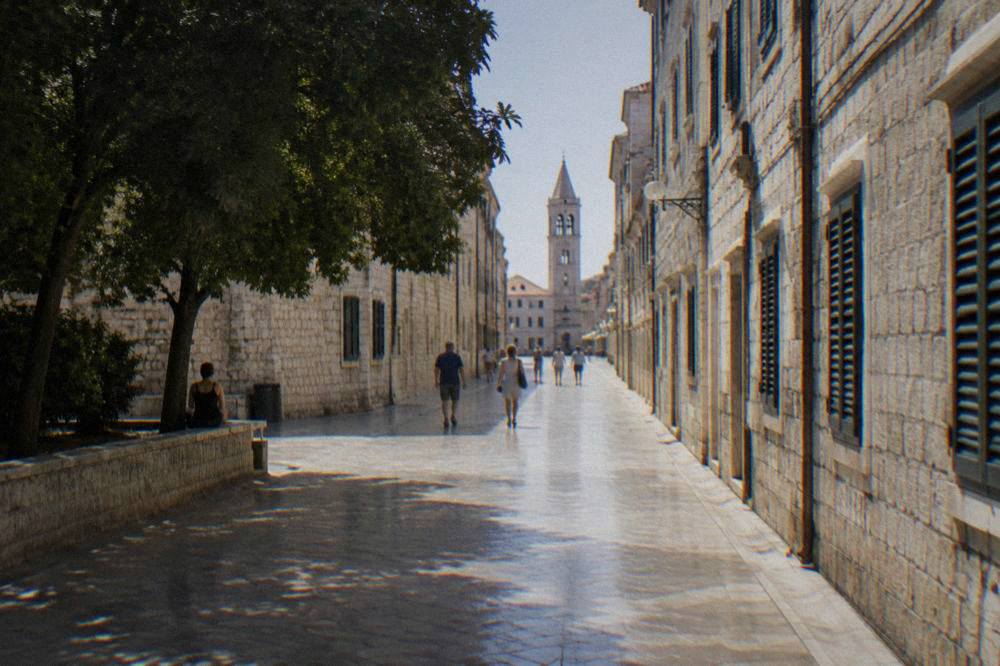
The free and open layer of Zadar needs no language at all. The Roman Forum, Five Wells Square, Kalelarga and the Land Gate, built in 1543, are public space with free access. Zadar's piece of UNESCO status, inscribed in 2017, is one of six components of the Venetian Works of Defence property, and reading that story benefits from English-language interpretation available through the tourist board's own pages.
Where Croatian helps, it is a small set of words, and none of them carries a price or a claim:
| Croatian | Roughly | Where you will see it |
|---|---|---|
| Ulaz | Entrance | Museums and churches |
| Izlaz | Exit | Parking and public buildings |
| Otvoreno / Zatvoreno | Open / Closed | Shop doors |
| Molim | Please / here you are | Counters |
| Hvala | Thank you | Everywhere |
| Kruh | Bread | Bakeries and the market |
One caution reported from the 2026 season: the city installed dress-code signage at key access points to the peninsula requiring appropriate clothing, with fines up to 130 EUR reported after a warning. The signage follows the city's own communal order decision and was covered in Croatian local media. It is the kind of rule that reaches English-speaking visitors last, which is a fair summary of the language situation in Zadar generally: everything commercial meets you in English, everything municipal meets you in Croatian first.
Is English Enough For Getting Around And Day Trips From Zadar?
English is enough for transport decisions around Zadar in the planning stage, because the airport, the ferry operator and the national parks all publish English versions of the pages that matter, and this page links none of them blindly: every operational fact here comes from those English or official sources. The gaps are operational details the sources do not state in any language, such as the price of the Preko ferry crossing or the tourist-tax rate, and those are confirmed at booking or on the spot, not translated.
Getting in is well documented in English. The airport's own page gives the distance, about 8 km to the city, and the Liburnija shuttle at 5.00 EUR one way including luggage, roughly 20 minutes to the Old Town, with the ticket valid 90 minutes on city buses. The fuller arrival walkthrough is on the airport to city centre page. Ferries follow the same pattern: Jadrolinija's route pages exist in English, the Gaženica to Brbinj crossing on Dugi Otok takes 1 h 40 min, and the Zadar to Preko crossing on Ugljan runs about 25 to 30 minutes, but no verified price was found for it, so none is printed.
Islands are the other big day-trip direction, and where the ferries go from Zadar covers the routes. For the sea itself, boat products from the harbour describe their routes and inclusions in English on the operator's live listing, so the language question answers itself at the point of booking.
Common Questions About Speaking English In Zadar
Is Croatian hard to learn for a short visit?
A short visit needs almost nothing beyond greetings and thank you. Croatian uses the Latin alphabet with added diacritics such as š and ž, so signs are readable even when the words are unfamiliar, and pronunciation is regular once those accents are recognized.
Do menus in Zadar have English translations?
Zadar's restaurants in the visitor-facing parts of the city publish menus in English alongside Croatian as standard practice, and the tourist economy runs on an international summer audience. In smaller konoba spots away from the centre, translations can be thinner, and the dish names themselves are Croatian: ask for the daily list rather than assuming a printed translation.
Do national park staff speak English?
The parks around Zadar publish their price lists and visitor information in English at the official-source level, including Krka's official 2026 tariff PDF and Plitvice's ticketing pages. At the gates, staff in the summer season handle international visitors daily. Anything rule-specific, such as Krka's swimming restrictions at Skradinski Buk, is written on signage as well as published online.
Can I get by without Croatian at markets and in shops?
Yes, and the practical basics help: prices are in euro, Croatia's currency since 1 January 2023, and pointing plus numbers covers a market stall transaction. The emergency number 112 works in English as the EU-wide standard.
The short version: plan in English from the official sources, book guided days in English from the operator's live listing, carry five Croatian words for the Old Town's corners, and confirm anything with a price the sources do not state, the tourist tax, the Barkajoli crossing, ferry fares, at booking or on the spot.
